
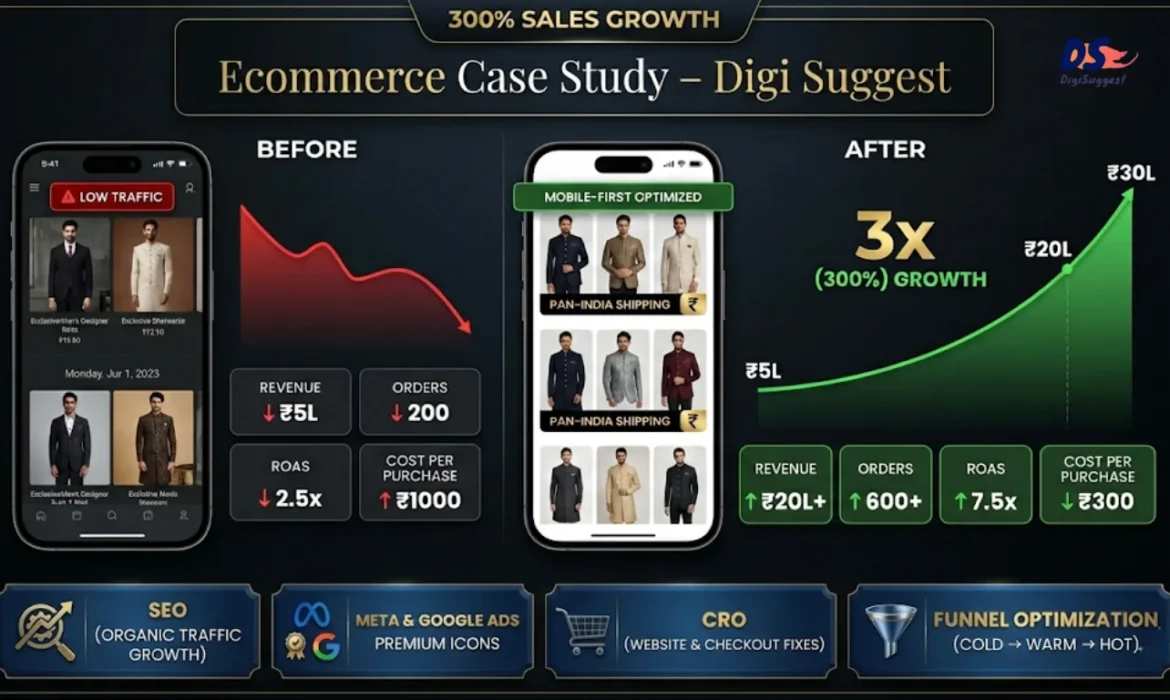
How Digi Suggest Increased Ecommerce Sales by 300% (Real Case Study)
Client Background
- Client: Bharat Reshma
- Industry: Ethnic wear & traditional textiles
- Business Model: D2C ecommerce
- Market: India (pan-India shipping)
Bharat Reshma is a bollywood inspired Indian brand selling premium traditional and ethnic men's wear online. The brand had a strong offline reputation and high-quality products, but ecommerce performance did not reflect that belief.
The founders believed in the product, but ecommerce performance did not reflect that belief.
- The Situation Before Digi Suggest
- The Real Problem (What Most Agencies Miss)
- Why Their Earlier Efforts Failed
- Digi Suggest’s Growth Philosophy for This Project
- Step 1: Funnel & Website Audit (Foundation)
- Step 2: CRO & Website Optimization
- Step 3: Paid Ads Strategy (After Funnel Fix)
- Step 4: Continuous Optimization (Scaling Phase)
- Results: 300% Increase in Ecommerce Sales
- Key Learnings for Other Ecommerce Brands
- How Digi Suggest Helps Ecommerce Brands Scale
The Situation Before Digi Suggest
When Bharat Reshma approached us in October 2021, their ecommerce store had:
- Website traffic from ads and no organic traffic at all
- Regular Instagram activity
- Active Google & Meta Ads campaigns
Yet, results were disappointing.
Key Problems Observed
- Online sales were inconsistent and stagnant
- Paid ads were running, but ROAS was unstable
- Cost per purchase kept increasing
- Traffic was coming in, but conversion rate was low
- Scaling ads resulted in higher spend, not higher profit
In simple words:
Traffic existed. Sales did not scale.
This is a very common situation for Indian ecommerce brands.
Struggling with high traffic but low sales?
The Real Problem (What Most Agencies Miss)
At first glance, many agencies would say:
- “Increase ad budget”
- “Run more creatives”
- “Try influencers”
But after auditing the account and website, the real problem became clear:
👉 Bharat Reshma did not have a scalable ecommerce funnel.
More specifically:
- Ads were sending traffic without intent alignment
- Homepage messaging was unclear for new users
- Product pages lacked strong trust signals
- Checkout experience had friction for first-time buyers
- CRO was completely missing from the growth strategy
This meant:
Even good traffic could not convert consistently.
Why Their Earlier Efforts Failed
Before working with us, the brand had already tried:
- Increasing Meta Ads budgets
- Running discount-based campaigns
- Promoting products on Instagram
But these approaches failed because:
- Discounts attracted price-only buyers
- Ads were not aligned with landing pages
- Website experience did not support decision-making
- Checkout drop-offs were high
👉 The brand was trying to scale traffic before fixing conversions.
Digi Suggest’s Growth Philosophy for This Project
At Digi Suggest, we follow one rule:
Never scale traffic before fixing the funnel.
So instead of jumping straight into aggressive advertising, we rebuilt the entire ecommerce growth system.
Our strategy had four clear pillars:
- Funnel clarity
- CRO & trust building
- Performance-focused ads
- Scalable optimization framework
Step 1: Funnel & Website Audit (Foundation)
We started with a full funnel audit, not just ads.
What We Analyzed
- User behavior (entry pages, exits, drop-offs)
- Homepage clarity & trust signals
- Product page content & structure
- Checkout friction points
- Mobile experience (critical for India)
Key Insights
- Homepage did not clearly communicate why the brand was different
- New users did not immediately trust the brand
- Product pages focused more on product description than benefits
- Checkout lacked reassurance for first-time buyers
This explained the low conversion rate.
Step 2: CRO & Website Optimization
Instead of redesigning everything, we applied high-impact CRO fixes.
Homepage Optimization
- Clear value proposition above the fold
- Trust signals (heritage, quality, authenticity)
- Strong primary CTA guiding users to products
Product Page Optimization
- Benefit-focused product descriptions
- Real product imagery and use-case clarity
- Clear delivery, return, and COD information
- Social proof placement near CTAs
Checkout Optimization
- Reduced friction in form fields
- Clear COD and delivery messaging
- Reassurance near payment buttons
👉 These changes alone improved user confidence and flow.
Need a high-impact CRO Audit for your store?
Step 3: Paid Ads Strategy (After Funnel Fix)
Only after fixing the website funnel did we scale ads.
Meta Ads Strategy
- Shifted from discount-only creatives to story + product value creatives
- Focused on problem-awareness for cold audiences
- Used retargeting to close warm users
- Controlled budget scaling to avoid CPA spikes
Google Ads Strategy
- Focused on high-intent search & shopping traffic
- Optimized product feed for relevance and clarity
- Avoided wasteful keywords and placements
👉 Ads were now sending ready-to-convert traffic to a conversion-ready website.
Step 4: Continuous Optimization (Scaling Phase)
Scaling was done gradually and systematically. We:
- Monitored conversion rates closely
- Identified winning creatives and messages
- Removed underperforming traffic sources
- Improved ROAS by improving conversion efficiency, not just bids
This allowed the brand to scale without losing profitability.
Results: 300% Increase in Ecommerce Sales
Within a few months of implementing this strategy, Bharat Reshma achieved:
📈 Key Outcomes
- 300% growth in online sales
- Significant improvement in conversion rate
- Lower cost per purchase despite higher volume
- More predictable and stable revenue
- Improved confidence in scaling ads
Importantly: 👉 Growth was sustainable, not a short-term spike.
Why This Strategy Worked
This growth did not happen because of:
- ❌ One viral ad
- ❌ Massive discounts
- ❌ Aggressive budget increases
It worked because:
- The funnel was fixed first
- Trust was built before selling
- CRO supported paid traffic
- Scaling was controlled and data-driven
In short: We fixed the journey, not just the traffic.
Key Learnings for Other Ecommerce Brands
If you’re an ecommerce founder, this case study highlights some important lessons:
1️⃣ Traffic Does Not Equal Sales - If your website doesn’t convert, traffic only increases losses.
2️⃣ CRO Is Not Optional - Conversion optimization is the foundation of scaling.
3️⃣ Ads Work Best After Funnel Fixes - Paid ads amplify what already exists - good or bad.
4️⃣ Indian Buyers Need Trust First - Clear messaging, reassurance, and transparency matter more than hype.
Who This Case Study Is Relevant For
This approach works best for ecommerce brands that:
- Have good products but low online sales
- Are spending on ads but not seeing returns
- Want sustainable growth, not short-term spikes
- Are serious about building a brand, not just running offers
If this sounds like your business this strategy is replicable.
How DigiSuggest Helps Ecommerce Brands Scale
At Digi Suggest, we don’t promise hacks or shortcuts. We focus on:
- Ecommerce Funnel optimization
- CRO-driven growth
- Ads aligned with user intent
- Long-term profitability
This case study is not an exception. It’s the result of a repeatable growth system.
🚀 Struggling to Scale Ecommerce Sales?
If your store gets traffic but not sales, you need a better funnel.
Final Thought
Ecommerce growth doesn’t come from spending more. It comes from fixing what stops users from buying.
This case study proves one thing clearly: When traffic, CRO, and ads work together growth becomes predictable.
FAQs
Yes, but only when growth is driven by funnel optimization, CRO, and intent-aligned ads. Results depend on product quality, margins, and execution.
The growth happened progressively over a few months, not overnight. Sustainable ecommerce growth requires fixing the funnel before scaling traffic.
No. Ads alone did not drive results. CRO, trust optimization, and checkout improvements played a major role in increasing conversions.
Yes. The strategy is designed specifically for Indian buyer behavior, including trust concerns, COD preference, and mobile usage.
No ethical agency should guarantee numbers. Digi Suggest focuses on building systems that maximize growth potential, not promising fixed outcomes.
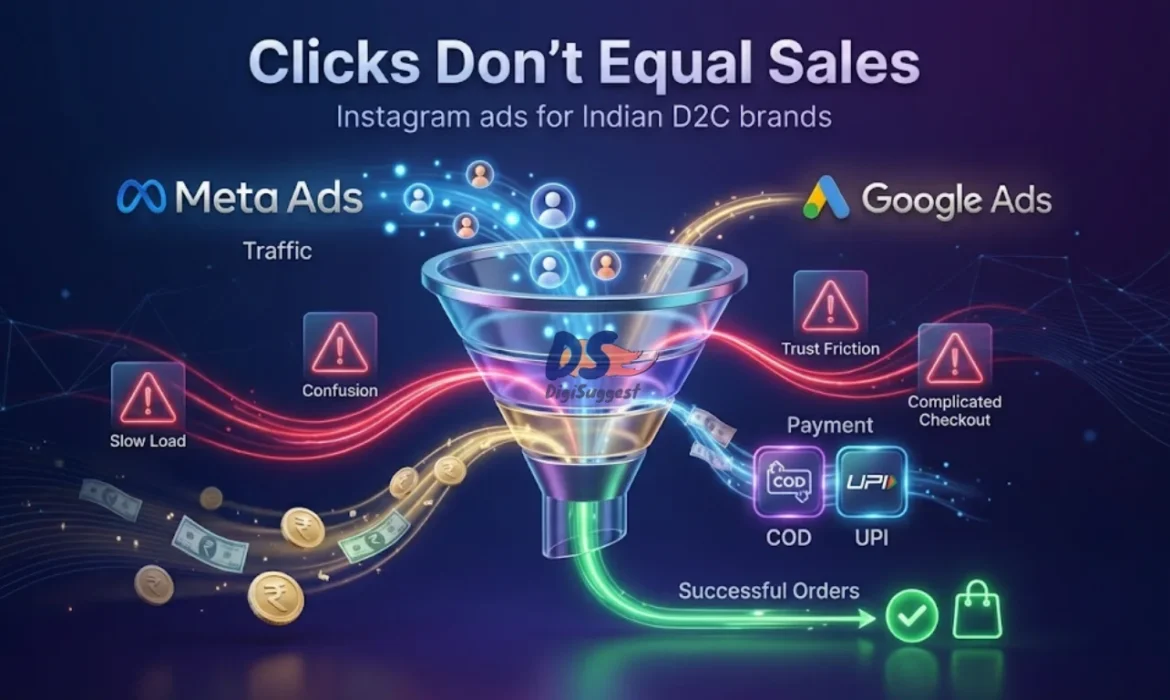
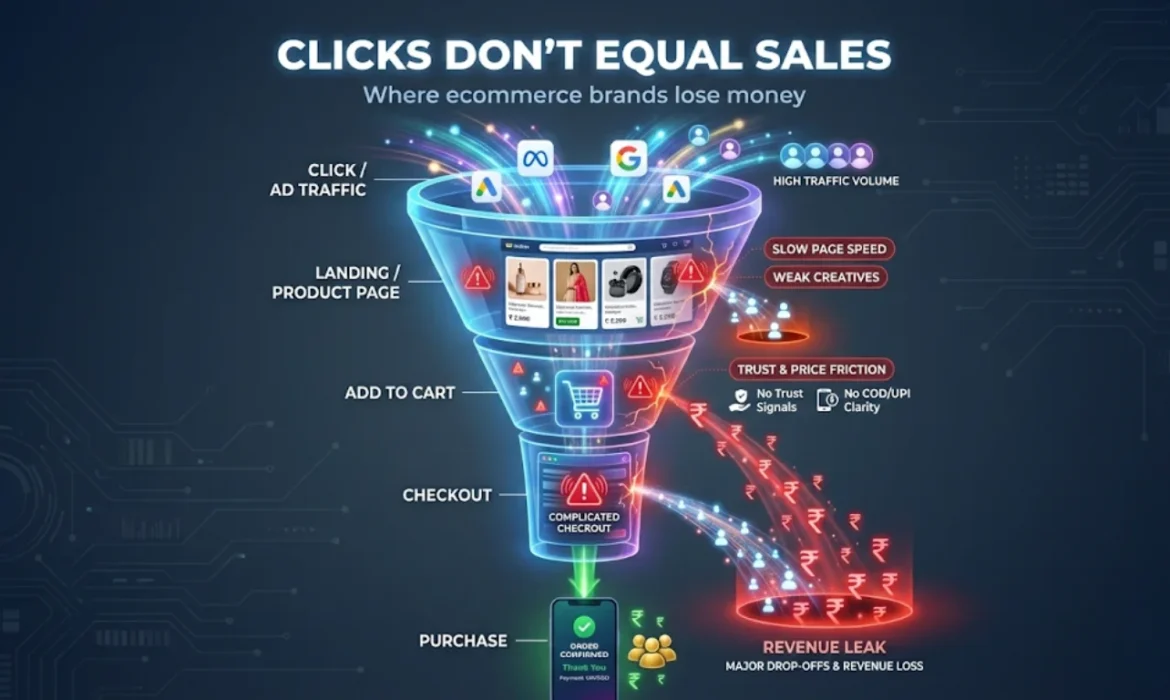
Ecommerce Funnel Explained: From Click to Conversion
“User Click Karta Hai… Phir Kya Hota Hai?”
Most ecommerce brands believe their funnel looks like this:
Ad → Product Page → Checkout → Sale
That’s not a funnel.
That’s hope.
In reality, ecommerce sales are not linear.
They are emotional, hesitant, distracted and fragmented - especially in India.
This is why brands say:
- “Traffic aa raha hai, sales nahi”
- “Ads ka ROAS unstable hai”
- “Users checkout tak jaate hain, par buy nahi karte”
- “Repeat sales nahi aa rahi”
The problem is rarely:
- Traffic quality
- Ad platform
- Budget
👉 The real problem is a broken ecommerce funnel.
This blog explains:
- What an ecommerce funnel actually is
- How users move from click to conversion
- Where most Indian ecommerce brands leak revenue
- How to fix funnel gaps in 2026
- What Is an Ecommerce Funnel (Really)?
- Why Most Ecommerce Funnels Fail (Especially in India)
- Stage 1: The Click (Where Funnels Are Born)
- Stage 2: Landing Page (Interest or Exit)
- Stage 3: Exploration (Silent Decision-Making)
- Stage 4: Add to Cart (Intent, Not Commitment)
- Stage 5: Checkout (Where Money Is Won or Lost)
- Stage 6: Purchase Confirmation (Big Mistake)
- Stage 7: Retention & Repeat Purchases
- The Biggest Ecommerce Funnel Mistakes Indian Brands Make
- How Traffic, CRO & Funnels Work Together
- Funnel Optimization vs More Traffic: The ROI Truth
- What a Healthy Ecommerce Funnel Looks Like in 2026
- How Digi Suggest Optimizes Ecommerce Funnels
- Final Thought
What Is an Ecommerce Funnel (Really)?
An ecommerce funnel is not pages.
It is user psychology over time.
A funnel represents how users move through these mental stages:
- Awareness
- Interest
- Consideration
- Trust
- Purchase
- Retention
Pages support these stages but they don’t replace them.
👉 Funnels are psychological journeys, not URLs. You can read more about sales funnel stages here.
Why Most Ecommerce Funnels Fail (Especially in India)
Most funnels fail because brands assume:
- Users are ready to buy
- One visit is enough
- One ad can close a sale
- Discounts replace trust
Indian ecommerce users:
- Compare heavily
- Research slowly
- Distrust new brands
- Get distracted easily
- Often return multiple times
If your funnel doesn’t support this behavior:
👉 Users drop out silently.
Is your Ecommerce Funnel Leaking Revenue?
Stop guessing. Start converting.
Stage 1: The Click (Where Funnels Are Born)
The funnel starts before the website.
The click comes from:
- Meta Ads
- Google Ads
- SEO
- Influencers
- WhatsApp / Email
The Biggest Funnel Mistake at This Stage
Sending traffic with misaligned intent.
Example:
- Ad promises “problem solution”
- Landing page shows product features
- User feels confused
Funnel Principle
👉 Every click carries an expectation.
Your landing page must match it.
This is called message match and it’s critical.
Stage 2: Landing Page (Interest or Exit)
This is where most funnels collapse.
Users ask subconsciously:
- “Am I in the right place?”
- “Is this relevant to me?”
- “Can I trust this brand?”
Common Funnel Leaks Here
- Vague messaging
- Slow page speed
- No clarity above the fold
- No trust signals
What a Funnel-Ready Landing Page Does
- Clearly explains the product
- Shows who it’s for
- Builds trust immediately
- Guides the next action
👉 Landing pages don’t sell. They guide.
Stage 3: Exploration (Silent Decision-Making)
If users don’t bounce, they explore:
- Scroll
- Click images
- Read reviews
- Check FAQs
- Open policies
This stage is invisible in dashboards but crucial.
What Users Are Really Doing
They’re asking:
- “Is this legit?”
- “Will this work for me?”
- “What if I regret it?”
Funnel Leak Here
- Weak product pages
- Feature-heavy content
- No proof
- Poor mobile UX
Funnel Fix
- Benefits over features
- Social proof everywhere
- Clear use cases
- Real images & videos
👉 Users don’t need more info.
They need more confidence.
Stage 4: Add to Cart (Intent, Not Commitment)
Add to cart feels like success but it’s not.
In India:
- Add to cart is often “bookmarking”
- Users add and leave (known as cart abandonment)
- Intention exists, commitment doesn’t
Funnel Leak
Brands celebrate add-to-cart but ignore:
- Cart clarity
- Cart friction
- Cart reassurance
Funnel Fix
- Clear pricing
- Shipping & COD clarity
- Easy cart edits
- Visible trust signals
👉 Add to cart = interest. Checkout = trust.
Don't let high intent users drop off.
We optimize your cart and checkout flow.
Stage 5: Checkout (Where Money Is Won or Lost)
Checkout is the most fragile stage.
Users are ready but anxious.
They think:
- “Is payment safe?”
- “What if delivery is late?”
- “What if product is bad?”
- “What if return is hard?”
Common Funnel Killers
- Forced login
- Long forms
- Hidden charges
- Payment failures
- Poor mobile checkout
Funnel Fix
- Guest checkout
- Minimal fields
- Transparent pricing
- COD clarity
- Reassurance near CTA
👉 Checkout optimization is emotional optimization.
Stage 6: Purchase Confirmation (Most Brands Stop Here - Big Mistake)
After purchase, brands relax.
But this stage decides:
- Trust
- Repeat purchases
- Word of mouth
- Refund anxiety
Funnel Leak
- Poor confirmation page
- No reassurance
- No next steps
Funnel Fix
- Clear order summary
- Delivery expectations
- Support info
- Thank-you messaging
- Cross-sell (soft)
👉 Post-purchase experience decides loyalty.
Stage 7: Retention & Repeat Purchases (The Hidden Funnel)
Most ecommerce profit comes from:
Yet many brands:
- Ignore post-purchase funnel
- Focus only on acquisition
- Burn money repeatedly
Funnel Fix
- Email & WhatsApp flows
- Product education
- Review requests
- Repeat purchase offers
- Loyalty incentives
👉 Acquisition without retention is expensive.
The Biggest Ecommerce Funnel Mistakes Indian Brands Make
- ❌ Assuming one visit = one sale
- ❌ Sending cold traffic directly to checkout
- ❌ Ignoring mobile behavior
- ❌ Overusing discounts instead of trust
- ❌ Fixing ads instead of funnel leaks
- ❌ Measuring only last-click ROAS
Funnels fail when brands think tactically, not holistically.
How Traffic, CRO & Funnels Work Together
Traffic brings users.
CRO removes friction.
Funnels guide decisions.
If any one is weak:
- Growth stalls
- Costs rise
- ROAS becomes unstable
👉 Funnels multiply the impact of traffic.
Funnel Optimization vs More Traffic: The ROI Truth
Option A:
- Increase ad spend by 20%
- Risk higher CPA
Option B:
- Fix funnel leaks
- Improve conversion by 20%
- Same traffic, more revenue
👉 Funnel optimization always wins long-term.
What a Healthy Ecommerce Funnel Looks Like in 2026
A strong funnel:
- Matches intent at every step
- Builds trust progressively
- Reduces friction continuously
- Supports Indian buyer behavior
- Works on mobile first
- Encourages repeat purchases. See India's growing ecommerce stats here.
It doesn’t force sales.
It removes reasons not to buy.
How Digi Suggest Optimizes Ecommerce Funnels
At Digi Suggest, we don’t optimize pages in isolation.
We optimize the entire ecommerce funnel.
Our Funnel Optimization Approach
- Traffic & intent audit
- Funnel-stage diagnostics
- Friction & trust mapping
- CRO + speed optimization
- Checkout & retention fixes
🎯 We don’t chase clicks.
🎯 We fix the journey.
🚀 Getting Clicks but Not Conversions?
If your ecommerce store is getting traffic but not consistent sales, the problem is almost always the funnel not the ads.
Final Thought
Ecommerce success is not about:
- One ad
- One page
- One trick
It’s about:
- Guiding users
- Building trust
- Removing friction
- Respecting buyer psychology
Traffic brings users.
Funnels turn them into customers.
If you want sustainable ecommerce growth fix the funnel.
FAQs
An ecommerce funnel represents the journey users take from first click to purchase, including awareness, trust-building, checkout, and retention.
Funnels fail because brands focus on traffic instead of intent, trust, and friction removal across different user stages.
No. Funnels are psychological journeys. Pages support funnels, but user intent and decision-making drive conversions.
Brands should analyze bounce rates, scroll depth, add-to-cart drop-offs, checkout exits and repeat purchase data.
Better funnel optimization is usually more profitable, as it increases revenue from existing traffic without increasing acquisition costs.

How Page Speed Affects Ecommerce Sales (2026 CRO Guide)
“Website Chal Toh Rahi Hai… Par Slow Hai”
Most ecommerce founders don’t panic when their website is slow. They say things like:
- “Site thodi slow hai, but load ho jaati hai”
- “Mobile pe thoda time lagta hai”
- “Ads toh chal rahi hain, problem wahan hogi”
Here’s the uncomfortable truth: 👉 A slow website doesn’t break suddenly.
It slowly bleeds revenue every single day.
You don’t get an error.
You don’t get alerts.
You just get:
- Higher bounce rates
- Lower conversion rates
- Higher CPA
- Poor ad scalability
And most founders never connect it back to page speed.
This blog explains how page speed directly affects ecommerce sales, why it matters even more in India, and what ecommerce brands should focus on in 2026.
- Page Speed Is Not a “Technical Metric” - It’s a Business Metric
- Why Page Speed Matters More in India Than Anywhere Else
- The Psychology of Speed: What Users Feel
- Page Speed vs Conversion Rate: The Direct Relationship
- How Page Speed Impacts the Entire Ecommerce Funnel
- Google, SEO & Page Speed (2026 Reality)
- Common Page Speed Killers in Ecommerce (India-Focused)
- Speed Problems Are Often Invisible to Founders
- What “Fast Enough” Means for Ecommerce in 2026
- Quick Page Speed Wins for Ecommerce Brands
- How Digi Suggest Approaches Page Speed for Ecommerce
Page Speed Is Not a “Technical Metric” - It’s a Business Metric
Most people think page speed is:
- A developer issue
- A tech checklist
- A Google recommendation
That thinking is outdated. In ecommerce: 👉 Page speed directly affects money.
Every second of delay:
- Reduces trust
- Increases friction
- Lowers conversions
- Increases ad costs
Slow websites don’t just feel bad. They convert worse.
Why Page Speed Matters More in India Than Anywhere Else
Page speed is critical globally, but in India it’s even more important.
Indian Ecommerce Reality
- Majority traffic is mobile
- Internet quality varies widely
- Many users use budget devices
- Users multitask and get distracted easily
If your website is slow: 👉 Users don’t wait. They leave.
Unlike desktop users in high-speed environments, Indian mobile users are impatient by necessity, not by choice.
Is Your Website Bleeding Revenue Due to Speed?
Don't let slow loading times kill your sales. Get a comprehensive analysis.
The Psychology of Speed: What Users Feel When a Site Is Slow
Users don’t consciously say:
“This website is slow, so I won’t buy.”
They subconsciously feel:
- “Something feels off”
- “Is this site trustworthy?”
- “Why is it taking so long?”
- “Let me check later”
That hesitation is enough to: 👉 Kill the purchase.
Speed affects:
- Confidence
- Trust
- Momentum
In ecommerce, momentum matters.
Page Speed vs Conversion Rate: The Direct Relationship
Let’s simplify this. If your page:
- Loads in under 2 seconds → users stay engaged
- Takes 3–4 seconds → users hesitate
- Takes 5+ seconds → users start leaving
For ecommerce stores:
- Even a 1-second delay can reduce conversions significantly
- Mobile users are far more sensitive than desktop users
👉 Page speed doesn’t just affect bounce rate.
👉 It affects every step of the funnel.
How Page Speed Impacts the Entire Ecommerce Funnel
1️⃣ Ads Performance Suffers First
If your landing page is slow:
- Users bounce before seeing content
- Meta & Google record poor engagement
- CPMs increase
- CPCs increase
- CPA increases
This is why many brands say: “Ads mehngi hoti ja rahi hain.”
Sometimes, ads aren’t the problem. 👉 The page is.
2️⃣ Product Page Engagement Drops
Slow product pages cause:
- Lower scroll depth
- Fewer image views
- Fewer “Add to Cart” clicks
Users don’t explore. They skim or leave.
Learn more about optimizing product page SEO here.
3️⃣ Checkout Drop-Off Increases
Slow checkout pages are deadly. Users at checkout are:
- Ready to buy
- Emotionally invested
A delay here causes:
- Anxiety
- Doubt
- Exit
👉 Speed issues at checkout directly lose revenue.
Read our guide on checkout page optimization.
Ads Performing Poorly? It Might Be Your Site Speed.
We optimize ecommerce funnels to lower CPA and increase ROAS.
Google, SEO & Page Speed (2026 Reality)
Google now treats page speed as:
- A ranking factor
- A quality signal
In 2026:
- Core Web Vitals matter more than ever
- Mobile performance is prioritized
- User experience affects visibility
Slow ecommerce sites face:
- Lower rankings
- Lower traffic quality
- Poor organic conversion rates
👉 Page speed impacts both SEO and CRO.
Common Page Speed Killers in Ecommerce (India-Focused)
Most ecommerce websites are slow for predictable reasons.
❌ Heavy Images & Videos
- Uncompressed product images
- Autoplay videos
- Large banners
❌ Too Many Apps & Scripts
- Shopify apps overload
- Tracking scripts everywhere
- Unused plugins
❌ Poor Mobile Optimization
- Desktop-first design
- Heavy animations
- Complex layouts
❌ Cheap Hosting or Bad Themes
- Slow servers
- Bloated themes
- Poor caching
Speed Problems Are Often Invisible to Founders
Here’s why page speed issues go unnoticed:
- Founders use high-speed internet
- They test on laptops
- They’re logged-in users (cached)
- They’re familiar with the site
Real users:
- Are on mobile
- Have slower networks
- Are first-time visitors
👉 Your experience ≠ user experience.
What “Fast Enough” Means for Ecommerce in 2026
You don’t need perfection. You need acceptable performance.
General benchmarks:
- Homepage: under ~2.5 seconds
- Product pages: under ~2 seconds
- Checkout: as fast as possible
More important than tools like PageSpeed Insights or GTmetrix is How fast the site feels to users.
Quick Page Speed Wins for Ecommerce Brands
You don’t need a full rebuild to see improvements. High-Impact Fixes:
- Compress & lazy-load images
- Remove unnecessary apps/scripts
- Optimize mobile layouts
- Use lightweight fonts
- Improve server response time
These alone can:
- Reduce bounce rate
- Improve conversions
- Lower CPA
The CRO + Speed Connection (Most Miss This)
Page speed is part of CRO. A fast page:
- Feels trustworthy
- Reduces friction
- Improves flow
A slow page:
- Creates doubt
- Breaks momentum
- Increases exits
👉 Speed is conversion psychology.
How Page Speed Improves ROAS Without Increasing Spend
When your site is faster:
- More users stay
- More users reach checkout
- More users complete purchases
That means:
- Same traffic
- Same ad spend
- More revenue
👉 Page speed is one of the cheapest ROI improvements.
When Should You Prioritize Page Speed Fixes?
You should focus on page speed if:
- Bounce rate is high
- Mobile conversions are low
- Ads feel expensive
- Checkout drop-off is high
- Scaling ads feels unstable
In most cases: 👉 Speed is a hidden bottleneck.
How Digi Suggest Approaches Page Speed for Ecommerce
At Digi Suggest, we don’t treat page speed as a developer-only task. We treat it as a revenue optimization lever.
Our Page Speed + CRO Approach
- Mobile-first performance audits
- Funnel-level speed analysis
- Identify revenue-impacting delays
- Prioritize fixes by ROI
- Align speed improvements with conversions
🎯 The goal is not just better scores.
🎯 The goal is more sales from the same traffic.
Website Slow? Sales Slower?
If your website feels slow, you’re losing revenue silently. Book a free page speed + CRO audit.
Final Thought
A slow ecommerce website doesn’t crash. It quietly underperforms.
In 2026:
- Speed affects trust
- Speed affects conversions
- Speed affects ROAS
Before increasing ad budgets fix the speed of the page where users decide.
FAQs
Yes. Page speed directly affects bounce rate, trust, conversion rate and ad costs, especially for mobile users in India.
In 2026, ecommerce pages should ideally load within 2–3 seconds on mobile to avoid significant conversion drops.
Slow pages increase bounce rates, which signals poor user experience to ad platforms, raising CPCs and lowering ROAS.
Yes. Since most Indian ecommerce traffic is mobile, speed optimization has a greater impact on mobile conversions than desktop.
If bounce rates are high, speed fixes often deliver better ROI than launching new campaigns.
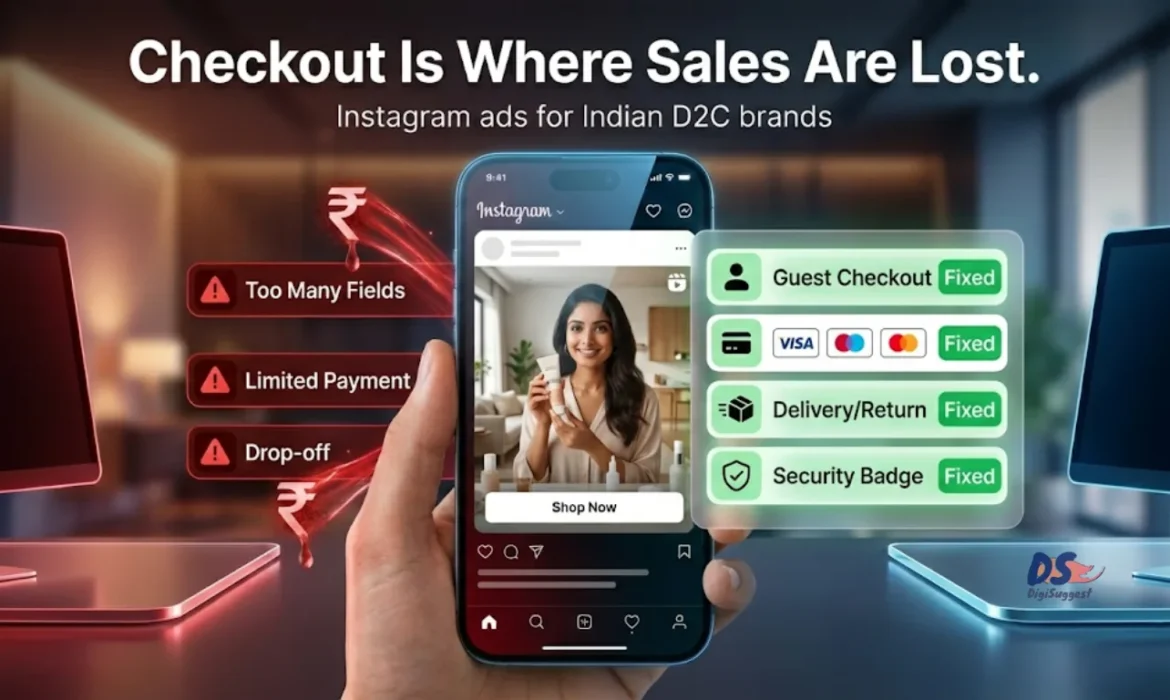
Checkout Page Optimization Tips for Higher Ecommerce Sales
The Most Expensive Page on Your Website
If you run an ecommerce business, this fact might surprise you:
👉 Your checkout page is where the maximum revenue is lost not your ads, not your homepage.
Most Indian ecommerce stores:
- Spend heavily on Meta Ads & Google Ads
- Improve creatives and targeting
- Drive quality traffic
Yet still face:
- 60–80% cart abandonment
- Drop-offs during checkout
- Users who almost buy but don’t
Founders often say: “User ne add to cart kiya… phir pata nahi kya hua.”
What happened is simple:
👉 Your checkout page created friction or fear.
This blog explains:
- Why checkout pages fail
- The most common checkout mistakes Indian brands make
- Practical checkout optimization tips that increase sales
- How to think about checkout CRO in 2026
- Why Checkout Page Optimization Matters
- Indian Ecommerce Reality
- The Psychology of Checkout
- Mistake 1: Forcing Login
- Mistake 2: Too Many Form Fields
- Mistake 3: No COD Clarity
- Mistake 4: Surprise Charges
- Mistake 5: Payment Failures
- Mistake 6: Unsafe Look
- Mistake 7: Too Many Steps
- Mistake 8: No Reassurance
- Mistake 9: Poor Mobile Experience
- Mistake 10: No Exit Recovery
- High-Impact Optimization Checklist
- How Digi Suggest Optimizes Funnels
Why Checkout Page Optimization Matters More Than Anything Else
Checkout users are:
- Highly motivated
- Already convinced about the product
- Ready to pay
At this stage:
👉 Even small issues cause exits.
Improving checkout conversion by just 5–10% can often:
- Increase revenue more than doubling ad budgets
- Reduce CPA across all channels
- Improve repeat purchase rate
Checkout CRO is pure profit optimization.
Indian Ecommerce Reality: Why Checkout Is Extra Sensitive
Indian ecommerce checkout faces unique challenges:
- COD preference
- Trust concerns
- Payment failures
- Mobile-first users
- Slow internet in many regions
A checkout that works in the US or Europe:
👉 Often fails in India.
This is why India-specific checkout optimization is critical.
Is your checkout page leaking revenue?
Fix friction and increase conversions.
The Psychology of Checkout: What Users Are Feeling
At checkout, users think:
- “Is this brand trustworthy?”
- “Will my money be safe?”
- “What if delivery is late?”
- “Can I return this easily?”
- “Why is checkout taking so long?”
Checkout optimization is not technical.
👉 It is psychological.
Your job is to:
- Reduce anxiety
- Reduce effort
- Increase reassurance
Mistake 1️⃣ Forcing Login or Account Creation
This is one of the biggest checkout killers. Many sites require users to:
- Sign up
- Create a password
- Verify email
Why This Fails
Users think: “Abhi sirf product chahiye, account baad mein.”
CRO Fix
- Enable guest checkout
- Ask for account creation after purchase
👉 Forced login = lost sales.
Mistake 2️⃣ Too Many Form Fields
Every extra field reduces conversion. Common unnecessary fields:
- Company name
- Alternate phone (mandatory)
- Address line 2 (required)
- DOB / gender
CRO Fix
- Remove non-essential fields
- Use smart defaults
- Auto-fill where possible
👉 Shorter forms = higher conversions.
Mistake 3️⃣ No COD Clarity (Critical in India)
COD is not optional in India. If users don’t clearly see:
- COD available
- COD charges (if any)
They hesitate or leave.
CRO Fix
- Show COD availability early
- Mention COD near payment options
- Be transparent about any COD fees
👉 COD clarity builds trust instantly.
Mistake 4️⃣ Surprise Charges at Checkout
This is a silent conversion killer. Users hate discovering:
- Shipping charges late
- Convenience fees
- COD fees at the last step
Why This Kills Sales
It breaks trust. Users feel: “Mujhe pehle batana chahiye tha.” This is a classic example of why you might have traffic but no sales.
CRO Fix
- Show shipping & charges upfront
- Use “No hidden charges” messaging
- Display final price early
👉 Transparency > persuasion.
Don't let hidden errors kill your sales.
We optimize ecommerce funnels for higher ROAS.
Mistake 5️⃣ Payment Failures or Limited Options
Indian users expect:
- UPI
- Debit cards
- Wallets
- Net banking
- COD
If payment fails once:
👉 Many users never retry.
CRO Fix
- Offer multiple payment methods
- Optimize payment gateway speed
- Show “secure payment” badges
- Handle payment failures gracefully
👉 Payment friction = lost intent.
Mistake 6️⃣ Checkout Looks Unsafe or Unprofessional
Even small visual cues matter. Red flags:
- Poor design
- Broken layouts
- No SSL indication
- No trust badges
Users subconsciously think: “Yeh site safe hai ya nahi?” This often stems from poor website development practices.
CRO Fix
- Clean, minimal checkout design
- SSL & security indicators
- Trusted payment logos
- Professional UI
👉 Checkout must feel safe, not fancy.
Mistake 7️⃣ Too Many Steps in Checkout
Long checkout flows kill momentum. Each step is an opportunity to exit.
CRO Fix
- Use single-page checkout where possible
- Or show clear progress indicator
- Minimize clicks & page reloads
👉 Faster checkout = more sales.
Mistake 8️⃣ No Reassurance Near the “Pay” Button
This is a subtle but powerful CRO tactic. Before clicking “Pay”, users want reassurance.
CRO Fixes Near CTA
- “Easy 7-day returns”
- “COD available”
- “100% secure payment”
- “Free delivery above ₹X”
👉 Place reassurance near the final action.
Mistake 9️⃣ Poor Mobile Checkout Experience
Most Indian ecommerce traffic is mobile. Common mobile issues include tiny input fields, keyboard covering fields, and slow loading. Remember, page speed affects ecommerce sales drastically.
CRO Fix
- Mobile-first checkout design
- Large buttons
- Autofill-friendly forms
- Minimal scrolling
👉 If checkout fails on mobile, you lose most users.
Mistake 🔟 No Exit Recovery at Checkout
Users don’t always leave forever. Many abandon checkout because:
- They get distracted
- They want to think
- They want to compare
CRO Fix
- Exit-intent popups (soft, not aggressive)
- Cart reminder emails / WhatsApp
- Retargeting ads aligned with checkout objections
👉 Checkout optimization continues after exit.
High-Impact Checkout Optimization Checklist
Here’s what most Indian D2C brands should fix first:
- ✅ Guest checkout
- ✅ Fewer form fields
- ✅ COD clarity
- ✅ Transparent pricing
- ✅ Multiple payment options
- ✅ Security & trust signals
- ✅ Mobile optimization
- ✅ Reassurance near CTA
These are simple fixes, not redesigns.
Checkout CRO vs More Traffic: The ROI Comparison
If you:
- Improve checkout conversion by 10%
- You increase revenue immediately.
If you:
- Increase traffic by 10%
- You increase costs too.
👉 Checkout CRO is the cheapest growth lever. It is often more effective than simply debating SEO vs Ads.
How Checkout Optimization Improves Ads Performance
A better checkout:
- Lowers CPA
- Improves ROAS on Meta Ads
- Stabilizes scaling
- Increases repeat purchases
This means:
👉 CRO multiplies ad performance.
How Digi Suggest Optimizes Checkout Funnels
At Digi Suggest, we don’t “guess” checkout fixes. We analyze:
- Drop-off points
- User behavior
- Payment failures
- Mobile issues
- Trust gaps
Our Checkout CRO Approach
- Ecommerce funnel & step-wise analysis
- Friction & anxiety mapping
- India-specific payment optimization
- Mobile-first improvements
- Continuous testing
🎯 The goal is not cosmetic changes.
🎯 The goal is more completed orders. Learn more about our ecommerce marketing services.
Stop Losing Sales at Checkout
Book a free checkout CRO audit and recover lost sales.
Stop Losing Sales at Checkout
🚀 High Cart Abandonment?
If users are adding to cart but not completing purchases, your checkout page is leaking revenue every day.
👉 We optimize ecommerce funnels, not just traffic. Read our scaling case study to see how we do it.
👉 Book a free checkout CRO audit and recover lost sales.
Final Thought
If users reach checkout:
- Your Google Ads worked
- Your product worked
If they don’t pay: 👉 Your checkout failed.
Before spending more on traffic, fix the page where money is actually made.
FAQs
Checkout optimization directly impacts revenue because users at checkout already intend to buy. Any friction here causes immediate loss of sales.
In 2026, Indian ecommerce cart abandonment rates often range from 65–80%, mainly due to trust issues, COD clarity, and payment friction.
Yes. Forced login remains one of the biggest checkout conversion killers, especially for first-time buyers.
Clear COD visibility and transparency significantly improve checkout conversions by reducing trust anxiety among Indian shoppers.
Yes. A better checkout improves overall conversion rates, which lowers CPA and stabilizes ad performance across platforms.
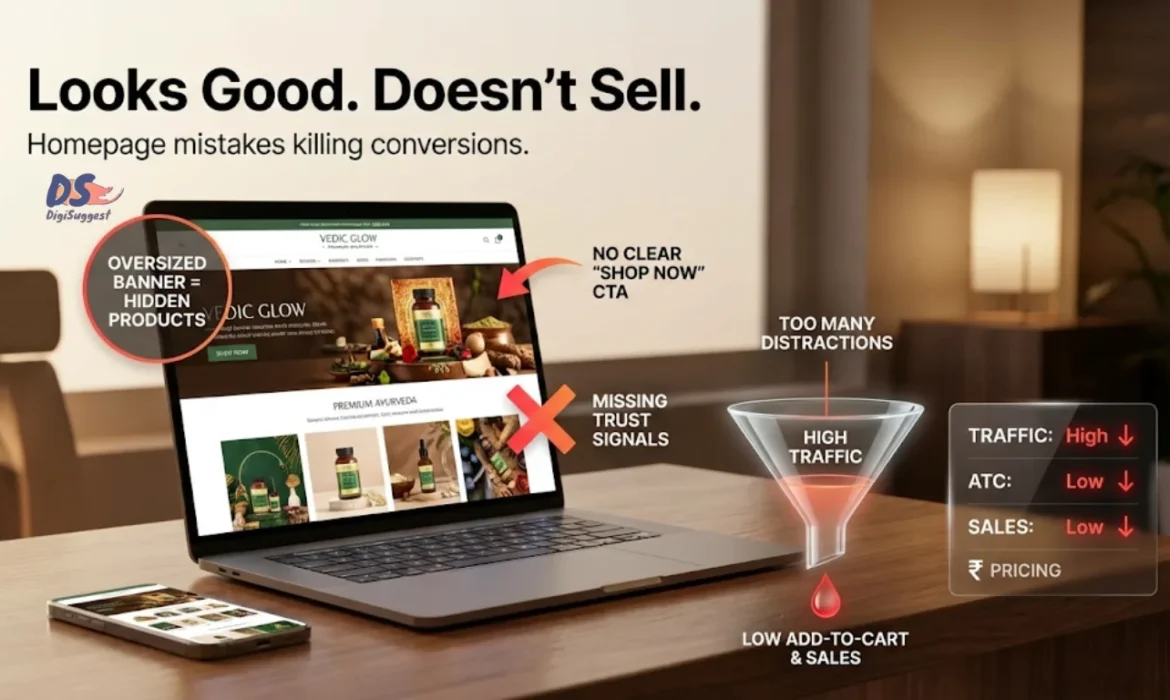
Homepage Mistakes That Reduce Ecommerce Conversions
“Website Sundar Hai… Phir Bhi Log Buy Kyun Nahi Kar Rahe?”
Many ecommerce founders proudly say:
- “Website premium lagti hai”
- “Design bahut acha hai”
- “Homepage modern hai”
Yet the data tells a different story:
- High bounce rate
- Low product page visits
- Poor conversion rate
This leads to confusion: “Homepage toh sahi hai… problem ads mein hogi.”
Here’s the uncomfortable truth:
👉 Most ecommerce homepages don’t fail because they look bad. They fail because they don’t guide decisions.
In ecommerce, your homepage is not:
- A brand brochure
- A mood board
- A design showcase
👉 Your homepage is a decision-making page.
This blog breaks down the most common homepage mistakes that reduce ecommerce conversions, why they happen, and how Indian ecommerce brands can fix them in 2026.
Is your Homepage leaking revenue?
Get a professional audit to find out why users aren't buying.
- The 5-Second Rule: Why Homepages Matter So Much
- Mistake 1️⃣ Your Hero Section Is Vague or Brand-Focused
- Mistake 2️⃣ No Clear Primary Call-to-Action (CTA)
- Mistake 3️⃣ Too Much Information Too Early
- Mistake 4️⃣ No Trust Signals Above the Fold
- Mistake 5️⃣ Homepage Talks About Brand, Not User Problems
- Mistake 6️⃣ Weak Navigation Structure
- Mistake 7️⃣ No Clear “Who Is This For?”
- Mistake 8️⃣ Over-Reliance on Discounts
- Mistake 9️⃣ Homepage Is Not Mobile-Optimized
- Mistake 🔟 No Clear Flow to Product Pages
- A Simple High-Converting Homepage Framework
- Why Homepage CRO Impacts Ads & SEO Performance
- How Digi Suggest Fixes Homepage Conversion Issues
- Final Thought
The 5-Second Rule: Why Homepages Matter So Much
When a user lands on your homepage, you have:
👉 5 seconds or less to answer three questions:
- What do you sell?
- Who is it for?
- Why should I trust you?
If your homepage doesn’t answer these immediately:
- Users scroll aimlessly
- Or bounce
- Or click randomly
None of these lead to conversions. This is often referred to as the 5-second test in marketing psychology.
Mistake 1️⃣ Your Hero Section Is Vague or Brand-Focused
This is the biggest homepage mistake. Most ecommerce hero sections show:
- Brand slogans
- Emotional taglines
- Lifestyle images
- Generic claims
Example: “Redefining wellness for modern India.”
Sounds nice. Converts nothing.
Why This Kills Conversions
New visitors:
- Don’t know your brand
- Don’t care about your mission yet
- Want clarity, not poetry
CRO Fix
Your hero section should clearly state:
- What you sell
- For whom
- The main benefit
Example: “Skincare products designed for Indian skin dermatologically tested, safe for daily use.”
👉 Clarity beats creativity on the homepage, especially for D2C brands.
Mistake 2️⃣ No Clear Primary Call-to-Action (CTA)
Many homepages have:
- Multiple CTAs
- Competing buttons
- Or no clear next step
Examples:
- “Explore”
- “Learn more”
- “Our story”
- “Shop collections”
- “Read blog”
This creates decision paralysis.
Why This Reduces Conversions
Users don’t want to decide what to do. They want guidance.
CRO Fix
- One primary CTA above the fold
- Clear, action-oriented text
- Secondary CTAs only after intent builds
Example:
“Shop Bestsellers”
“Find Your Perfect Product”
👉 One page = one main action.
Mistake 3️⃣ Too Much Information Too Early
Many ecommerce homepages try to show:
- All categories
- All products
- All features
- All certifications
- All blog content
This overwhelms users.
Why This Fails
Users landing on your homepage are:
- Cold
- Curious
- Not ready to process everything
Information overload causes:
- Skimming
- Confusion
- Exit
CRO Fix
- Progressive disclosure
- Show essentials first
- Deeper details later
👉 Homepage should invite exploration, not demand attention.
Mistake 4️⃣ No Trust Signals Above the Fold (Critical in India)
Indian ecommerce users are cautious.
If your homepage doesn’t show trust immediately, users assume: “Ye naya brand lag raha hai… risk hai.”
Common Missing Trust Signals
- Customer reviews
- Media mentions
- COD availability
- Return policy highlights
- Social proof numbers
CRO Fix
Add trust signals above or just below the fold:
- “Trusted by 50,000+ customers”
- ⭐⭐⭐⭐⭐ reviews
- COD & easy returns badges
- Delivery timeline clarity
👉 In India, trust precedes interest.
Build Trust & Increase Sales
We help you optimize for the Indian consumer mindset.
Mistake 5️⃣ Homepage Talks About Brand, Not User Problems
Many homepages focus on:
- Brand story
- Vision & mission
- Founder philosophy
This content has value but not upfront.
Why This Hurts Conversions
New users think: “This brand is talking about itself, not me.”
CRO Fix
Flip the narrative:
- Start with user pain
- Then introduce the brand as the solution
Example:
❌ “We started this brand to change the industry”
✅ “Tired of products that don’t work for Indian conditions?”
👉 Make the user the hero, not the brand.
Mistake 6️⃣ Weak Navigation Structure
Navigation Structure is often ignored in CRO discussions.
Common issues:
- Too many menu items
- Confusing category names
- Hidden bestsellers
- No logical flow
Why This Reduces Conversions
If users can’t quickly find:
- What they’re looking for
- Or where to start
They leave.
CRO Fix
- Simple category structure
- Highlight bestsellers
- Logical grouping
- Clear labels
👉 Navigation should reduce thinking, not add it.
Mistake 7️⃣ No Clear “Who Is This For?”
Many ecommerce homepages fail to clarify:
- Target audience
- Use cases
- Scenarios
This causes users to wonder: “Is this meant for someone like me?”
CRO Fix
Use segmentation:
- “For dry skin”
- “For beginners”
- “For daily use”
- “For fitness beginners”
This helps users self-identify quickly.
👉 Relevance increases conversions.
Mistake 8️⃣ Over-Reliance on Discounts
Some homepages lead with:
- Flat discounts
- Big offers
- Sale banners
This attracts:
- Price-only buyers
- Low loyalty users
And hurts:
- Brand perception
- Long-term conversions, as discount-only marketing kills brand value.
CRO Fix
- Lead with value
- Support with offers
- Don’t make discounts your identity
👉 Trust + value convert better than price alone.
Mistake 9️⃣ Homepage Is Not Mobile-Optimized
In India, most ecommerce traffic is mobile.
Common mobile homepage issues:
- Long loading time
- Huge banners
- Tiny text
- Difficult navigation
- Too much scrolling
CRO Fix
- Design mobile-first
- Short sections
- Clear CTAs
- Fast load speed (Focus on Core Web Vitals)
👉 If your homepage fails on mobile, it fails overall.
Mistake 🔟 No Clear Flow to Product Pages
Many homepages fail to push users toward product pages. They:
- Distract with content
- Promote too many sections
- Forget the core goal
CRO Fix
Your homepage flow should be:
Hero → Trust → Categories → Bestsellers → Proof → CTA
👉 Every section should move users closer to products.
A Simple High-Converting Homepage Framework
Here’s a structure that works for most ecommerce brands:
- Clear hero section (what + who + benefit)
- Primary CTA (shop / explore)
- Trust signals
- Bestsellers or categories
- Benefits & differentiators
- Social proof
- Reassurance (delivery, returns)
Simple. Focused. Effective.
Why Homepage CRO Impacts Ads & SEO Performance
If your homepage:
- Confuses users
- Lacks clarity
- Doesn’t build trust
Then:
- Ad traffic wastes money
- SEO traffic bounces
- Overall CPA increases
👉 Homepage CRO multiplies the ROI of every channel.
How Digi Suggest Fixes Homepage Conversion Issues
At Digi Suggest, we don’t redesign homepages blindly. We diagnose:
- User behavior
- Funnel flow
- Trust gaps
- Clarity issues
Our Homepage CRO Approach
- Heatmap & behavior analysis
- Above-the-fold clarity fixes
- Trust & reassurance optimization
- Mobile-first improvements
- Funnel-aligned layout changes
🎯 The goal is not “better design”.
🎯 The goal is more conversions from the same traffic.
This is why most websites don't rank or sell as they miss the basics of user experience.
Homepage Getting Traffic but Not Sales?
Book a free homepage CRO audit and uncover what’s stopping conversions.
Final Thought
A good-looking homepage doesn’t guarantee sales. A clear, trust-building homepage does.
If your homepage:
- Confuses users
- Hides value
- Lacks trust
No amount of ads will save it. Before scaling traffic fix your homepage.
FAQs
In 2026, the homepage sets trust and clarity within the first 5 seconds. If users don’t immediately understand the product and value, they exit.
Homepages should focus on clarity and guidance first. Branding supports conversions but should not replace clear product messaging.
The biggest mistake is vague hero messaging that talks about the brand instead of clearly explaining what the user can buy and why it matters.
Yes. Reviews, COD availability, delivery timelines, and return policies significantly improve homepage conversions in India.
Homepages should be reviewed quarterly or whenever traffic sources, product focus, or user behavior changes.
Ecommerce Conversion Rate Optimization: Simple Fixes That Boost Sales
“Traffic Aa Raha Hai, Sales Kyun Nahi Badh Rahi?”
This is one of the most common frustrations we hear from ecommerce founders:
- “Website traffic badh raha hai”
- “Ads chal rahi hain”
- “Instagram pe reach bhi hai”
- “Phir bhi sales stagnant hain”
At this stage, many brands make a costly mistake:
👉 They try to fix conversion problems with more traffic.
They:
- Increase ad budgets
- Add new channels
- Push influencers
- Chase more impressions
But revenue doesn’t scale proportionally.
Why?
Because traffic doesn’t convert by default.
This is where Ecommerce Conversion Rate Optimization (CRO) becomes the difference between:
- A struggling store
- And a profitable, scalable business
This blog explains:
- What CRO really means (without jargon)
- Why most ecommerce sites fail to convert
- Simple but powerful CRO fixes that boost sales
- How Indian ecommerce brands should approach CRO in 2026
- What Ecommerce Conversion Rate Optimization Actually Means
- Why CRO Matters More Than Traffic in 2026
- Indian Ecommerce Reality: Why CRO Is Often Ignored
- The Biggest CRO Myth: “Users Will Figure It Out”
- The 5 Core Pillars of Ecommerce CRO
- High-Impact CRO Fixes That Work for Most Ecommerce Stores
- CRO vs More Ad Spend: The Brutal Truth
- Common CRO Mistakes Indian Brands Repeat
- CRO in 2026: What Has Changed?
- How Digi Suggest Approaches Ecommerce CRO
- Final Thought
What Ecommerce Conversion Rate Optimization Actually Means
Let’s remove the biggest misconception first.
CRO Is NOT:
- ❌ Button color testing
- ❌ Fancy UX redesigns
- ❌ Random A/B testing
- ❌ Copying competitor layouts
CRO IS:
- ✅ Removing friction
- ✅ Increasing clarity
- ✅ Building trust
- ✅ Matching user intent
- ✅ Making buying decisions easier
In simple words:
👉 CRO is about helping users say “yes” faster.
Is your traffic not converting into sales?
Stop guessing and start optimizing.
Why CRO Matters More Than Traffic in 2026
In 2026:
- Ad costs are higher
- Competition is intense
- Attention spans are shorter
- Users are more skeptical
This means:
👉 Every wasted visitor is expensive.
Simple Math Example
If:
- 10,000 visitors/month
- Conversion rate = 1%
- Orders = 100
Improve CRO to 2%:
- Orders = 200
- Same traffic
- Same ad spend
👉 Revenue doubles without increasing traffic.
That’s why CRO has the highest ROI of all growth levers.
Indian Ecommerce Reality: Why CRO Is Often Ignored
Many Indian brands skip CRO because:
- They think it’s “technical”
- They believe ads alone drive sales
- They don’t know where to start
- Agencies don’t talk about it
But Indian ecommerce users are:
- Price-sensitive
- Trust-driven
- Comparison-heavy
- Mobile-first
Ignoring CRO in India is especially costly.
The Biggest CRO Myth: “Users Will Figure It Out”
Most ecommerce websites assume: “User samajh jaayega.”
They won’t.
If users feel:
- Confused
- Unsure
- Overwhelmed
- Distrustful
They leave.
👉 Users don’t want to think. They want clarity.
The 5 Core Pillars of Ecommerce CRO
Every CRO fix falls under one of these five pillars.
Pillar 1️⃣ Clarity: Can Users Understand What You Sell in 5 Seconds?
The 5-second rule is real. When a user lands on your site, they should instantly know:
- What you sell
- Who it’s for
- Why it’s better
Common Clarity Mistakes
- ❌ Vague headlines
- ❌ Brand slogans instead of value
- ❌ Too many messages
- ❌ No clear hero section
Simple CRO Fixes
- Clear headline (product + benefit)
- One primary CTA
- Minimal distractions
- Visual focus on product use
👉 If users are confused, they don’t convert.
Pillar 2️⃣ Trust: Do Users Feel Safe Buying From You?
Trust is the biggest conversion factor in Indian ecommerce. Users worry about:
- Fake brands
- Poor quality
- COD issues
- Returns & refunds
- Delivery delays
CRO Trust Killers
- ❌ No reviews
- ❌ Hidden policies
- ❌ No real images
- ❌ No contact details
Simple CRO Fixes
- Show reviews above the fold
- Display COD, returns & delivery clearly
- Add real customer photos
- Show address & support details
👉 In India, trust converts more than discounts.
Don't let friction kill your sales.
We build high-converting ecommerce funnels.
Pillar 3️⃣ Friction: How Hard Is It to Buy?
Every extra step reduces conversions.
Common Friction Points
- Forced login
- Long forms
- Too many popups
- Hidden charges
- Slow pages
Simple CRO Fixes
- Guest checkout
- Shorter forms
- Clear pricing
- Fewer steps
- Minimal distractions
👉 Less effort = more sales.
Pillar 4️⃣ Reassurance: Are You Removing Buyer Doubts?
Even interested users hesitate. Common doubts:
- “Is this worth the price?”
- “What if it doesn’t work?”
- “What if delivery is late?”
- “What if quality is bad?”
CRO Fixes for Reassurance
- FAQs near CTA
- Return & refund clarity
- Testimonials addressing objections
- Usage demos or videos
👉 Good CRO doesn’t push users.
👉 It reassures them.
Pillar 5️⃣ Speed: Is Your Website Fast Enough?
Speed is not just technical. Speed is psychological. If your site feels slow:
- Users lose patience
- Trust drops
- Conversions drop
Simple Speed Fixes
- Compress images
- Reduce heavy apps
- Optimize mobile layout
- Improve Core Web Vitals
👉 Slow websites silently kill sales. You can check your speed on Google PageSpeed Insights.
High-Impact CRO Fixes That Work for Most Ecommerce Stores
Here are simple CRO changes that often deliver quick wins.
✅ Improve Above-the-Fold Section
- Clear value proposition
- One CTA
- Trust signals
✅ Add Social Proof Everywhere
- On homepage
- On product pages
- Near CTA buttons (utilize Social Media Marketing insights here)
✅ Optimize Product Pages
- Benefits > features
- Clear pricing
- FAQs
- Real images/videos
- See more on Category vs Product Page SEO.
✅ Simplify Checkout
- Fewer fields
- COD clarity
- Payment reassurance
✅ Align Ads With Landing Pages
- Message match
- Same promise
- Same visuals
- Learn from our D2C Fashion Case Study.
CRO vs More Ad Spend: The Brutal Truth
Many brands try to fix low conversions by: 👉 Spending more on ads.
What happens?
- More traffic
- Same leaks
- Higher costs
CRO works in the opposite direction:
- Same traffic
- Fewer leaks
- Higher profit
👉 Traffic multiplies problems. CRO fixes them.
Common CRO Mistakes Indian Brands Repeat
- ❌ Testing without data
- ❌ Copying international brands blindly
- ❌ Focusing only on design
- ❌ Ignoring mobile experience
- ❌ Running ads to weak pages
CRO must be: 👉 Data-driven + user-focused.
CRO in 2026: What Has Changed?
In 2026:
- Mobile dominates
- Attention spans are shorter
- Trust matters more
- UX expectations are higher
This means: 👉 CRO is no longer optional. 👉 It’s foundational.
How Digi Suggest Approaches Ecommerce CRO
At Digi Suggest, we don’t treat CRO as a side task. We treat it as a growth system.
Our CRO Approach
- Funnel-level analysis
- User behavior study
- Friction & trust audits
- Data-backed fixes
- Continuous optimization
🎯 We don’t guess.
🎯 We fix what actually blocks conversions.
Getting Traffic but Not Sales?
Book a free CRO audit and uncover the exact reasons users aren’t buying.
Final Thought
In ecommerce:
- Traffic brings people
- CRO turns them into customers
Brands that ignore CRO:
- Spend more
- Earn less
Brands that master CRO:
- Spend smarter
- Scale faster
Before you buy more traffic fix your conversions.
FAQs
In 2026, ecommerce CRO focuses on reducing friction, improving trust, and aligning user intent across the funnel not just A/B testing button colors or layouts.
Yes. With rising ad costs in 2026, improving conversion rates often delivers higher ROI than increasing traffic through ads or SEO.
For Indian ecommerce brands in 2026, conversion rates typically range from 1–3%, depending on category, traffic quality, and funnel maturity.
Absolutely. CRO improves ROAS by converting more visitors from the same traffic, reducing CPA across Meta Ads and Google Ads.
Many CRO fixes show impact within 2–6 weeks, especially improvements related to trust, clarity, checkout, and mobile experience.
Instagram Ads for Ecommerce: Strategy That Actually Sells (2026)
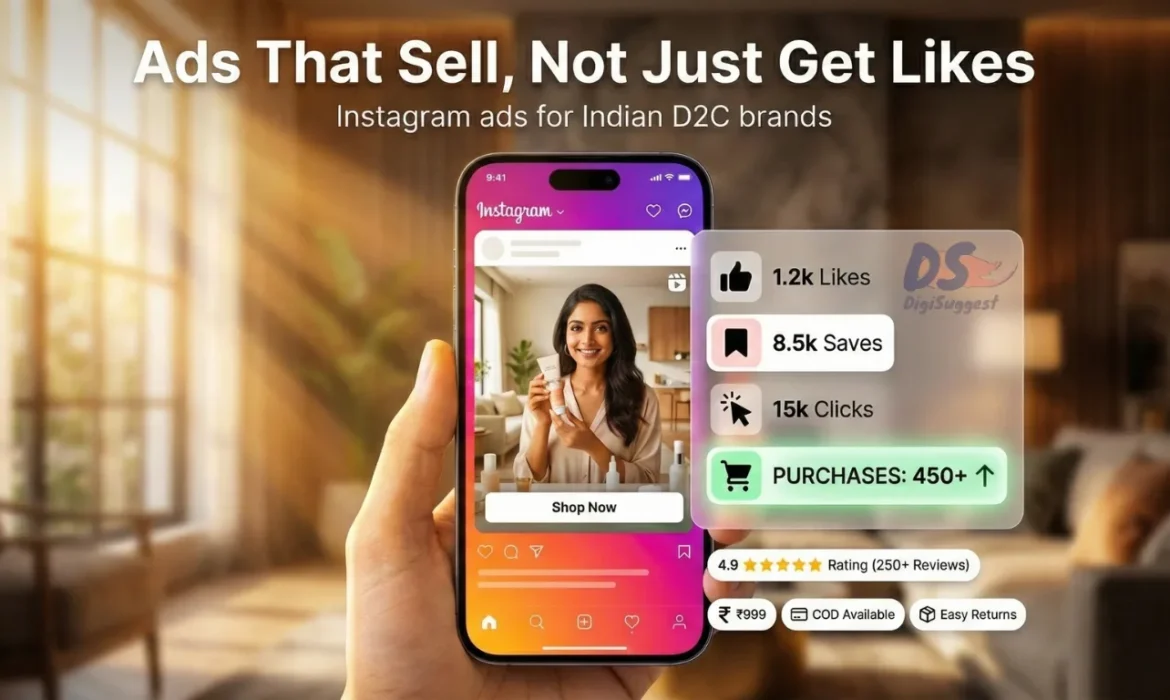
Instagram Ads Get Views… But Why Don’t They Sell?
Almost every Indian ecommerce founder running Instagram ads says some version of this:
- “Views aa rahe hain, sales nahi”
- “Engagement acha hai, conversion nahi”
- “Instagram pe sirf likes milte hain”
- “Facebook ads phir bhi better lagti hain”
So founders conclude:
“Instagram ads sirf branding ke liye hoti hain.”
That conclusion is wrong.
👉 Instagram ads can sell extremely well but only if you understand how Instagram users behave.
Instagram is not Google. Instagram is not Facebook.
If you treat Instagram ads like:
- Product catalog ads
- Discount banners
- Hard-selling creatives
They will fail.
This blog breaks down how Instagram ads actually drive ecommerce sales in 2026, especially for Indian D2C brands.
Struggling to get profitable sales from your Instagram Ads?
- First, Understand the Instagram Mindset
- Why Instagram Ads Fail for Most Ecommerce Brands
- The Biggest Myth: “Pretty Ads Sell on Instagram”
- What Actually Sells on Instagram in 2026
- The 5 Pillars of Winning Instagram Ads
- Ideal Instagram Ads Funnel (2026)
- Landing Page Reality: Instagram Traffic Is Impatient
- Common Instagram Ads Mistakes Indian Brands Make
- How to Measure Instagram Ads Correctly
- How Digi Suggest Makes Instagram Ads Sell
First, Understand the Instagram Mindset (Very Important)
Instagram is a lean-back platform. Users open Instagram to:
- Relax
- Scroll
- Watch reels
- Kill time
- Consume content
They are not actively shopping. This single fact changes everything.
What This Means for Ecommerce Ads
Instagram ads must:
- Feel like content
- Blend into the feed
- Enter conversations naturally
- Earn attention before selling
If your ad looks like an ad:
👉 Users scroll past instantly.
Why Instagram Ads Fail for Most Ecommerce Brands
Let’s be brutally honest. Most Indian ecommerce Instagram ads fail because:
- They look like catalogue images
- They push discounts immediately
- They focus on product features
- They ignore storytelling
- They treat Instagram like Facebook
Instagram users punish this behavior with:
- Low watch time
- Low CTR
- Low conversions
Meta’s algorithm notices and reduces delivery.
The Biggest Myth: “Pretty Ads Sell on Instagram”
Many brands invest heavily in:
- Studio shoots
- Perfect lighting
- Polished videos
- Aesthetic grids
These ads often get:
- Likes
- Comments
- Shares
But not sales.
Why? Because pretty ads don’t feel personal. Indian Instagram users respond more to:
- Real people
- Raw videos
- Honest opinions
- Relatable problems
👉 Authenticity beats aesthetics in 2026.
What Actually Sells on Instagram in 2026
Instagram ads sell when psychology, trust and speed align. Let’s break that down.
The 5 Pillars of Winning Instagram Ads
Pillar 1: Content-First, Not Product-First
Winning Instagram ads don’t start with:
- Product shots
- Price
- Discount
They start with:
- A situation
- A problem
- A story
- A relatable moment
Example
❌ “Buy our vitamin C serum”
✅ “I tried 5 vitamin C serums and my skin got worse”
The second one:
- Stops the scroll
- Builds curiosity
- Feels like content
Pillar 2: Reels Are Non-Negotiable in 2026
If you’re still running:
- Only image ads
- Only square creatives
You’re already behind.
Why Reels Dominate
According to Instagram Business, Reels drive incremental engagement.
- Highest reach
- Highest watch time
- Algorithm priority
- Native behavior
Instagram Reels ads should:
- Look organic
- Be vertical (9:16)
- Feel like influencer content
- Avoid heavy branding
Stop wasting budget on ads that don't convert. Get a Reels-first strategy.
Pillar 3: UGC Is the Backbone of Instagram Ecommerce Ads
User-generated content (UGC) is the highest converting format on Instagram.
Why UGC Works So Well
- Feels honest
- Builds trust fast
- Reduces skepticism
- Mimics peer recommendation
UGC doesn’t mean: Influencers only. It can be:
- Customers
- Founders
- Team members
- Creators talking naturally
👉 In India, UGC + Hinglish = conversion gold.
Pillar 4: Soft Selling Beats Hard Selling
Instagram users hate being sold to. They respond better when:
- Product is introduced naturally
- Benefits are shown, not claimed
- CTA is subtle
Example CTAs That Work
- “I didn’t expect this to work, but…”
- “This helped me fix ___”
- “I wish I knew this earlier”
Hard CTAs like
- “Buy now”
- “Limited offer”
- “Flat 30% off”
Pillar 5: Instagram Ads Need a Funnel (Not One Campaign)
Many brands run:
- One campaign
- One audience
- One creative type
This kills performance.
Ideal Instagram Ads Funnel (2026)
1️⃣ Cold Instagram Traffic
Audience: Broad, Lookalikes, Interest-light
Creative: Reels, UGC, Problem-first storytelling
Goal: 👉 Stop scroll & create interest
2️⃣ Warm Instagram Traffic
Audience: Video viewers, Profile engagers, Website visitors
Creative: Testimonials, Product demos, Comparisons
Goal: 👉 Build trust & intent
3️⃣ Retargeting (Instagram + Facebook)
Audience: Product viewers, Add to cart, Checkout initiated
Creative: FAQs, COD & delivery clarity, Offers & urgency
Goal: 👉 Close the sale
👉 Instagram ads work best when they feed retargeting, not replace it.
Landing Page Reality: Instagram Traffic Is Impatient
Instagram traffic behaves differently from Facebook or Google. Instagram users:
- Click impulsively
- Decide fast
- Leave fast if confused
If your landing page:
- Loads slow
- Looks generic
- Lacks trust
- Doesn’t match ad message
You lose the sale.
Instagram-Optimized Landing Pages Must:
- Load fast on mobile
- Match creative promise
- Show reviews early
- Clearly mention COD & returns
- Reduce friction
👉 Instagram ads don’t forgive bad UX.
Product Categories That Sell Best on Instagram (India)
Instagram works exceptionally well for:
- Skincare & beauty
- Fashion & accessories
- Fitness & supplements
- Home décor
- Lifestyle products
It struggles for:
- Highly technical products
- High-ticket B2B items
- Complex explanations
Understanding this avoids false expectations.
Common Instagram Ads Mistakes Indian Brands Make
- ❌ Treating Instagram like Facebook
- ❌ Running only image ads
- ❌ Selling too early
- ❌ Ignoring Reels & UGC
- ❌ Same creative for cold & retargeting
- ❌ Judging success only by likes (leading to Low ROAS)
Instagram doesn’t reward shortcuts.
2026 Reality: Instagram Is a Brand-Building Sales Channel
Instagram ads don’t always convert immediately or show perfect ROAS on day one. But they:
- Build brand recall
- Increase retargeting efficiency
- Improve overall Meta Ads performance
- Support long-term growth
Instagram is not just a sales channel. It’s a demand creation channel.
How to Measure Instagram Ads Correctly
Instead of asking: “Instagram ads ka ROAS kya hai?”, ask:
- Is retargeting CPA improving?
- Is brand search increasing?
- Is overall Meta Ads performance improving?
- Is repeat purchase rate increasing?
Instagram ads often work indirectly.
How Digi Suggest Makes Instagram Ads Sell
At Digi Suggest, we don’t treat Instagram ads as “creative posting”. We build Instagram-first ecommerce funnels.
Our Instagram Ads Approach
- Content-first creative strategy
- Reels & UGC frameworks
- Funnel-based campaign structure
- Creative fatigue management
- Landing page alignment
🎯 Our goal is not vanity metrics.
🎯 Our goal is revenue-driven Instagram ads.
Ready to Scale with Revenue-Driven Instagram Ads?
Book a free Instagram Ads audit today.
Make Instagram Ads Actually Sell
🚀 Instagram Ads Getting Views But No Sales?
If your Instagram ads are getting engagement but not revenue, the problem isn’t Instagram - it’s the strategy.
👉 Struggling with Meta Ads? Let Digi Suggest handle it.
👉 Book a free Instagram Ads audit and see exactly what’s stopping conversions.
Final Thought
Instagram ads don’t fail because:
- People don’t buy on Instagram
- The platform is weak
They fail because:
- Brands sell too early
- Creatives don’t feel human
- Funnels are missing
Treat Instagram like a content platform first and it becomes a powerful ecommerce sales engine.
FAQs
Yes. Instagram ads drive ecommerce sales in 2026 when used as a content-first, trust-building channel supported by retargeting.
This happens when ads focus on aesthetics rather than storytelling, trust, and funnel alignment.
Yes. Reels are the highest-performing format in 2026 due to higher reach, watch time, and algorithm preference.
UGC-style videos, founder-led content, problem-first storytelling, and testimonial-based creatives convert best.
Instagram ads should be evaluated by their impact on overall Meta Ads performance, retargeting CPA, and brand recall not just last-click ROAS.
How Much Should Ecommerce Brands Spend on Meta Ads? (2026 Guide)
“Meta Ads Pe Kitna Spend Karein?”
This is one of the most stressful questions for ecommerce founders. You’ll hear it in different forms:
- “Minimum budget kitna hona chahiye?”
- “₹1,000/day kaam karega?”
- “Kitna spend karein taaki ROAS positive aaye?”
- “Budget badhane se sales kyun nahi badh rahi?”
And most answers online are useless:
“Start with a small budget.”
“Test and scale.”
“Depends on your product.”
These answers don’t help when real money is at stake.
👉 The truth: There is no “perfect” Meta Ads budget. But there is a wrong budget for every stage.
This blog will help you decide how much your ecommerce brand should spend on Meta Ads in 2026, based on:
- Brand stage
- Margins
- Funnel maturity
- Indian market realities.
Confused about your Ad Budget? Get a Free Audit.
- First, Kill This Myth: “Low Budget = Safe Budget”
- What Actually Decides Your Meta Ads Budget
- Factor 1: Your Brand Stage (Most Important)
- Factor 2: Your Gross Margins
- Factor 3: Your Funnel Maturity
- Factor 4: Creative Volume
- Factor 5: Time Horizon
- Common Budget Mistakes Indian Brands Make
- How to Increase Budget Without Killing Performance
- How to Know If You’re Spending Too Much or Too Little
- How Digi Suggest Helps Brands Set the Right Budget
First, Kill This Myth: “Low Budget = Safe Budget”
Many Indian founders believe:
“Kam budget lagayenge toh risk kam hoga.”
In Meta Ads, the opposite is often true.
Why Very Low Budgets Fail
If your budget is too low:
- Meta doesn’t get enough data
- Learning phase never stabilizes
- Creatives don’t get tested
- Performance looks random
A ₹300–₹500/day budget often produces no clarity, wastes time and creates wrong conclusions.
👉 Low budget is not testing. It’s guessing.
What Actually Decides Your Meta Ads Budget
Your Meta Ads budget should NOT be decided by:
- What competitors spend
- What an agency suggests blindly
- Arbitrary daily limits
It should be decided by five business factors.
Factor 1️⃣ Your Brand Stage (Most Important)
Let’s break this down clearly.
Stage 1: New / Early-Stage Brand
Profile:
- Low brand awareness
- No proven creatives
- Limited data
- Founder-driven marketing
Recommended Budget:
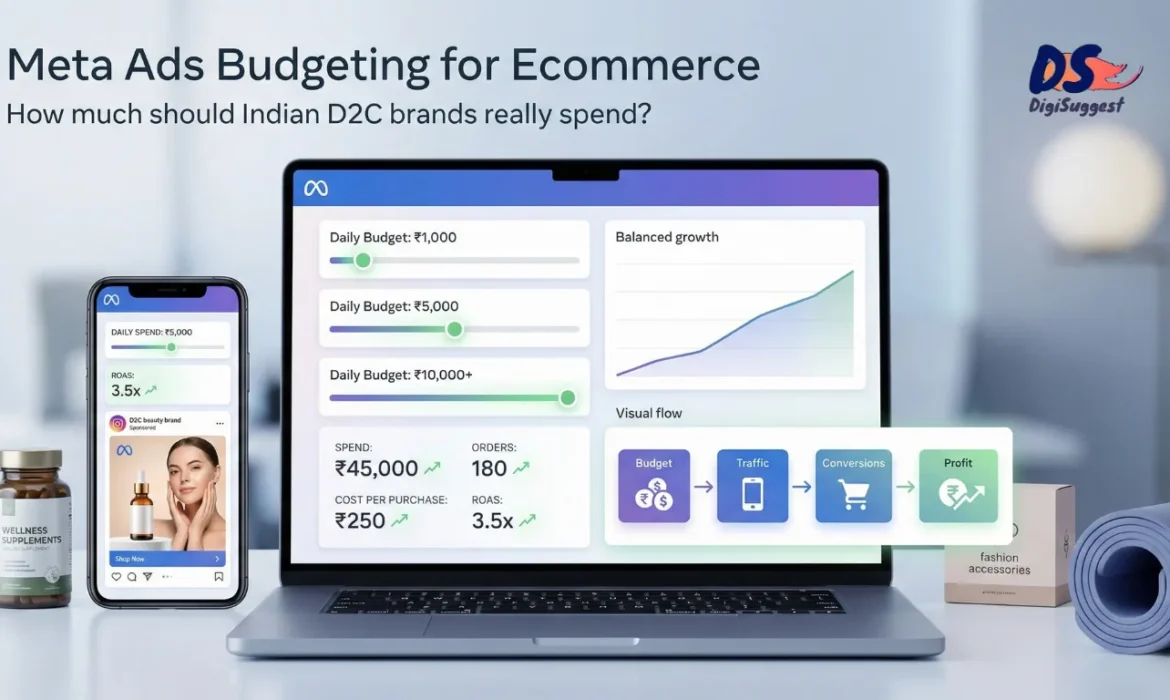
- ₹1,000 – ₹3,000/day
- ₹30,000 – ₹90,000/month
Why This Range Works:
- Enough data for learning
- Allows creative testing
- Doesn’t overexpose brand.
Focus at This Stage:
- Finding winning creatives
- Understanding ICP
- Building retargeting pool.
❌ Don’t expect scale.
❌ Don’t chase ROAS aggressively.
👉 Goal: Clarity, not profit.
Stage 2: Growing Brand (Validation Achieved)
Profile:
- Ads already generating sales
- Some repeat buyers
- Creative patterns emerging
- Clear product-market fit.
Recommended Budget:
- ₹3,000 – ₹10,000/day
- ₹1L – ₹3L/month.
Focus at This Stage:
- Scaling winning creatives
- Funnel optimization
- Retargeting efficiency
- CPA stabilization.
👉 This is where Meta Ads become a growth engine.
Stage 3: Scaling Brand
Profile:
- Consistent ROAS
- Multiple winning creatives
- Strong funnel, Stable supply chain
Recommended Budget:
- ₹10,000 – ₹50,000+/day
- ₹3L – ₹15L+/month)
Focus at This Stage:
- Creative velocity
- Fatigue management
- Incremental scaling
- Profit optimization.
👉 Budget now follows performance. (See our Zero to Scalable Case Study).
Factor 2️⃣ Your Gross Margins (India Reality Check)
Margins decide how much you can spend, not how much you want to spend.
Example:
- If Product price: ₹1,500
- Gross margin: 50% (₹750)
- Your maximum sustainable CPA (roughly): ₹400–₹500 (before overheads)
If your Meta Ads CPA is ₹700–₹800, no budget will save you.
👉 Budget cannot fix poor unit economics.
Stop Wasting Money on Wrong Budgets
Get a Unit Economics Analysis Today.
Factor 3️⃣ Your Funnel Maturity
Two brands with the same budget can get very different results.
Why?
👉 Funnel maturity
Weak Funnel = Low Budget Ceiling
If:
- Cold ads are sales-focused
- Retargeting is missing
- Creatives are generic
- Landing page is weak
Even ₹10L/month will struggle.
Strong Funnel = Higher Budget Efficiency
If:
- Cold ads build interest
- Retargeting closes sales
- Creatives match intent
- Landing pages convert well
Even ₹1L/month can perform well.
👉 Budget works only when the funnel works.
Factor 4️⃣ Creative Volume (Most Ignored Factor)
Meta Ads scaling in 2026 is creative-driven.
Budget Without Creative Volume Is Dangerous
If you spend:
- ₹5,000/day and test
- 1–2 creatives only
Your ads will:
- Fatigue fast
- Become expensive
- Stop scaling
Creative Rule of Thumb (2026)
For every:
- ₹1L/month spend
You need: - 8–12 new creatives/month
More spend = more creative testing.
👉 Creative volume sets your spending ceiling.
Factor 5️⃣ Time Horizon (Short-Term vs Long-Term)
Many founders ask:
“Kitne din mein result aayega?”
Your budget decision changes based on expectations.
Short-Term Expectation (1–2 months)
- Budget should be controlled
- Focus on testing
- Avoid aggressive scaling
Long-Term Expectation (6–12 months)
- Higher budget justified
- Funnel optimization pays off
- Creative systems compound
👉 Meta Ads reward patience + consistency.
Common Budget Mistakes Indian Brands Make
- ❌ Spending Too Little for Too Long: No data, no learning, no results.
- ❌ Increasing Budget to Fix Bad Performance: Budget amplifies problems (Read why ads fail despite high spend).
- ❌ Copying Competitor Budgets: Different margins, different funnels.
- ❌ Ignoring Creative Costs: Ad spend without creative investment fails.
- ❌ Expecting ROAS on Day 1: Meta Ads need time to stabilize.
How to Increase Budget Without Killing Performance
Scaling budgets incorrectly is the fastest way to destroy ROAS.
Safe Scaling Rules:
- Increase budgets by 15–25% at a time
- Scale winning campaigns only
- Don’t touch everything at once
- Monitor frequency & CPA closely
👉 Scaling is gradual, not aggressive.
How to Know If You’re Spending Too Much or Too Little
Signs You’re Spending Too Little:
- Learning phase never ends
- Results fluctuate daily
- No clear winners
- Retargeting pool stays small
Signs You’re Spending Too Much:
- CPA rising continuously
- Creatives fatiguing fast
- Frequency > 3–4
- Diminishing returns (See why ROAS drops)
Budget must sit in the productive middle.
2026 Reality: ROAS Is Not the Only KPI
In 2026, judging Meta Ads only on ROAS is dangerous. You should also track:
- Blended CPA
- Total revenue growth
- Retargeting efficiency
- Brand search lift (often driven by comparing platforms)
- Repeat purchase rate
Sometimes: Slightly lower ROAS = much higher scale & profit.
Scale Your Brand Profitably & Sustainably.
How Digi Suggest Helps Brands Set the Right Meta Ads Budget
At Digi Suggest, we don’t push random budgets. We align budgets with Brand stage, Margins, Funnel maturity, Creative capacity, and Growth goals.
Our Budget-First Approach:
- Unit economics analysis (via our consulting services)
- Funnel readiness audit
- Creative capacity planning
- Safe scaling roadmap
- Continuous optimization
🎯 Our goal is not “more spend”.
🎯 Our goal is profitable, sustainable growth.
🚀 Unsure How Much to Spend on Meta Ads?
If you’re confused about Meta Ads budget, chances are you’re either overspending or underspending.
👉 Struggling with Instagram Ads or Meta Ads? Let Digi Suggest handle it.
👉 Book a free Meta Ads budget & funnel audit and get clarity before wasting money.
Final Thought
Meta Ads don’t fail because budgets are low or high. They fail because:
- Budgets don’t match brand stage
- Funnels aren’t ready
- Creatives aren’t scaled
- Expectations are unrealistic
Spend the right amount, at the right time, for the right reason. That’s how Meta Ads grow ecommerce brands in 2026.
FAQs
In 2026, most ecommerce brands need at least ₹1,000–₹3,000 per day to allow Meta’s algorithm to learn and optimize properly.
No. Very low budgets often fail to generate enough data, leading to unstable results and wrong conclusions.
Margins determine the maximum sustainable CPA. Without healthy margins, increasing Meta Ads budget will not improve profitability.
Budgets should be increased only after stable performance, winning creatives, and a functional funnel are established.
Not always. In 2026, brands should also track blended CPA, revenue growth, retargeting efficiency, and repeat purchase behavior.

Why Your Ecommerce Creatives Are Not Converting (Meta Ads 2026)
“Targeting Sahi Hai, Budget Hai… Phir Ads se orders Kyun Nahi aa Rahe?”
This is the most common statement we hear from Indian ecommerce founders running Meta Ads:
- “Audience sahi hai”
- “Interest targeting bhi correct hai”
- “Budget bhi kam nahi hai”
- “Phir bhi sale nahi aa rahi”
And usually, the conclusion is: “Meta Ads kaam nahi karti.”
Here’s the uncomfortable truth:
👉 In 2026, Meta Ads don’t fail because of targeting.
They fail because of weak creatives. Meta has changed how ads are evaluated:
- Targeting is broader
- Automation is higher
- Creatives decide who sees your ad
If your ecommerce creatives are not converting, it’s not bad luck. It’s a creative-system problem.
This blog breaks down exactly why ecommerce creatives fail and how Indian brands should fix them in 2026.
Struggling with Meta Ads Performance?
Stop guessing. Let's fix your creative strategy.
- The Biggest Shift: Meta Ads Are Creative-First in 2026
- Reason 1: Your Creatives Look Like Everyone Else’s
- Reason 2: You’re Selling Too Early
- Reason 3: Your Creative Talks About the Product, Not the Problem
- Reason 4: Your Creative Doesn’t Match the Funnel Stage
- Reason 5: Creative Fatigue Hits Faster in 2026
- Reason 6: Your Creatives Lack Trust Signals
- Reason 7: Over-Produced Creatives Perform Worse
- Reason 8: No Clear Hook in the First 3 Seconds
- Reason 9: Your Creative Does Not Answer “Why You?”
- Reason 10: No Creative Testing System
- What Converting Ecommerce Creatives Look Like
- Creative Framework That Works (India-Focused)
- How Landing Pages Can Kill Even Good Creatives
- How Digi Suggest Fixes Non-Converting Creatives
- Final Thought
The Biggest Shift: Meta Ads Are Creative-First in 2026
Let’s clear a major misconception.
Old Thinking (Pre-2022)
- Find perfect audience
- Show basic product ad
- Scale by duplicating ad sets
Reality in 2026
- Broad audiences
- Algorithm tests creatives aggressively
- Winners get spend
- Losers die fast
👉 Creatives are the new targeting.
If your creative doesn’t:
- Stop the scroll
- Build curiosity
- Match intent
Meta simply won’t push it.
Reason 1️⃣ Your Creatives Look Like Everyone Else’s
Open Instagram right now. What do you see?
- Product photos
- Discount banners
- “Buy now” creatives
- Perfect lighting
- Polished videos
Indian ecommerce feeds are creative clones.
Why This Kills Conversions
- Users ignore familiar patterns
- Ads blend into the feed
- No emotional hook
- No reason to stop scrolling
👉 Pretty ≠ persuasive.
Reason 2️⃣ You’re Selling Too Early (Biggest Creative Mistake)
Most ecommerce creatives scream: “Buy now!”, “Flat 20% off!”, “Limited time deal!”
But the viewer:
- Doesn’t know you
- Doesn’t trust you
- Didn’t ask for your product
This creates resistance.
In 2026, Meta Rewards:
- Curiosity
- Engagement
- Watch time
- Saves & shares
Hard-selling kills all of these.
👉 If you sell before you connect, creatives won’t convert.
Reason 3️⃣ Your Creative Talks About the Product, Not the Problem
Indian ecommerce creatives often show:
- Ingredients
- Features
- Specs
- Claims
But users care about:
- Their problem
- Their pain
- Their confusion
- Their past failures
Example
❌ “Vitamin C Serum with 10% LAA”
✅ “Why most Vitamin C serums don’t work on Indian skin”
Problem-first creatives:
- Feel relatable
- Trigger curiosity
- Earn attention
👉 People don’t buy products. They buy solutions.
Need High-Converting Creatives?
Data-Driven | Problem-First | Scalable
Reason 4️⃣ Your Creative Doesn’t Match the Funnel Stage
This is a huge miss. Many brands use:
- Same creative for cold traffic
- Same creative for retargeting
- Same message everywhere
Why This Fails
Cold users need:
- Education
- Relatability
- Trust
Retargeting users need:
- Proof
- Reassurance
- Urgency
Using the same creative for both:
👉 Confuses users
👉 Lowers conversion rate
Reason 5️⃣ Creative Fatigue Hits Faster in 2026
In 2026:
- Users scroll faster
- CPMs are higher
- Frequency builds quickly
Creatives that worked last month or last quarter… will die silently.
Signs of Creative Fatigue
- CTR drops
- CPM increases
- CPA rises
- Comments reduce
If you’re not refreshing creatives:
👉 Meta stops scaling you.
Reason 6️⃣ Your Creatives Lack Trust Signals (Critical in India)
Indian ecommerce buyers are cautious. They worry about:
- Fake brands
- Quality
- COD issues
- Returns
- Delivery
If your creative doesn’t show:
- Real people
- Reviews
- Proof
- Transparency
Users hesitate.
Trust-Building Creative Elements
- UGC videos
- Customer testimonials
- Founder presence
- Real-life usage
- Hindi / Hinglish language
👉 Trust converts more than polish.
Reason 7️⃣ Over-Produced Creatives Perform Worse Than Raw Ones
Many brands invest in:
- Studio shoots
- High-budget videos
- Perfect edits
But Meta’s feed is: Casual, Human, Imperfect.
Raw UGC often:
- Looks native
- Feels honest
- Gets more watch time
👉 Meta Ads in 2026 reward authenticity, not perfection.
Reason 8️⃣ No Clear Hook in the First 3 Seconds
Meta users decide in 👉 2–3 seconds whether to keep watching.
If your creative starts with Logo, Slow intro, or Product shot — You’ve already lost.
Hooks That Work
- Bold statements
- Questions
- Pain points
- Unexpected visuals
- Relatable scenarios
Example: “I wasted ₹7,000 on skincare before fixing this one mistake.”
Reason 9️⃣ Your Creative Does Not Answer “Why You?”
Indian ecommerce is crowded. If your creative doesn’t clearly answer:
- Why your brand?
- Why this product?
- Why now?
Users default to: Not buying, Comparing, or Scrolling away.
Differentiation must be: Simple, Clear, Visible quickly.
Reason 🔟 No Creative Testing System (Only Guesswork)
Most brands: Launch few creatives, Wait, Panic, Change targeting.
What they don’t have: 👉 A creative testing system.
What a Creative System Looks Like
- Multiple hooks
- Multiple formats
- Multiple angles
- Weekly testing
- Monthly refresh
Creatives shouldn’t be emotional decisions. They should be data-driven experiments.
Don't rely on guesswork. Build a testing system.
Scale your brand with data-backed creatives.
What Converting Ecommerce Creatives Look Like in 2026
Winning creatives usually:
- Lead with problem
- Show human faces
- Use simple language
- Build curiosity first
- Sell later in the funnel
Formats That Convert Best
- Reels-style videos
- UGC testimonials
- Before/after stories
- Founder explanations
- POV-style content
Creative Framework That Works (India-Focused)
- Step 1️⃣ Hook (0–3 sec): Pain / curiosity
- Step 2️⃣ Relatability (3–6 sec): “This happened to me too”
- Step 3️⃣ Solution Introduction: Soft product reveal
- Step 4️⃣ Proof: Review / result / demo
- Step 5️⃣ CTA: Clear but non-pushy
How Landing Pages Can Kill Even Good Creatives
Even perfect creatives fail if:
- Page loads slow
- Message mismatch exists
- Trust is missing
Creatives create intent. Pages convert intent. According to global marketing statistics, a one-second delay in page response can result in a 7% reduction in conversions.
In 2026: 👉 Creatives + CRO = conversions.
How Digi Suggest Fixes Non-Converting Creatives
At Digi Suggest, we don’t “design ads”. We build creative systems for ecommerce Meta Ads.
Our Creative-First Approach
- Audience psychology analysis
- Funnel-based creative mapping
- UGC & founder content strategy
- Continuous testing cycles
- Creative fatigue management
🎯 Our goal is not pretty ads.
🎯 Our goal is ads that convert and scale.
Fix Your Ecommerce Creatives with Us
🚀 Meta Ads Not Converting?
If your Meta Ads are getting impressions and clicks but not sales, the issue is almost always creative not targeting.
👉 Struggling with Meta Ads? Let Digi Suggest handle it.
👉 Book a free creative audit and find exactly why your ads aren’t converting.
Final Thought
In 2026:
- Targeting won’t save weak creatives
- Budgets won’t fix bad hooks
- Automation won’t hide poor messaging
Creatives are the gatekeepers of performance. Fix them and Meta Ads start selling.
FAQs
In 2026, Meta uses broad targeting and automation. Creatives determine who sees the ad, making them more important than audience selection.
Creative fatigue sets in faster in 2026 due to high ad exposure. Without regular creative refresh, performance drops quickly.
No. Raw, authentic UGC-style creatives generally outperform highly polished ads because they feel native and trustworthy.
Most brands should refresh or test new creatives every 2–4 weeks to maintain stable performance.
Selling too early. Cold audiences need problem-led storytelling and trust-building before direct sales messaging.
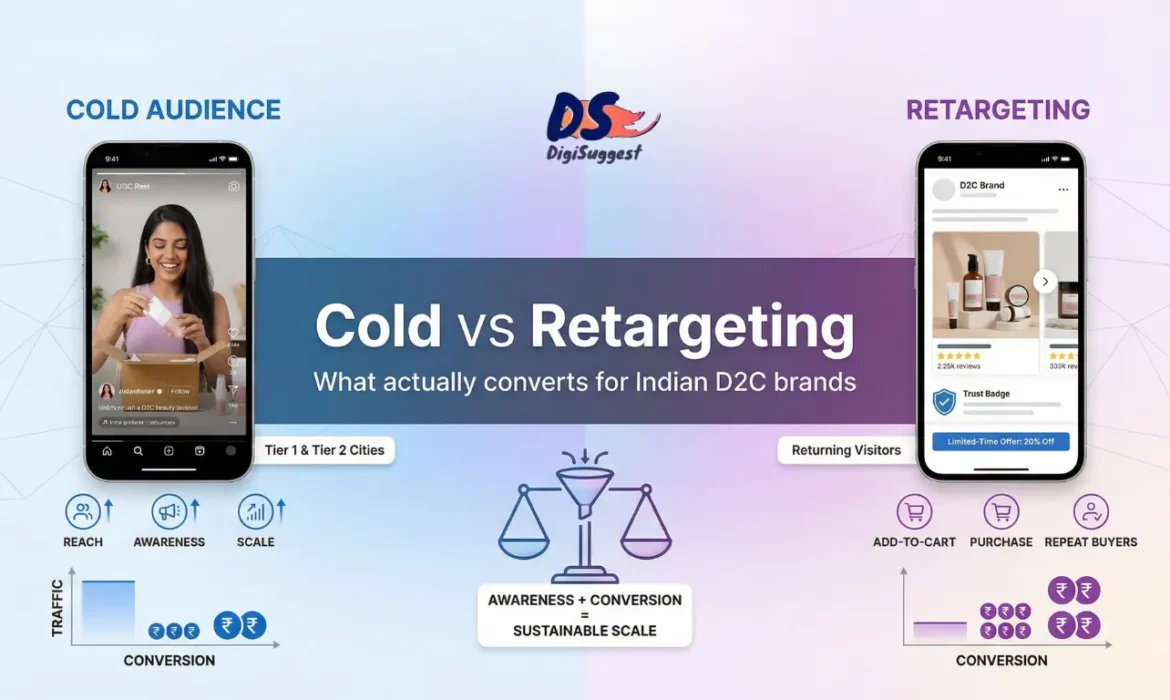
Cold Audience vs Retargeting Ads for Ecommerce – What Converts More?
The Most Misunderstood Question in Meta Ads
Every Indian ecommerce founder running Meta Ads eventually asks this:
- “Cold audience ads bilkul convert nahi karti”
- “Retargeting ads hi sale la rahi hain”
- “Cold ads pe paisa waste ho raha hai”
- “Sirf retargeting pe focus kar lein?”
This confusion is normal but dangerous. Because many brands take the wrong decision here:
👉 They pause cold ads and go all-in on retargeting.
For a few weeks, it feels great:
- CPA drops
- ROAS improves
- Sales look stable
Then suddenly:
- Frequency shoots up
- Retargeting stops converting
- CPA spikes again
- Scaling completely breaks
At this point founders say: “Meta Ads hi unstable hai.”
The truth is very different. 👉 Meta Ads are not unstable. Your funnel logic is incomplete.
To answer “what converts more?”, we must first answer: 👉 What is each ad type actually meant to do?
- Step 1: Stop Comparing Cold Ads & Retargeting Ads Directly
- Step 2: Understanding User Psychology
- Step 3: Why Retargeting Ads Always “Look Better”
- Step 4: Why Cold Ads Feel “Expensive” in India
- Step 5: The Real Job of Cold Ads in 2026
- Step 6: Cold Ads That Actually Work in 2026
- Step 7: Retargeting Ads – Where Sales Actually Close
- Step 8: The Ideal Cold → Retargeting Funnel
- Step 9: The Biggest Mistakes Indian Brands Make
- Step 10: Attribution Reality in 2026
- Step 11: How to Know If Cold Ads Are Working
- How Digi Suggest Builds Profitable Meta Funnels
Step 1: Stop Comparing Cold Ads & Retargeting Ads Directly
This is the first mindset shift you must make. Cold ads and retargeting ads:
- Talk to different people
- At different stages
- With different intent
- With different psychology
Comparing them only on:
- CPA
- ROAS
- Conversion rate
…is like comparing: 👉 A first date vs a marriage proposal.
Of course one converts more but both are necessary. You can read more in our beginners guide to Facebook Ads.
Step 2: Understanding User Psychology (Very Important)
Cold Audience Psychology
Cold users:
- Don’t know your brand
- Don’t trust you yet
- Don’t understand your product
- Are scrolling casually
Their internal thought: “Why should I stop for this?”
Cold ads are fighting:
- Low attention
- High skepticism
- Zero trust
Expecting immediate sales from cold ads is unrealistic in 2026.
Retargeting Audience Psychology
Retargeting users:
- Have seen your product
- Have visited your website
- Have engaged with your content
- Are already considering purchase
Their internal thought: “Should I buy now or later?”
Retargeting ads are not convincing strangers. They are pushing undecided buyers over the line.
That’s why:
- Conversion rate is higher
- CPA is lower
- ROAS looks amazing
Is your ROAS dropping unexpectedly?
We analyze your funnel logic to fix profitability.
Step 3: Why Retargeting Ads Always “Look Better” in Reports
This is where many Indian brands get fooled. Retargeting ads almost always show:
- 2x–5x better ROAS
- Much lower CPA
- Faster conversions
But here’s the hidden truth: 👉 Retargeting ads convert demand created by cold ads. If you are struggling with numbers, check why you might have low ROAS on Meta Ads in India.
If you turn off cold ads:
- Retargeting still works for a while
- Because demand already exists
Once that demand dries up:
- Retargeting collapses
- There are no new users to retarget
This is why many brands experience: “Retargeting pe hi focus kiya… phir sab band ho gaya.”
Step 4: Why Cold Ads Feel “Expensive” in India
Indian ecommerce has unique challenges that make cold ads look worse on paper.
Indian Buyer Behavior (Reality Check)
Indian users:
- Compare prices heavily
- Check reviews
- Delay purchases
- Prefer COD
- Come back multiple times before buying
Cold users often:
- Click today
- Browse
- Leave
- Google your brand later
- Buy after 3–10 days
If you rely on last-click attribution:
👉 Cold ads will look unprofitable.
But in reality:
👉 Cold ads started the journey.
Step 5: The Real Job of Cold Ads in 2026
Cold ads in 2026 are NOT meant to:
- Match retargeting ROAS
- Convert cheaply
- Close sales instantly
Cold ads are meant to:
- Introduce your brand
- Create brand awareness
- Build familiarity
- Seed future conversions
- Feed your retargeting pool
Cold ads are investment ads, not harvest ads. This is crucial for long-term customer retention.
Step 6: Cold Ads That Actually Work in 2026 (India-Focused)
Cold ads stopped working for many brands because: 👉 They’re still using 2021-style creatives. If your images aren't working, read why your ecommerce creatives are not converting.
What No Longer Works for Cold Audiences
- ❌ Plain product photos
- ❌ Heavy discount banners
- ❌ “Buy now” messaging
- ❌ Feature-only ads
- ❌ Over-polished brand videos
Indian cold audiences ignore these instantly.
What Works for Cold Audiences in 2026
Cold creatives must earn attention first. High-performing angles include:
1️⃣ Problem-First Storytelling
Example: “Most face serums fail on Indian skin because…”
2️⃣ Founder or Human-Face Ads
People trust people, not logos.
3️⃣ UGC & Honest Reviews
Raw videos outperform studio shoots. This is key for a solid Instagram ads strategy.
4️⃣ Myth-Busting & Education
Example: “Why cheap protein powders don’t work long-term”
5️⃣ Relatability Over Perfection
Hindi / Hinglish works extremely well.
👉 Cold ads sell interest and trust, not products.
Need high-converting creatives?
We create Storytelling & UGC ads that work for Indian audiences.
Step 7: Retargeting Ads – Where Sales Actually Close
Retargeting ads have one single job:
👉 Remove hesitation.
At this stage, users already know:
- What the product is
- Why they want it
They are stuck because of:
- Price doubt
- Trust issues
- Delivery concerns
- COD / returns confusion
Retargeting Ads That Convert in 2026
Winning retargeting creatives focus on:
- Customer testimonials
- Before/after proof
- FAQs (COD, returns, delivery)
- Comparison with alternatives
- Limited-time offers
- Scarcity & urgency
Retargeting ads don’t need creativity. They need clarity and reassurance. Proper checkout page optimization also helps convert this traffic.
Step 8: The Ideal Cold → Retargeting Funnel (2026)
Here’s what a healthy Meta Ads funnel looks like. Getting the right Meta ads budget allocation is critical here.
🔹 Stage 1: Cold Traffic (Top Funnel)
- Audience: Broad, Lookalikes, Interest-light
- Budget: 60–70%
- Creative Tone: Problem-based, Story-driven, Educational
- Goal: 👉 Fill the funnel with quality users, not force sales.
🔹 Stage 2: Warm Traffic (Middle Funnel)
- Audience: Video viewers, Instagram engagers, Website visitors
- Budget: 15–25%
- Creative Tone: Benefits, Social proof, Comparison
- Goal: 👉 Build trust and consideration.
🔹 Stage 3: Retargeting (Bottom Funnel)
- Audience: Product viewers, Cart abandoners, Initiate checkout
- Budget: 10–15%
- Creative Tone: Urgency, Reassurance, Offer clarity
- Goal: 👉 Convert efficiently.
👉 Brands that skip any layer break scalability.
Step 9: The Biggest Mistakes Indian Brands Make
❌ Expecting Cold Ads to Perform Like Retargeting
This leads to killing cold ads too early.
❌ Over-Retargeting Small Audiences
High frequency = ad blindness + irritation. Sometimes you need to know the difference between Meta ads vs boosting posts.
❌ Same Creative for All Audiences
Cold & retargeting users need different messaging.
❌ Measuring Cold Ads Only by ROAS
Cold ads should also be judged by:
- Retargeting pool growth
- Brand search increase (check your SEO vs Ads data)
- Assisted conversions
- Overall CPA improvement
Step 10: Attribution Reality in 2026
In 2026:
- Attribution is fragmented
- Users switch devices
- Users see multiple ads
- Conversion paths are longer
Cold ads often:
- Start the journey
- Retargeting ends it
If you credit only the last ad: 👉 You kill the ads that actually grow the business.
Step 11: How to Know If Cold Ads Are Working
Instead of asking: “Cold ads ka ROAS kya hai?”
Ask:
- Is retargeting CPA improving?
- Is overall revenue growing?
- Is brand recall increasing?
- Is funnel volume stable?
Cold ads work silently but powerfully. They are essential to scale ecommerce sales with Meta ads.
How Digi Suggest Builds Profitable Meta Funnels
At Digi Suggest, we don’t argue “cold vs retargeting”. We build full-funnel Meta Ads systems. Whether it is Google Ads or Facebook Ads, the funnel matters most.
Our Funnel-First Approach:
- Cold ads for demand creation
- Warm ads for trust building
- Retargeting for conversions
- Creative mapped to user intent
- Budget aligned with funnel role
🎯 Our goal is not isolated ROAS.
🎯 Our goal is scalable, predictable ecommerce growth using our ecommerce marketing services.
Fix Your Meta Ads Funnel
Book a free Meta Ads funnel audit and see exactly where your conversions are leaking.
Final Thought
Cold ads don’t fail. Retargeting doesn’t scale alone.
Profitable ecommerce brands in 2026:
- Respect both
- Design funnels
- Measure correctly
- Think long term
Cold ads create demand. Retargeting converts demand.
That’s how Meta Ads actually sell.
FAQs
Yes. Cold audience ads work in 2026, but their role is to create demand and fill the funnel, not to match retargeting ROAS immediately.
Retargeting ads convert better because users already know the brand and product. They require reassurance, not introduction.
No. Retargeting alone cannot scale in 2026 because audience size is limited and performance drops due to high frequency.
Cold ads should be measured by funnel growth, retargeting pool expansion, assisted conversions, and overall CPA improvement not only direct ROAS.
Most Indian ecommerce brands perform best with 60–70% budget on cold traffic and 10–15% on retargeting, adjusted by brand stage.


