
How Much Does a WordPress Website Cost in Delhi? (Price List)
When a business owner in Delhi decides to build a website, the first question is almost always: "Bhaiya, website banane ka kitna loge?" (Brother, how much will you charge for the website?)
It is a valid question. But getting a straight answer can be difficult.
You might call one freelancer in Laxmi Nagar who quotes ₹5,000 and then call a professional agency in Connaught Place or Gurugram that quotes ₹50,000 or even ₹1 Lakh+ for the seemingly same requirement.
Why is there such a huge difference? And what is the actual right price for a WordPress website in Delhi in 2026?
In this guide, Digi Suggest breaks down the real costs of building WordPress websites so you don't get overcharged or worse, scammed with a low-quality product.
The 3 Main Factors That Decide the Cost
Before we talk about numbers, you need to understand what you are paying for. A website is like a house; the cost depends on the size, the material and the interior design.
- Domain & Hosting (The Land): This is the rent you pay to keep your website on the internet.
- Domain (.com or .in): ₹800 - ₹1,200 per year.
- Hosting: Cheap shared hosting costs ₹3,000/year, but for a fast business site, you should budget ₹6,000 - ₹10,000 per year. Pro tip: Never compromise here, or your site will crash.
- Design & Development (The Construction): This is where the major cost difference lies.
- Template/Theme: Using a ready-made design (Cheaper).
- Custom Design: Designing from scratch to match your brand (Premium). Many businesses also opt for Shopify development for specific retail needs.
- Functionality (The Features): Do you just need a contact form? Or do you need a payment gateway, WhatsApp chat integration and automatic booking systems? More features = Higher cost. For example, a WhatsApp marketing setup can be a vital addition.
WordPress Website Price List in Delhi (2026 Estimates)
Here is a realistic breakdown of what you should expect to pay for professional WordPress Website Design Services in Delhi.
1. Basic Informational Website (The "Digital Visiting Card")
- Best for: Small shops, consultants, personal portfolios.
- Features: Home, About, Services, Contact page. Mobile responsive.
- Estimated Cost: ₹15,000 - ₹25,000
- Verdict: Good for establishing a basic presence, but might lack advanced lead-generation features.
Ready to launch your business online?
We build websites that sell, tailored for Delhi businesses.
2. Small Business / Corporate Website (The Standard)
- Best for: Private Limited companies, Service providers (CA, Lawyers, Doctors), Agencies.
- Features: Custom branding, SEO-optimized structure, fast loading speed, Social Media integration, Google Map, Inquiry forms.
- Estimated Cost: ₹30,000 – ₹60,000
- Verdict: This is the "sweet spot" for most businesses. You get a professional site that builds trust.
3. E-commerce Website (Online Store)
- Best for: Selling clothes, electronics, organic products, etc.
- Features: Product listing, Cart, Checkout, Payment Gateway (Razorpay/PhonePe), Inventory management, User login.
- Estimated Cost: ₹50,000 – ₹1,50,000+
- Verdict: Selling online is a serious business. You need a secure, high-performance site. If you plan to sell, also consider budgeting for Ecommerce SEO Services in Delhi to actually get customers to your store.
Warning: The "₹5000 Website" Trap
You will see ads on Facebook or get calls saying "Website banwaye matra ₹4999 mein!" (Get a website for just ₹4999!).
Savdhaan rahein (Be careful). Here is what usually happens with these ultra-cheap packages:
- Slow Servers: They put your site on the cheapest, slowest server. Google will hate it, and customers will leave because it takes 10 seconds to load. You can check how page speed affects sales here.
- Pirated Themes: They often use "nulled" (cracked) themes that contain viruses or malware. Your site could get hacked within a month.
- No Support: Once you pay, they disappear. If you want to change a photo later, they won't pick up your phone.
- Zero SEO: The site will look okay, but the internal code will be messy. It will never rank on Google without proper technical SEO.
Remember: Cheap is not always best. A website is a 3-5 year investment for your business. Don't risk your brand reputation to save a few thousand rupees.
Ongoing Costs: Maintenance & Marketing
Building the website is just step one. To make it profitable, you need to budget for:
- Annual Maintenance (AMC): Roughly 15-20% of the development cost. This covers plugin updates, security scans, and backups.
- SEO (Search Engine Optimization): A beautiful website is useless if no one visits it. You need SEO Services in Delhi to rank for keywords like "Best [Your Service] in Delhi". SEO is a monthly investment, usually starting from ₹15,000/month.
Want a Custom WordPress Design?
Get a website that matches your premium brand experience.
Custom vs. Template: Which One Do You Need?
- Go for Template (Pre-made design) if you have a tight budget (under ₹25k) and need the site live in 7-10 days.
- Go for Custom Design if you have a unique brand, specific feature requirements or want to beat competitors with a premium look. Check our portfolio to see the difference.
At Digi Suggest, we offer both. We tell you clearly what fits your budget. No hidden charges, no surprises.
Conclusion: Calculate Your ROI, Not Just Cost
Don't look at a website as an expense. Look at it as an employee.
If you spend ₹40,000 on a good WordPress website and it brings you 10 new clients worth ₹5 Lakh in a year, was it expensive? No. It was a profit machine. You can even boost results further with PPC services.
If you spend ₹5,000 on a bad website and it brings you 0 clients because it doesn't open on mobile phones, you just wasted ₹5,000.
Ready to get a transparent quote?
We assess your business needs first, then give you a price. Whether you are in South Delhi, Karol Bagh, or Noida, we are the Website Development Agency you can trust.
👉 Contact Digi Suggest Today for a Free Website Consultation!
FAQs (Frequently Asked Questions)
The difference is in quality. Low-cost providers often use pirated themes, slow hosting, and offer no support. Agencies charging fair rates provide custom design, security, mobile optimization, and dedicated support, ensuring your website actually helps your business grow.
WordPress itself is free, but you have to pay yearly for Domain and Hosting. Additionally, if you hire an agency for SEO Services in Delhi or regular maintenance, those will be monthly or annual costs.
A basic business website typically takes 7-10 days. A more complex e-commerce or custom website can take 3-4 weeks.
No, standard professional practice in Delhi is to pay 50% advance to start the project, and the remaining 50% after the website is completed and you are satisfied with the design.
Yes. At Digi Suggest, all our WordPress Website Design Services include 100% mobile responsive designs standard, so your site looks great on iPhones, Androids, and tablets.
Why Choose WordPress for Business Websites in Delhi?
If you are running a business in Delhi NCR whether it’s a boutique in South Ex, a manufacturing unit in Okhla or a startup in Gurugram, you know one thing for sure: Competition is tough (Competition tagda hai).
In 2026, having just "a website" is not enough. You need a website that works as your 24/7 salesman. It needs to be fast, secure and easy to manage. Most importantly, it needs to rank on Google so your customers can actually find you.
This is where WordPress comes into the picture.
Many business owners ask us, "Why should I use WordPress? Why not custom coding or other builders?"
Seedhi baat (Straight talk): WordPress powers over 43% of the entire internet. It is the number one choice for businesses in Delhi NCR, from small shops to big corporate firms.
In this blog, Digi Suggest will tell you exactly why WordPress is the best investment for your business and how it saves you time and money.
- Easy to Manage (No Coding Required)
- Google Loves WordPress (SEO Advantage)
- It Fits Every Budget (Pocket-Friendly)
- Scalability: From a Blog to an E-commerce Empire
- Professional Design That Builds Trust
- Security and Safety
- Huge Support Community
- Conclusion: Is WordPress Right for You?
- FAQs (Frequently Asked Questions)
Easy to Manage (No Coding Required)
Let’s be honest - you are a business owner, not a coder. You do not have time to call a developer every time you want to change a photo or update a phone number on your website.
The biggest advantage of WordPress is its simplicity.
If you can use Facebook or send an email, you can manage a WordPress website. It comes with a user-friendly dashboard where you can:
- Add new blog posts.
- Update your service prices.
- Upload new product images.
- Change your contact details.
Matlab, full control aapke haath mein (Meaning, full control is in your hands). You don't need to depend on an agency for small daily tasks. However, for the initial setup and professional look, it is always recommended to hire experts for WordPress Website Design Services in Delhi to ensure your foundation is strong.
Google Loves WordPress (SEO Advantage)
Delhi has millions of businesses. If someone searches for "Best interior designer in Delhi" or "Car repair in Noida" and your website is on Page 2 or 3 of Google, you are invisible.
WordPress is built in a way that search engines like Google really like. The code is clean, the structure is logical, and it makes it very easy for Google’s bots to crawl your site.
Why WordPress Wins at SEO:
- Fast Loading Speed: Google ranks fast websites higher. With the right optimization, WordPress sites fly.
- Mobile Optimized: Most of your customers in Delhi are searching on their phones while stuck in traffic or sitting in the metro. WordPress themes are mobile-responsive by default.
- SEO Plugins: Tools like Yoast SEO or RankMath guide you to write better content. They tell you exactly where to put your keywords.
If you are serious about ranking #1, combining a WordPress site with professional SEO Services in Delhi is the ultimate formula for success.
Ready to launch your business online?
We build websites that sell, tailored for Delhi businesses.
It Fits Every Budget (Pocket-Friendly)
Comparison karein toh (If we compare), a custom-coded website (HTML/PHP) can cost you lakhs of rupees and take months to build.
WordPress is open-source software. This means the core software is free. You only pay for:
- Hosting & Domain (Annual cost).
- Theme & Plugins (One-time or annual).
- Development Fee (If you hire an agency).
For a small business or a startup in Delhi, this is huge. You can get a high-quality, professional-looking website at a fraction of the cost of custom development. Whether you have a budget of Rs.15,000 or Rs.1,50,000, WordPress scales with you. As your business grows, your website can grow too.
Scalability: From a Blog to an E-commerce Empire
Maybe today you just want a simple brochure website to show your services. But what about next year?
- Do you want to start selling products online?
- Do you want to add a booking system for appointments?
- Do you want to sell online courses?
With WordPress, you don't need to rebuild your website from scratch. You just add "Plugins."
For example, by installing the WooCommerce plugin, you can turn your simple business site into a fully functional online store. You can accept payments via UPI, Paytm, Razorpay, and manage inventory easily. If you are planning to sell products, check out our specialized Ecommerce SEO Services in Delhi to see how we help online stores get more sales.
Professional Design That Builds Trust
In Delhi’s market, "Jo dikhta hai, wo bikta hai" (What looks good, sells).
Your website is often the first interaction a customer has with your brand. If it looks old, broken, or unprofessional, they will immediately go to your competitor.
WordPress offers thousands of "Themes" (designs). But using a free theme often looks generic. To stand out, you need a Custom WordPress Design. This ensures your website matches your brand colors, logo, and unique style.
Want a Custom WordPress Design?
Get a website that matches your premium brand experience.
Security and Safety
There is a myth that WordPress sites get hacked easily. Yeh sach nahi hai (This is not true).
WordPress is very secure if maintained correctly. Most hacking happens because people use weak passwords (like "admin123") or don't update their plugins.
To keep your business site safe:
- Use an SSL Certificate (that little lock icon in the browser).
- Install security plugins like Wordfence.
- Take regular backups.
When you work with a professional Website Development Agency, they handle these security protocols for you, so you can sleep peacefully knowing your business data is safe.
Huge Support Community
Since WordPress is used by millions, help is always available. If you ever get stuck, or if your website faces an error, it is very easy to find a solution. There are thousands of developers in Delhi who know WordPress inside out. You will never be "locked in" with one developer who disappears with your code. The platform is universal.
Conclusion: Is WordPress Right for You?
If you want a website that is:
✓ Easy to update (Self-manageable)
✓ SEO Friendly (Ranks on Google)
✓ Budget-friendly (Value for money)
✓ Scalable (Grows with your business)
...then WordPress is the best choice for your Delhi-based business.
Don't waste money on expensive custom coding or cheap, limited website builders that you don't own. Invest in a platform that gives you full ownership and control.
At Digi Suggest, we specialize in creating stunning, high-performance WordPress websites tailored for Delhi businesses. We don't just design; we build websites that sell.
Want Lower CPA Without Increasing Spend?
👉 Get a Quote for WordPress Website Design Services in Delhi Today!
FAQs (Frequently Asked Questions)
Yes, absolutely. WordPress is the most cost-effective and scalable platform for small businesses. It allows you to start with a low budget and add features like e-commerce or booking systems as your business grows. Unlike Wix or Shopify, you have full ownership of your site.
The cost depends on your requirements. A basic business informational website starts from a lower range, while a custom-designed e-commerce store costs more. WordPress is generally cheaper than custom HTML/PHP development. Contact us for a custom quote on WordPress Website Design Services in Delhi.
Yes! WordPress has a very user-friendly dashboard. You can easily edit text, upload images, and publish blog posts without writing a single line of code. We provide a brief training session to help you manage daily updates easily.
Yes, WordPress is highly SEO-friendly. It has clean code and powerful plugins like Yoast SEO that help you rank higher. However, ranking #1 requires a good strategy. We recommend combining your new site with our SEO Services in Delhi for the best results.
Yes, WordPress is secure if maintained properly. We ensure your site is safe by installing SSL certificates, security plugins and regular updates. Avoiding weak passwords and keeping plugins updated is key to preventing hacking attempts.

How We Reduced Cost Per Purchase by 40% for an Ecommerce Brand
Client Background
Client: Avry1 Pretty Beauty Oils
Industry: Beauty & Skincare
Business Model: D2C Ecommerce
Market: India
Avry1 Pretty Beauty Oils is an Indian D2C skincare brand selling products crafted with natural beauty oils for sensitive skin. It’s a science-backed, research-driven collaboration of top dermatologists, cosmetic chemists, and skin experts, all proudly associated with leading dermatology societies and associations in India.
The brand had already crossed the “initial traction” phase and was actively running Meta Ads to drive sales. Orders were coming in but profitability was under pressure.
- The Situation Before Digi Suggest
- The Real Problem: Ads Were Carrying All the Load
- Why Simple Bid or Budget Changes Wouldn’t Work
- Digi Suggest’s CPA Reduction Framework
- Step 1: Funnel & Drop-Off Analysis
- Step 2: CRO Fixes That Directly Impact CPA
- Step 3: Creative & Messaging Reset
- Step 4: Smarter Funnel-Based Ad Structure
- Step 5: Budget Reallocation (Not Increase)
- Results: 40% Reduction in Cost Per Purchase
- Key Learnings for Ecommerce Brands
- Final Thought
The Situation Before Digi Suggest
When the brand approached us, they were not struggling with sales volume.
They were struggling with efficiency.
Key Problems
- Cost per purchase was increasing month over month
- Ads worked initially, then performance dropped
- Scaling budgets resulted in lower ROAS
- Too much dependence on discounts
- Funnel drop-offs were ignored
In the founder’s words:
“Sales aa rahi hain, par margin nahi bach raha.”
This is a dangerous stage for any ecommerce business.
The Real Problem: Ads Were Carrying All the Load
Most ecommerce brands assume:
“CPA zyada hai toh ads ka problem hai.”
Our audit showed something different.
👉 The ads were not the main issue.
The funnel was leaking money. Specifically:
- Cold traffic was sent directly to sales pages
- Creatives focused on discounts, not value
- Product pages lacked reassurance
- Checkout friction increased drop-offs
- Retargeting was underutilized
This caused:
- Low intent conversion
- Wasted ad spend
- Rising CPAs
Why Simple Bid or Budget Changes Wouldn’t Work
Many agencies would try:
- Lower bids
- Change objectives
- Switch audiences
- Reduce budget
But these are temporary fixes.
Without fixing the funnel:
👉 CPA always climbs back up.
So instead of “fixing ads”, we fixed what ads were sending traffic to.
Is Your Ecommerce CPA Climbing?
Don't just fix the ads, fix the funnel.
Digi Suggest’s CPA Reduction Framework
At Digi Suggest, we reduce CPA using a three-layer approach:
- Better intent traffic
- Higher on-site conversion rate
- Stronger retargeting efficiency
This project followed the same framework.
Step 1: Funnel & Drop-Off Analysis
We mapped the entire user journey:
Ad → Landing page → Product page → Cart → Checkout
Key Observations
- High bounce rate from cold ads
- Add-to-cart rate was decent
- Checkout abandonment was high
- Mobile users dropped more than desktop
This indicated:
👉 Interest existed, confidence did not.
Step 2: CRO Fixes That Directly Impact CPA
We implemented high-impact CRO improvements.
Product Page Optimization
- Clear benefits instead of generic claims
- Ingredient & usage clarity
- FAQs addressing buyer doubts
- Reviews and reassurance near CTA
- Reduced form friction
- Clear COD availability
- Transparent pricing
- Trust & security messaging
These changes:
- Increased checkout completion
- Reduced wasted ad clicks
👉 Better conversion = lower CPA.
Step 3: Creative & Messaging Reset
The brand’s ads were:
- Over-focused on discounts
- Selling too early
- Attracting low-intent buyers
We shifted strategy to:
New Creative Approach
- Problem-first storytelling
- Skin concern–based messaging
- Education-led creatives
- UGC-style content
This filtered out:
- Window shoppers
- Discount-only buyers
And attracted: 👉 Higher intent users.
Step 4: Smarter Funnel-Based Ad Structure
We restructured Meta Ads into:
- Cold traffic (education & awareness)
- Warm traffic (proof & benefits)
- Retargeting (reassurance & offers)
Each stage had:
- Different creatives
- Different messaging
- Different expectations
This reduced pressure on cold ads to convert immediately.
Step 5: Budget Reallocation (Not Increase)
Instead of increasing spend, we:
- Cut wasteful campaigns
- Shifted budget to high-performing funnels
- Focused on consistency over scale
👉 CPA dropped without aggressive scaling.
Stop Wasting Budget on Low-Intent Clicks
Let's optimize your budget for profitability.
Results: 40% Reduction in Cost Per Purchase
After implementing these changes, the brand achieved:
📉 Key Outcomes
- 40% reduction in cost per purchase
- Improved ROAS across Meta Ads
- More stable performance after 30 days
- Reduced dependency on heavy discounts
- Higher-quality customer acquisition
Most importantly:
👉 Profitability improved without increasing ad spend.
Why This CPA Reduction Was Sustainable
This was not a short-term trick. CPA stayed lower because:
- Funnel conversion improved
- Low-intent traffic was filtered out
- Trust reduced hesitation
- Retargeting became more effective
👉 The overall system improved not just numbers.
Key Learnings for Ecommerce Brands
If your ecommerce brand is facing high CPA, learn this:
1️⃣ High CPA Is Often a Funnel Problem - Not just an ads problem.
2️⃣ Discounts Attract Expensive Customers - They convert, but don’t scale profitably.
3️⃣ CRO Reduces CPA Automatically - Better conversion = cheaper acquisition.
4️⃣ Ads Work Best When They Support the Funnel - Not when they replace it.
Who This Case Study Is For
This strategy is ideal for brands that:
- Are already running ads
- Get sales but low margins
- Want profitable scaling
- Are tired of unstable ROAS
If this sounds familiar then this approach works.
How Digi Suggest Reduces CPA for Ecommerce Brands
At Digi Suggest, we don’t chase vanity metrics. We focus on:
- Funnel efficiency
- Conversion improvement
- Intent-based traffic
- Sustainable performance
This case study reflects how we approach profitable growth.
🚀 Ads Running but Profit Not Growing?
If your ecommerce ads are generating sales but your cost per purchase is too high, the problem is rarely just bidding.
👉 Want similar results for your ecommerce brand? Talk to Digi Suggest.
👉 Get a free CPA & funnel audit and uncover where your money is leaking.
Want Lower CPA Without Increasing Spend?
Final Thought
You don’t reduce CPA by:
- Spending less
- Testing randomly
- Chasing hacks
You reduce CPA by:
- Fixing the funnel
- Improving trust
- Aligning ads with user intent
This case study proves one thing clearly: When funnels improve, CPA drops naturally.
FAQs
No. High CPA is often caused by funnel leaks, weak trust signals or checkout friction. It is not a just targeting or bidding issues.
Yes. Improving conversion rates and filtering low-intent traffic naturally lowers CPA without spending more.
Short-term yes, long-term no. Heavy discounts attract low-quality buyers and hurt profitability.
Meaningful CPA reduction usually happens within 4–8 weeks after funnel and CRO improvements are implemented.
Not if the funnel, creatives, and retargeting system are maintained and optimized continuously.

From Zero to Scalable Sales: Ecommerce Growth Case Study
Client Background
- Client: Avry1 Pretty Beauty Oils
- Industry: Beauty & Skincare
- Business Model: D2C Ecommerce
- Market: India
Avry1 Pretty Beauty Oils is a homegrown Indian skincare brand focused on natural beauty oils and daily skincare solutions. The products were well-formulated, competitively priced and suitable for Indian skin types.
However, when the brand approached Digi Suggest, it was at a very early ecommerce stage.
- The Situation Before Digi Suggest
- The Core Challenge: Starting Without Data or Trust
- Why Random Ads Would Have Failed
- Digi Suggest’s Zero-to-Scale Philosophy
- Phase 1: Foundation & Funnel Setup
- Phase 2: Controlled Traffic Introduction
- Phase 3: Funnel Learning & CRO Feedback Loop
- Phase 4: Retargeting & Trust Reinforcement
- Phase 5: Scaling What Worked
- Results: From Zero to Predictable Sales
- Why This Growth Was Sustainable
- Key Learnings for New Ecommerce Brands
- Who This Case Study Is For
- How Digi Suggest Helps New D2C Brands Grow
The Situation Before Digi Suggest
At the time of onboarding, Avry1 Pretty had:
- A newly launched ecommerce website
- Very limited brand awareness
- No predictable online sales
- No historical ad or funnel data
- No clear growth roadmap
Sales were:
- Occasional
- Inconsistent
- Mostly driven by personal networks
In the founder’s words:
“Kabhi order aa jata hai… par system nahi hai.”
This is the most fragile phase of any D2C brand.
The Core Challenge: Starting Without Data or Trust
Unlike established brands, Avry1 Pretty faced three simultaneous challenges:
- ❌ No brand trust
- ❌ No traffic system
- ❌ No conversion data
Most agencies struggle at this stage because:
- There’s nothing to optimize yet
- Ads don’t have learning signals
- Funnels are untested
Yet this is where strategy matters the most.
Struggling with low sales on your new D2C website?
Why Random Ads Would Have Failed
Running ads aggressively at this stage would have resulted in:
Why?
👉 Because users don’t trust unknown skincare brands easily especially in India.
Skincare requires:
- Proof
- Safety perception
- Emotional comfort
So, we decided not to chase sales immediately.
Digi Suggest’s Zero-to-Scale Philosophy
At Digi Suggest, we follow a simple rule for early-stage brands:
First build trust → then build traffic → then scale sales.
This project was executed in phases, not shortcuts.
Phase 1: Foundation & Funnel Setup (Critical)
Before spending on ads, we focused on making the website conversion-ready.
What We Fixed First
Website Clarity
- Clear product positioning
- Simple messaging (what + why + for whom)
- Focus on Indian skincare needs
Trust Elements
- Ingredient transparency
- Usage clarity
- Return & delivery messaging
- Brand story positioning
Product Pages
- Benefits over claims
- Simple routines explained
- FAQs addressing buyer doubts
👉 The goal was confidence, not hype.
Phase 2: Controlled Traffic Introduction
Once the website was ready, we introduced traffic slowly and strategically.
Meta Ads Strategy (Initial Phase)
Instead of direct “Buy Now” ads, we used:
- Education-led creatives
- Problem-solution storytelling
- Skin concern–based messaging
This helped:
- Warm audiences
- Create familiarity
- Avoid instant rejection
Budgets were kept intentionally low to:
- Gather learning
- Identify intent
- Reduce burn
Phase 3: Funnel Learning & CRO Feedback Loop
As traffic came in, we closely monitored:
- Scroll depth
- Product page engagement
- Add-to-cart behavior
- Checkout drop-offs
This data guided:
- Messaging changes
- Creative refinement
- Page-level improvements
👉 CRO started before scale.
Phase 4: Retargeting & Trust Reinforcement
Once people had:
- Visited the site
- Engaged with products
- Watched content
We introduced:
- Retargeting ads
- Testimonials & social proof
- Usage-based creatives
- Offer-led messaging (limited)
This converted:
- Curious visitors into buyers
- Hesitant users into first-time customers
Phase 5: Scaling What Worked (Not Everything)
Only after identifying:
- Best-performing creatives
- Most converting products
- Strong audience signals
Did we begin scaling budgets.
Scaling was:
- Gradual
- Data-backed
- Conversion-led
👉 No sudden budget jumps. No guesswork.
Ready to move from random orders to a scalable system?
Results: From Zero to Predictable Sales
Within a few months of systematic execution, Avry1 Pretty achieved:
📈 Key Outcomes
- Consistent daily orders
- Stable cost per purchase
- Repeat customers starting to appear
- Clear understanding of winning products & messages
- A scalable ecommerce foundation
Most importantly:
👉 Sales were no longer random.
The brand moved from:
“Kabhi order aa jata hai”
To:
“We know what brings orders.”
Why This Growth Was Sustainable
This success did not come from:
- ❌ Viral reels
- ❌ Heavy discounts
- ❌ Influencer hype
It came from:
- Funnel-first thinking
- Trust-led marketing
- CRO-supported ads
- Controlled scaling
The brand was now ready for:
- Higher budgets
- More channels
- Long-term growth
Key Learnings for New Ecommerce Brands
If you’re starting a D2C brand, this case study proves:
1️⃣ Don’t Rush Ads - Ads amplify weaknesses if the funnel isn’t ready.
2️⃣ Trust Comes Before Conversion - Especially in skincare and beauty.
3️⃣ Data Is Built, Not Given - Early-stage brands must earn data patiently.
4️⃣ Systems Beat Luck - Predictable sales come from structure, not chance.
Who This Case Study Is For
This approach is ideal for brands that:
- Are newly launched
- Have limited budgets
- Want sustainable growth
- Are serious about ecommerce
If you’re at zero or early stage, this is the right way forward.
How Digi Suggest Helps New D2C Brands Grow
At Digi Suggest, we specialize in:
- Launch-stage ecommerce strategy
- Funnel & CRO foundations
- Ads that don’t burn budgets
- Long-term scalable systems
This case study is a blueprint not an exception.
Want to Build Scalable Sales From Scratch?
Get a free launch-stage ecommerce audit and build growth the right way.
Final Thought
Every successful ecommerce brand starts with uncertainty. The difference is:
- Some brands gamble on ads
- Others build systems
This case study shows that:
With the right funnel and strategy, zero can become scalable.
FAQs
Yes. When growth is phased correctly starting with trust, CRO, and controlled traffic brands can scale without heavy losses.
Running ads without trust and funnel readiness leads to high CPA and poor learning. Early-stage brands need foundation first.
CRO is critical. Without it, early traffic does not convert, making ads inefficient and misleading.
Yes. This strategy is specifically designed to avoid budget burn and build predictable growth gradually.
Only after identifying winning products, messages, and stable conversion behavior.
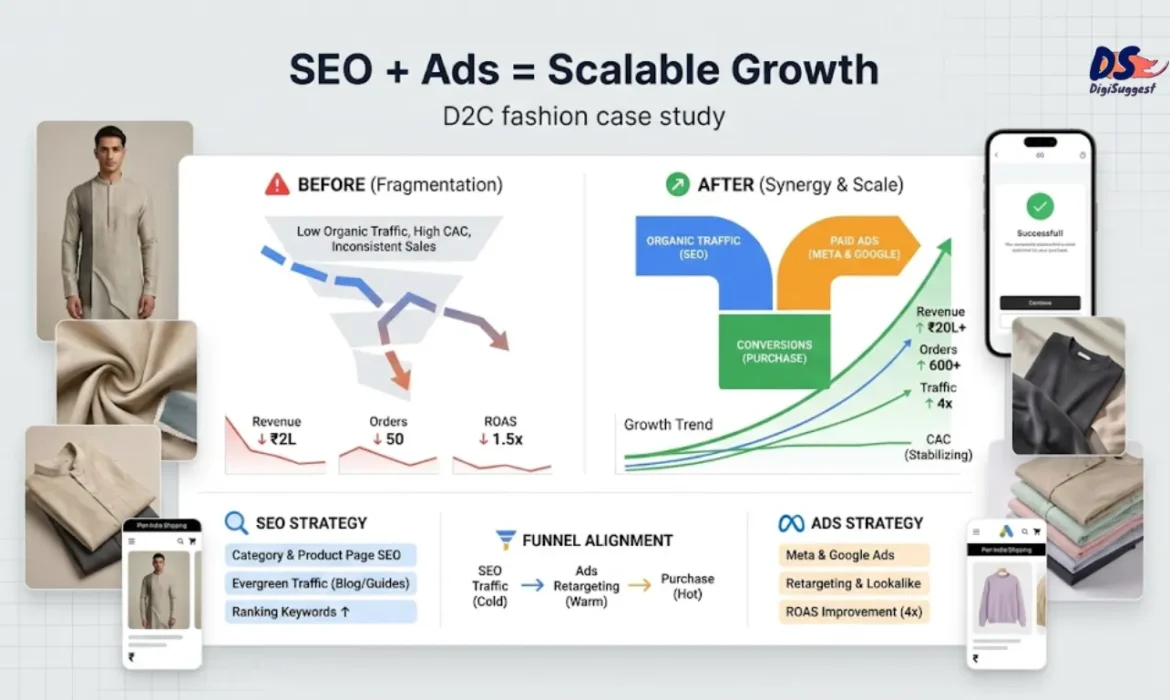
SEO + Ads Strategy That Worked for a D2C Fashion Brand (Case Study)
Client: Omission Collection
Industry: D2C Fashion & Apparel
Business Model: Direct-to-Consumer (Ecommerce)
Primary Market: India
Omission Collection is a modern D2C fashion brand catering to style-conscious Indian consumers. The brand had strong visual appeal, good product quality, and an active Instagram presence.
However, despite consistent effort, online sales were not scaling predictably.
Struggling to Scale Your D2C Fashion Brand?
- The Situation Before Digi Suggest
- The Core Problem (What Most Fashion Brands Miss)
- Why Their Earlier Strategy Was Not Sustainable
- Digi Suggest’s Core Insight
- Step 1: Demand & Search Opportunity Audit
- Step 2: SEO Foundation for Fashion Ecommerce
- Step 3: Paid Ads Repositioned (Not Replaced)
- Step 4: Funnel Alignment Between SEO & Ads
- Step 5: CRO & Conversion Support
- Results: Stable & Scalable Growth
- Key Takeaways for D2C Fashion Brands
- Final Thought
The Situation Before Digi Suggest
When Omission Collection approached us, the brand was already doing many things “right” on the surface:
- Regular Instagram posting
- Influencer collaborations
- Active Meta Ads campaigns
- Decent website traffic
Yet, growth felt stuck.
Core Challenges
- Heavy dependence on Instagram & Meta Ads
- Sales fluctuated month to month
- Rising cost per purchase
- No meaningful organic traffic
- No long-term traffic asset
In short: Sales existed, but stability and scalability did not.
The Core Problem (What Most Fashion Brands Miss)
Most D2C fashion brands believe: “Fashion sells on Instagram - SEO is not important.”
That assumption is costly.
Our audit revealed that:
- All growth depended on paid traffic
- Users had no organic discovery path
- Search demand existed, but the brand wasn’t capturing it
- Ads were doing both awareness and conversion work
👉 Paid ads were being forced to do everything.
This is why CPA kept increasing.
Why Their Earlier Strategy Was Not Sustainable
Before working with us, the brand relied on:
- Instagram creatives
- Influencer traffic
- Conversion-focused ads
This failed to scale because:
- Cold traffic was expensive
- There was no organic trust layer
- Users often researched but didn’t find the brand on Google
- Ads had to repeatedly introduce the brand from scratch
👉 Without SEO, every sale was rented - not owned.
Digi Suggest’s Core Insight
At Digi Suggest, we strongly believe:
SEO avoids dependency.
Ads create velocity.
Together, they create scale.
So, instead of choosing between SEO or ads, we built a hybrid growth system.
Step 1: Demand & Search Opportunity Audit
We started by identifying:
- How people search for fashion products
- Category-level search intent
- Non-brand vs brand keywords
- Comparison & style-based queries
Key Insight
Users were:
- Searching for outfit types
- Comparing styles
- Looking for alternatives
- Researching before buying
But Omission Collection was:
- Invisible in search results
- Dependent only on social discovery
This was a massive missed opportunity.
Step 2: SEO Foundation for Fashion Ecommerce
We built an SEO strategy focused on purchase intent, not vanity traffic.
What We Did
Category & Collection Page SEO
- Optimized category pages for style-based searches
- Improved on-page structure and internal linking
- Clear descriptions matching buyer intent
Product Page SEO
- Search-friendly titles & descriptions
- Structured content for discovery
- Better indexation & crawlability
Content That Supports Conversion
- Fashion-focused informational content
- Styling & category education
- Internal links to product collections
👉 SEO was designed to support sales, not just traffic.
Step 3: Paid Ads Repositioned (Not Replaced)
Once SEO foundation was laid, we restructured ads.
Meta Ads Changes
- Reduced pressure on cold ads
- Focused Meta Ads on discovery + retargeting
- Used creatives aligned with search intent
Google Ads Changes
- Focused on high-intent search terms
- Protected brand searches
- Avoided overlapping with organic rankings
👉 Ads now worked with SEO, not against it.
Step 4: Funnel Alignment Between SEO & Ads
A key reason this strategy worked was message alignment.
- SEO users landed on informative, trust-building pages
- Ads users landed on conversion-ready pages
- Retargeting worked across both channels
This created:
- Better user experience
- Higher trust
- Lower resistance to purchase
Step 5: CRO & Conversion Support
To support both SEO and Ads traffic, we made light but impactful CRO improvements:
- Clear value proposition on key pages
- Strong social proof placement
- Mobile-first usability improvements
- Clear delivery & return messaging
👉 SEO traffic converted better.
👉 Ads traffic converted cheaper.
Build a Sustainable Growth System for Your Brand.
Results: Stable & Scalable Growth
Within a few months of implementing this hybrid strategy, Omission Collection saw:
📈 Key Outcomes
- Significant increase in organic traffic
- Reduced dependency on Meta Ads alone
- More consistent month-on-month sales
- Improved ROAS across paid campaigns
- Better predictability in revenue planning
Most importantly: 👉 Growth became less volatile and more controllable.
Why This Strategy Worked for a Fashion Brand
This approach succeeded because:
- SEO captured existing demand
- Ads created new demand
- Trust was built through search visibility
- Paid ads didn’t carry the full burden
- Funnel was aligned across channels
Fashion ecommerce doesn’t fail because SEO doesn’t work. It fails when SEO is ignored.
Key Takeaways for D2C Fashion Brands
If you run a fashion ecommerce brand, learn this:
1️⃣ Instagram Alone Is Not a Growth Strategy - It’s a channel, not a foundation.
2️⃣ SEO Builds Trust Before Purchase - Users trust brands they can find on Google.
3️⃣ Ads Scale Faster When SEO Exists - Lower CPA, better ROAS, stronger retargeting.
4️⃣ Long-Term Brands Own Traffic - Short-term brands rent it.
Who This Case Study Is For
This strategy is ideal for D2C fashion brands that:
- Depend heavily on Meta Ads
- See rising CPAs
- Want predictable growth
- Are building a long-term brand
If that’s you then this model is proven.
How Digi Suggest Helps D2C Brands Scale Sustainably
At Digi Suggest, we don’t push one channel. We build:
- SEO foundations
- Performance ad systems
- Funnel alignment
- CRO-backed growth
This case study shows how balanced growth beats aggressive tactics.
🚀 Struggling With Unstable Ecommerce Sales?
Want SEO + Ads Working Together? Get a free growth audit.
Final Thought
D2C fashion growth doesn’t come from choosing SEO or Ads.
It comes from connecting them intelligently.
This case study proves one thing clearly:
When SEO builds trust and Ads create momentum, ecommerce growth becomes sustainable.
FAQs
Yes. Fashion brands benefit from SEO by capturing high-intent searches, comparison traffic, and category-level demand that ads alone cannot sustain.
Instagram creates demand, but SEO captures existing demand. Relying only on ads makes growth expensive and unstable long-term.
Initial SEO improvements can show impact in 3–6 months, while long-term compounding benefits grow over time.
Yes. SEO improves brand trust and awareness, which often leads to lower CPAs and better ROAS for paid ads.
Yes, but execution differs. New brands need stronger trust-building and controlled ad spend alongside SEO foundations.
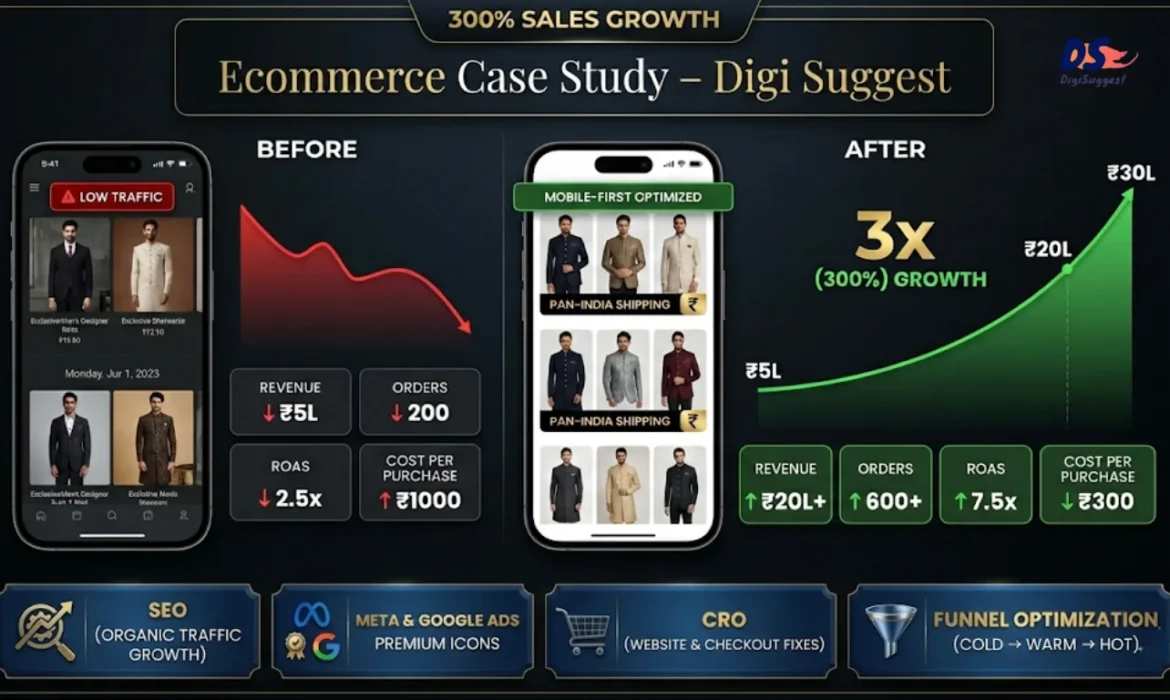
How Digi Suggest Increased Ecommerce Sales by 300% (Real Case Study)
Client Background
- Client: Bharat Reshma
- Industry: Ethnic wear & traditional textiles
- Business Model: D2C ecommerce
- Market: India (pan-India shipping)
Bharat Reshma is a bollywood inspired Indian brand selling premium traditional and ethnic men's wear online. The brand had a strong offline reputation and high-quality products, but ecommerce performance did not reflect that belief.
The founders believed in the product, but ecommerce performance did not reflect that belief.
- The Situation Before Digi Suggest
- The Real Problem (What Most Agencies Miss)
- Why Their Earlier Efforts Failed
- Digi Suggest’s Growth Philosophy for This Project
- Step 1: Funnel & Website Audit (Foundation)
- Step 2: CRO & Website Optimization
- Step 3: Paid Ads Strategy (After Funnel Fix)
- Step 4: Continuous Optimization (Scaling Phase)
- Results: 300% Increase in Ecommerce Sales
- Key Learnings for Other Ecommerce Brands
- How Digi Suggest Helps Ecommerce Brands Scale
The Situation Before Digi Suggest
When Bharat Reshma approached us in October 2021, their ecommerce store had:
- Website traffic from ads and no organic traffic at all
- Regular Instagram activity
- Active Google & Meta Ads campaigns
Yet, results were disappointing.
Key Problems Observed
- Online sales were inconsistent and stagnant
- Paid ads were running, but ROAS was unstable
- Cost per purchase kept increasing
- Traffic was coming in, but conversion rate was low
- Scaling ads resulted in higher spend, not higher profit
In simple words:
Traffic existed. Sales did not scale.
This is a very common situation for Indian ecommerce brands.
Struggling with high traffic but low sales?
The Real Problem (What Most Agencies Miss)
At first glance, many agencies would say:
- “Increase ad budget”
- “Run more creatives”
- “Try influencers”
But after auditing the account and website, the real problem became clear:
👉 Bharat Reshma did not have a scalable ecommerce funnel.
More specifically:
- Ads were sending traffic without intent alignment
- Homepage messaging was unclear for new users
- Product pages lacked strong trust signals
- Checkout experience had friction for first-time buyers
- CRO was completely missing from the growth strategy
This meant:
Even good traffic could not convert consistently.
Why Their Earlier Efforts Failed
Before working with us, the brand had already tried:
- Increasing Meta Ads budgets
- Running discount-based campaigns
- Promoting products on Instagram
But these approaches failed because:
- Discounts attracted price-only buyers
- Ads were not aligned with landing pages
- Website experience did not support decision-making
- Checkout drop-offs were high
👉 The brand was trying to scale traffic before fixing conversions.
Digi Suggest’s Growth Philosophy for This Project
At Digi Suggest, we follow one rule:
Never scale traffic before fixing the funnel.
So instead of jumping straight into aggressive advertising, we rebuilt the entire ecommerce growth system.
Our strategy had four clear pillars:
- Funnel clarity
- CRO & trust building
- Performance-focused ads
- Scalable optimization framework
Step 1: Funnel & Website Audit (Foundation)
We started with a full funnel audit, not just ads.
What We Analyzed
- User behavior (entry pages, exits, drop-offs)
- Homepage clarity & trust signals
- Product page content & structure
- Checkout friction points
- Mobile experience (critical for India)
Key Insights
- Homepage did not clearly communicate why the brand was different
- New users did not immediately trust the brand
- Product pages focused more on product description than benefits
- Checkout lacked reassurance for first-time buyers
This explained the low conversion rate.
Step 2: CRO & Website Optimization
Instead of redesigning everything, we applied high-impact CRO fixes.
Homepage Optimization
- Clear value proposition above the fold
- Trust signals (heritage, quality, authenticity)
- Strong primary CTA guiding users to products
Product Page Optimization
- Benefit-focused product descriptions
- Real product imagery and use-case clarity
- Clear delivery, return, and COD information
- Social proof placement near CTAs
Checkout Optimization
- Reduced friction in form fields
- Clear COD and delivery messaging
- Reassurance near payment buttons
👉 These changes alone improved user confidence and flow.
Need a high-impact CRO Audit for your store?
Step 3: Paid Ads Strategy (After Funnel Fix)
Only after fixing the website funnel did we scale ads.
Meta Ads Strategy
- Shifted from discount-only creatives to story + product value creatives
- Focused on problem-awareness for cold audiences
- Used retargeting to close warm users
- Controlled budget scaling to avoid CPA spikes
Google Ads Strategy
- Focused on high-intent search & shopping traffic
- Optimized product feed for relevance and clarity
- Avoided wasteful keywords and placements
👉 Ads were now sending ready-to-convert traffic to a conversion-ready website.
Step 4: Continuous Optimization (Scaling Phase)
Scaling was done gradually and systematically. We:
- Monitored conversion rates closely
- Identified winning creatives and messages
- Removed underperforming traffic sources
- Improved ROAS by improving conversion efficiency, not just bids
This allowed the brand to scale without losing profitability.
Results: 300% Increase in Ecommerce Sales
Within a few months of implementing this strategy, Bharat Reshma achieved:
📈 Key Outcomes
- 300% growth in online sales
- Significant improvement in conversion rate
- Lower cost per purchase despite higher volume
- More predictable and stable revenue
- Improved confidence in scaling ads
Importantly: 👉 Growth was sustainable, not a short-term spike.
Why This Strategy Worked
This growth did not happen because of:
- ❌ One viral ad
- ❌ Massive discounts
- ❌ Aggressive budget increases
It worked because:
- The funnel was fixed first
- Trust was built before selling
- CRO supported paid traffic
- Scaling was controlled and data-driven
In short: We fixed the journey, not just the traffic.
Key Learnings for Other Ecommerce Brands
If you’re an ecommerce founder, this case study highlights some important lessons:
1️⃣ Traffic Does Not Equal Sales - If your website doesn’t convert, traffic only increases losses.
2️⃣ CRO Is Not Optional - Conversion optimization is the foundation of scaling.
3️⃣ Ads Work Best After Funnel Fixes - Paid ads amplify what already exists - good or bad.
4️⃣ Indian Buyers Need Trust First - Clear messaging, reassurance, and transparency matter more than hype.
Who This Case Study Is Relevant For
This approach works best for ecommerce brands that:
- Have good products but low online sales
- Are spending on ads but not seeing returns
- Want sustainable growth, not short-term spikes
- Are serious about building a brand, not just running offers
If this sounds like your business this strategy is replicable.
How DigiSuggest Helps Ecommerce Brands Scale
At Digi Suggest, we don’t promise hacks or shortcuts. We focus on:
- Ecommerce Funnel optimization
- CRO-driven growth
- Ads aligned with user intent
- Long-term profitability
This case study is not an exception. It’s the result of a repeatable growth system.
🚀 Struggling to Scale Ecommerce Sales?
If your store gets traffic but not sales, you need a better funnel.
Final Thought
Ecommerce growth doesn’t come from spending more. It comes from fixing what stops users from buying.
This case study proves one thing clearly: When traffic, CRO, and ads work together growth becomes predictable.
FAQs
Yes, but only when growth is driven by funnel optimization, CRO, and intent-aligned ads. Results depend on product quality, margins, and execution.
The growth happened progressively over a few months, not overnight. Sustainable ecommerce growth requires fixing the funnel before scaling traffic.
No. Ads alone did not drive results. CRO, trust optimization, and checkout improvements played a major role in increasing conversions.
Yes. The strategy is designed specifically for Indian buyer behavior, including trust concerns, COD preference, and mobile usage.
No ethical agency should guarantee numbers. Digi Suggest focuses on building systems that maximize growth potential, not promising fixed outcomes.
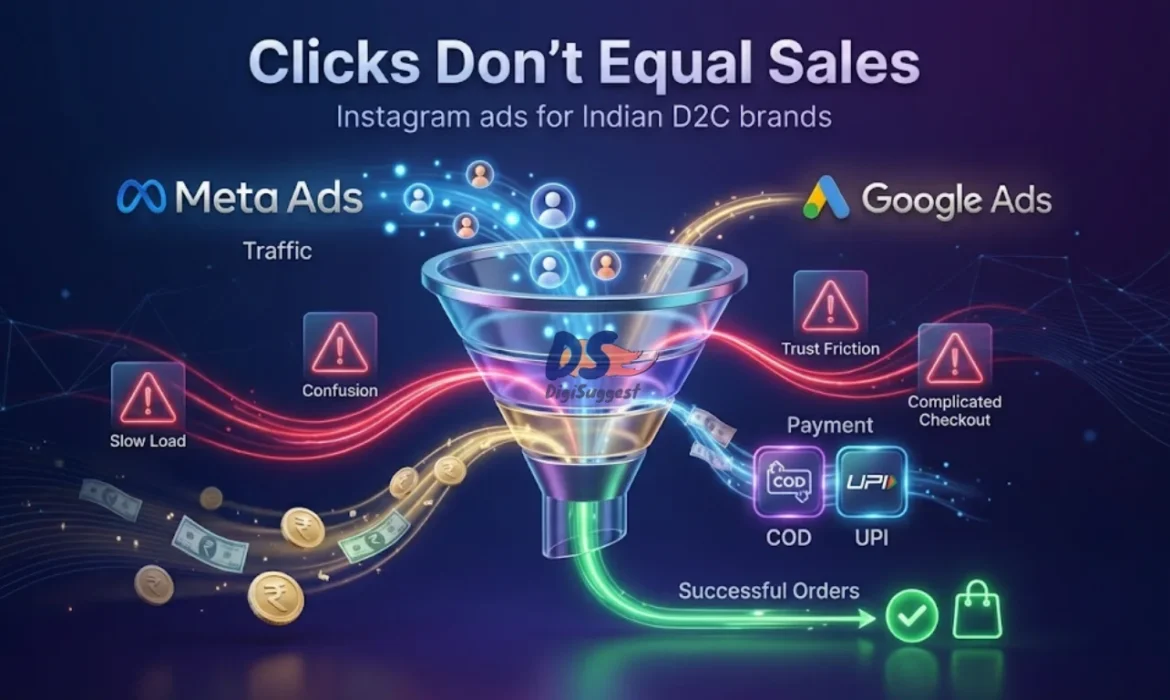
Ecommerce Funnel Explained: From Click to Conversion
“User Click Karta Hai… Phir Kya Hota Hai?”
Most ecommerce brands believe their funnel looks like this:
Ad → Product Page → Checkout → Sale
That’s not a funnel.
That’s hope.
In reality, ecommerce sales are not linear.
They are emotional, hesitant, distracted and fragmented - especially in India.
This is why brands say:
- “Traffic aa raha hai, sales nahi”
- “Ads ka ROAS unstable hai”
- “Users checkout tak jaate hain, par buy nahi karte”
- “Repeat sales nahi aa rahi”
The problem is rarely:
- Traffic quality
- Ad platform
- Budget
👉 The real problem is a broken ecommerce funnel.
This blog explains:
- What an ecommerce funnel actually is
- How users move from click to conversion
- Where most Indian ecommerce brands leak revenue
- How to fix funnel gaps in 2026
- What Is an Ecommerce Funnel (Really)?
- Why Most Ecommerce Funnels Fail (Especially in India)
- Stage 1: The Click (Where Funnels Are Born)
- Stage 2: Landing Page (Interest or Exit)
- Stage 3: Exploration (Silent Decision-Making)
- Stage 4: Add to Cart (Intent, Not Commitment)
- Stage 5: Checkout (Where Money Is Won or Lost)
- Stage 6: Purchase Confirmation (Big Mistake)
- Stage 7: Retention & Repeat Purchases
- The Biggest Ecommerce Funnel Mistakes Indian Brands Make
- How Traffic, CRO & Funnels Work Together
- Funnel Optimization vs More Traffic: The ROI Truth
- What a Healthy Ecommerce Funnel Looks Like in 2026
- How Digi Suggest Optimizes Ecommerce Funnels
- Final Thought
What Is an Ecommerce Funnel (Really)?
An ecommerce funnel is not pages.
It is user psychology over time.
A funnel represents how users move through these mental stages:
- Awareness
- Interest
- Consideration
- Trust
- Purchase
- Retention
Pages support these stages but they don’t replace them.
👉 Funnels are psychological journeys, not URLs. You can read more about sales funnel stages here.
Why Most Ecommerce Funnels Fail (Especially in India)
Most funnels fail because brands assume:
- Users are ready to buy
- One visit is enough
- One ad can close a sale
- Discounts replace trust
Indian ecommerce users:
- Compare heavily
- Research slowly
- Distrust new brands
- Get distracted easily
- Often return multiple times
If your funnel doesn’t support this behavior:
👉 Users drop out silently.
Is your Ecommerce Funnel Leaking Revenue?
Stop guessing. Start converting.
Stage 1: The Click (Where Funnels Are Born)
The funnel starts before the website.
The click comes from:
- Meta Ads
- Google Ads
- SEO
- Influencers
- WhatsApp / Email
The Biggest Funnel Mistake at This Stage
Sending traffic with misaligned intent.
Example:
- Ad promises “problem solution”
- Landing page shows product features
- User feels confused
Funnel Principle
👉 Every click carries an expectation.
Your landing page must match it.
This is called message match and it’s critical.
Stage 2: Landing Page (Interest or Exit)
This is where most funnels collapse.
Users ask subconsciously:
- “Am I in the right place?”
- “Is this relevant to me?”
- “Can I trust this brand?”
Common Funnel Leaks Here
- Vague messaging
- Slow page speed
- No clarity above the fold
- No trust signals
What a Funnel-Ready Landing Page Does
- Clearly explains the product
- Shows who it’s for
- Builds trust immediately
- Guides the next action
👉 Landing pages don’t sell. They guide.
Stage 3: Exploration (Silent Decision-Making)
If users don’t bounce, they explore:
- Scroll
- Click images
- Read reviews
- Check FAQs
- Open policies
This stage is invisible in dashboards but crucial.
What Users Are Really Doing
They’re asking:
- “Is this legit?”
- “Will this work for me?”
- “What if I regret it?”
Funnel Leak Here
- Weak product pages
- Feature-heavy content
- No proof
- Poor mobile UX
Funnel Fix
- Benefits over features
- Social proof everywhere
- Clear use cases
- Real images & videos
👉 Users don’t need more info.
They need more confidence.
Stage 4: Add to Cart (Intent, Not Commitment)
Add to cart feels like success but it’s not.
In India:
- Add to cart is often “bookmarking”
- Users add and leave (known as cart abandonment)
- Intention exists, commitment doesn’t
Funnel Leak
Brands celebrate add-to-cart but ignore:
- Cart clarity
- Cart friction
- Cart reassurance
Funnel Fix
- Clear pricing
- Shipping & COD clarity
- Easy cart edits
- Visible trust signals
👉 Add to cart = interest. Checkout = trust.
Don't let high intent users drop off.
We optimize your cart and checkout flow.
Stage 5: Checkout (Where Money Is Won or Lost)
Checkout is the most fragile stage.
Users are ready but anxious.
They think:
- “Is payment safe?”
- “What if delivery is late?”
- “What if product is bad?”
- “What if return is hard?”
Common Funnel Killers
- Forced login
- Long forms
- Hidden charges
- Payment failures
- Poor mobile checkout
Funnel Fix
- Guest checkout
- Minimal fields
- Transparent pricing
- COD clarity
- Reassurance near CTA
👉 Checkout optimization is emotional optimization.
Stage 6: Purchase Confirmation (Most Brands Stop Here - Big Mistake)
After purchase, brands relax.
But this stage decides:
- Trust
- Repeat purchases
- Word of mouth
- Refund anxiety
Funnel Leak
- Poor confirmation page
- No reassurance
- No next steps
Funnel Fix
- Clear order summary
- Delivery expectations
- Support info
- Thank-you messaging
- Cross-sell (soft)
👉 Post-purchase experience decides loyalty.
Stage 7: Retention & Repeat Purchases (The Hidden Funnel)
Most ecommerce profit comes from:
Yet many brands:
- Ignore post-purchase funnel
- Focus only on acquisition
- Burn money repeatedly
Funnel Fix
- Email & WhatsApp flows
- Product education
- Review requests
- Repeat purchase offers
- Loyalty incentives
👉 Acquisition without retention is expensive.
The Biggest Ecommerce Funnel Mistakes Indian Brands Make
- ❌ Assuming one visit = one sale
- ❌ Sending cold traffic directly to checkout
- ❌ Ignoring mobile behavior
- ❌ Overusing discounts instead of trust
- ❌ Fixing ads instead of funnel leaks
- ❌ Measuring only last-click ROAS
Funnels fail when brands think tactically, not holistically.
How Traffic, CRO & Funnels Work Together
Traffic brings users.
CRO removes friction.
Funnels guide decisions.
If any one is weak:
- Growth stalls
- Costs rise
- ROAS becomes unstable
👉 Funnels multiply the impact of traffic.
Funnel Optimization vs More Traffic: The ROI Truth
Option A:
- Increase ad spend by 20%
- Risk higher CPA
Option B:
- Fix funnel leaks
- Improve conversion by 20%
- Same traffic, more revenue
👉 Funnel optimization always wins long-term.
What a Healthy Ecommerce Funnel Looks Like in 2026
A strong funnel:
- Matches intent at every step
- Builds trust progressively
- Reduces friction continuously
- Supports Indian buyer behavior
- Works on mobile first
- Encourages repeat purchases. See India's growing ecommerce stats here.
It doesn’t force sales.
It removes reasons not to buy.
How Digi Suggest Optimizes Ecommerce Funnels
At Digi Suggest, we don’t optimize pages in isolation.
We optimize the entire ecommerce funnel.
Our Funnel Optimization Approach
- Traffic & intent audit
- Funnel-stage diagnostics
- Friction & trust mapping
- CRO + speed optimization
- Checkout & retention fixes
🎯 We don’t chase clicks.
🎯 We fix the journey.
🚀 Getting Clicks but Not Conversions?
If your ecommerce store is getting traffic but not consistent sales, the problem is almost always the funnel not the ads.
Final Thought
Ecommerce success is not about:
- One ad
- One page
- One trick
It’s about:
- Guiding users
- Building trust
- Removing friction
- Respecting buyer psychology
Traffic brings users.
Funnels turn them into customers.
If you want sustainable ecommerce growth fix the funnel.
FAQs
An ecommerce funnel represents the journey users take from first click to purchase, including awareness, trust-building, checkout, and retention.
Funnels fail because brands focus on traffic instead of intent, trust, and friction removal across different user stages.
No. Funnels are psychological journeys. Pages support funnels, but user intent and decision-making drive conversions.
Brands should analyze bounce rates, scroll depth, add-to-cart drop-offs, checkout exits and repeat purchase data.
Better funnel optimization is usually more profitable, as it increases revenue from existing traffic without increasing acquisition costs.

How Page Speed Affects Ecommerce Sales (2026 CRO Guide)
“Website Chal Toh Rahi Hai… Par Slow Hai”
Most ecommerce founders don’t panic when their website is slow. They say things like:
- “Site thodi slow hai, but load ho jaati hai”
- “Mobile pe thoda time lagta hai”
- “Ads toh chal rahi hain, problem wahan hogi”
Here’s the uncomfortable truth: 👉 A slow website doesn’t break suddenly.
It slowly bleeds revenue every single day.
You don’t get an error.
You don’t get alerts.
You just get:
- Higher bounce rates
- Lower conversion rates
- Higher CPA
- Poor ad scalability
And most founders never connect it back to page speed.
This blog explains how page speed directly affects ecommerce sales, why it matters even more in India, and what ecommerce brands should focus on in 2026.
- Page Speed Is Not a “Technical Metric” - It’s a Business Metric
- Why Page Speed Matters More in India Than Anywhere Else
- The Psychology of Speed: What Users Feel
- Page Speed vs Conversion Rate: The Direct Relationship
- How Page Speed Impacts the Entire Ecommerce Funnel
- Google, SEO & Page Speed (2026 Reality)
- Common Page Speed Killers in Ecommerce (India-Focused)
- Speed Problems Are Often Invisible to Founders
- What “Fast Enough” Means for Ecommerce in 2026
- Quick Page Speed Wins for Ecommerce Brands
- How Digi Suggest Approaches Page Speed for Ecommerce
Page Speed Is Not a “Technical Metric” - It’s a Business Metric
Most people think page speed is:
- A developer issue
- A tech checklist
- A Google recommendation
That thinking is outdated. In ecommerce: 👉 Page speed directly affects money.
Every second of delay:
- Reduces trust
- Increases friction
- Lowers conversions
- Increases ad costs
Slow websites don’t just feel bad. They convert worse.
Why Page Speed Matters More in India Than Anywhere Else
Page speed is critical globally, but in India it’s even more important.
Indian Ecommerce Reality
- Majority traffic is mobile
- Internet quality varies widely
- Many users use budget devices
- Users multitask and get distracted easily
If your website is slow: 👉 Users don’t wait. They leave.
Unlike desktop users in high-speed environments, Indian mobile users are impatient by necessity, not by choice.
Is Your Website Bleeding Revenue Due to Speed?
Don't let slow loading times kill your sales. Get a comprehensive analysis.
The Psychology of Speed: What Users Feel When a Site Is Slow
Users don’t consciously say:
“This website is slow, so I won’t buy.”
They subconsciously feel:
- “Something feels off”
- “Is this site trustworthy?”
- “Why is it taking so long?”
- “Let me check later”
That hesitation is enough to: 👉 Kill the purchase.
Speed affects:
- Confidence
- Trust
- Momentum
In ecommerce, momentum matters.
Page Speed vs Conversion Rate: The Direct Relationship
Let’s simplify this. If your page:
- Loads in under 2 seconds → users stay engaged
- Takes 3–4 seconds → users hesitate
- Takes 5+ seconds → users start leaving
For ecommerce stores:
- Even a 1-second delay can reduce conversions significantly
- Mobile users are far more sensitive than desktop users
👉 Page speed doesn’t just affect bounce rate.
👉 It affects every step of the funnel.
How Page Speed Impacts the Entire Ecommerce Funnel
1️⃣ Ads Performance Suffers First
If your landing page is slow:
- Users bounce before seeing content
- Meta & Google record poor engagement
- CPMs increase
- CPCs increase
- CPA increases
This is why many brands say: “Ads mehngi hoti ja rahi hain.”
Sometimes, ads aren’t the problem. 👉 The page is.
2️⃣ Product Page Engagement Drops
Slow product pages cause:
- Lower scroll depth
- Fewer image views
- Fewer “Add to Cart” clicks
Users don’t explore. They skim or leave.
Learn more about optimizing product page SEO here.
3️⃣ Checkout Drop-Off Increases
Slow checkout pages are deadly. Users at checkout are:
- Ready to buy
- Emotionally invested
A delay here causes:
- Anxiety
- Doubt
- Exit
👉 Speed issues at checkout directly lose revenue.
Read our guide on checkout page optimization.
Ads Performing Poorly? It Might Be Your Site Speed.
We optimize ecommerce funnels to lower CPA and increase ROAS.
Google, SEO & Page Speed (2026 Reality)
Google now treats page speed as:
- A ranking factor
- A quality signal
In 2026:
- Core Web Vitals matter more than ever
- Mobile performance is prioritized
- User experience affects visibility
Slow ecommerce sites face:
- Lower rankings
- Lower traffic quality
- Poor organic conversion rates
👉 Page speed impacts both SEO and CRO.
Common Page Speed Killers in Ecommerce (India-Focused)
Most ecommerce websites are slow for predictable reasons.
❌ Heavy Images & Videos
- Uncompressed product images
- Autoplay videos
- Large banners
❌ Too Many Apps & Scripts
- Shopify apps overload
- Tracking scripts everywhere
- Unused plugins
❌ Poor Mobile Optimization
- Desktop-first design
- Heavy animations
- Complex layouts
❌ Cheap Hosting or Bad Themes
- Slow servers
- Bloated themes
- Poor caching
Speed Problems Are Often Invisible to Founders
Here’s why page speed issues go unnoticed:
- Founders use high-speed internet
- They test on laptops
- They’re logged-in users (cached)
- They’re familiar with the site
Real users:
- Are on mobile
- Have slower networks
- Are first-time visitors
👉 Your experience ≠ user experience.
What “Fast Enough” Means for Ecommerce in 2026
You don’t need perfection. You need acceptable performance.
General benchmarks:
- Homepage: under ~2.5 seconds
- Product pages: under ~2 seconds
- Checkout: as fast as possible
More important than tools like PageSpeed Insights or GTmetrix is How fast the site feels to users.
Quick Page Speed Wins for Ecommerce Brands
You don’t need a full rebuild to see improvements. High-Impact Fixes:
- Compress & lazy-load images
- Remove unnecessary apps/scripts
- Optimize mobile layouts
- Use lightweight fonts
- Improve server response time
These alone can:
- Reduce bounce rate
- Improve conversions
- Lower CPA
The CRO + Speed Connection (Most Miss This)
Page speed is part of CRO. A fast page:
- Feels trustworthy
- Reduces friction
- Improves flow
A slow page:
- Creates doubt
- Breaks momentum
- Increases exits
👉 Speed is conversion psychology.
How Page Speed Improves ROAS Without Increasing Spend
When your site is faster:
- More users stay
- More users reach checkout
- More users complete purchases
That means:
- Same traffic
- Same ad spend
- More revenue
👉 Page speed is one of the cheapest ROI improvements.
When Should You Prioritize Page Speed Fixes?
You should focus on page speed if:
- Bounce rate is high
- Mobile conversions are low
- Ads feel expensive
- Checkout drop-off is high
- Scaling ads feels unstable
In most cases: 👉 Speed is a hidden bottleneck.
How Digi Suggest Approaches Page Speed for Ecommerce
At Digi Suggest, we don’t treat page speed as a developer-only task. We treat it as a revenue optimization lever.
Our Page Speed + CRO Approach
- Mobile-first performance audits
- Funnel-level speed analysis
- Identify revenue-impacting delays
- Prioritize fixes by ROI
- Align speed improvements with conversions
🎯 The goal is not just better scores.
🎯 The goal is more sales from the same traffic.
Website Slow? Sales Slower?
If your website feels slow, you’re losing revenue silently. Book a free page speed + CRO audit.
Final Thought
A slow ecommerce website doesn’t crash. It quietly underperforms.
In 2026:
- Speed affects trust
- Speed affects conversions
- Speed affects ROAS
Before increasing ad budgets fix the speed of the page where users decide.
FAQs
Yes. Page speed directly affects bounce rate, trust, conversion rate and ad costs, especially for mobile users in India.
In 2026, ecommerce pages should ideally load within 2–3 seconds on mobile to avoid significant conversion drops.
Slow pages increase bounce rates, which signals poor user experience to ad platforms, raising CPCs and lowering ROAS.
Yes. Since most Indian ecommerce traffic is mobile, speed optimization has a greater impact on mobile conversions than desktop.
If bounce rates are high, speed fixes often deliver better ROI than launching new campaigns.
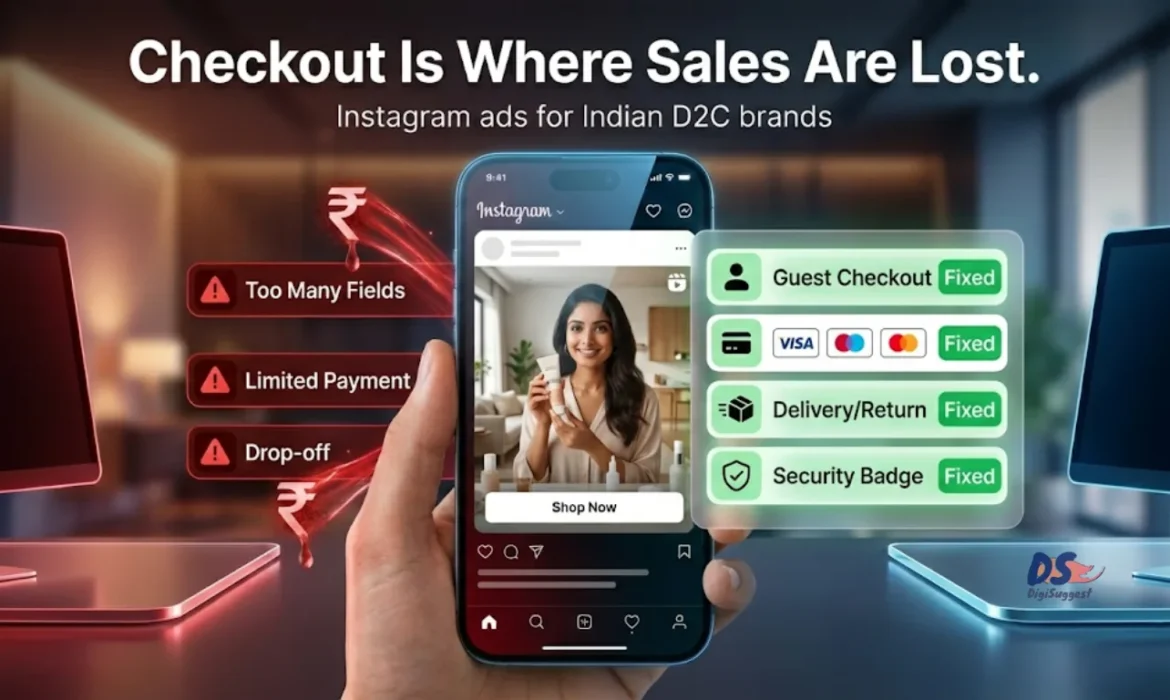
Checkout Page Optimization Tips for Higher Ecommerce Sales
The Most Expensive Page on Your Website
If you run an ecommerce business, this fact might surprise you:
👉 Your checkout page is where the maximum revenue is lost not your ads, not your homepage.
Most Indian ecommerce stores:
- Spend heavily on Meta Ads & Google Ads
- Improve creatives and targeting
- Drive quality traffic
Yet still face:
- 60–80% cart abandonment
- Drop-offs during checkout
- Users who almost buy but don’t
Founders often say: “User ne add to cart kiya… phir pata nahi kya hua.”
What happened is simple:
👉 Your checkout page created friction or fear.
This blog explains:
- Why checkout pages fail
- The most common checkout mistakes Indian brands make
- Practical checkout optimization tips that increase sales
- How to think about checkout CRO in 2026
- Why Checkout Page Optimization Matters
- Indian Ecommerce Reality
- The Psychology of Checkout
- Mistake 1: Forcing Login
- Mistake 2: Too Many Form Fields
- Mistake 3: No COD Clarity
- Mistake 4: Surprise Charges
- Mistake 5: Payment Failures
- Mistake 6: Unsafe Look
- Mistake 7: Too Many Steps
- Mistake 8: No Reassurance
- Mistake 9: Poor Mobile Experience
- Mistake 10: No Exit Recovery
- High-Impact Optimization Checklist
- How Digi Suggest Optimizes Funnels
Why Checkout Page Optimization Matters More Than Anything Else
Checkout users are:
- Highly motivated
- Already convinced about the product
- Ready to pay
At this stage:
👉 Even small issues cause exits.
Improving checkout conversion by just 5–10% can often:
- Increase revenue more than doubling ad budgets
- Reduce CPA across all channels
- Improve repeat purchase rate
Checkout CRO is pure profit optimization.
Indian Ecommerce Reality: Why Checkout Is Extra Sensitive
Indian ecommerce checkout faces unique challenges:
- COD preference
- Trust concerns
- Payment failures
- Mobile-first users
- Slow internet in many regions
A checkout that works in the US or Europe:
👉 Often fails in India.
This is why India-specific checkout optimization is critical.
Is your checkout page leaking revenue?
Fix friction and increase conversions.
The Psychology of Checkout: What Users Are Feeling
At checkout, users think:
- “Is this brand trustworthy?”
- “Will my money be safe?”
- “What if delivery is late?”
- “Can I return this easily?”
- “Why is checkout taking so long?”
Checkout optimization is not technical.
👉 It is psychological.
Your job is to:
- Reduce anxiety
- Reduce effort
- Increase reassurance
Mistake 1️⃣ Forcing Login or Account Creation
This is one of the biggest checkout killers. Many sites require users to:
- Sign up
- Create a password
- Verify email
Why This Fails
Users think: “Abhi sirf product chahiye, account baad mein.”
CRO Fix
- Enable guest checkout
- Ask for account creation after purchase
👉 Forced login = lost sales.
Mistake 2️⃣ Too Many Form Fields
Every extra field reduces conversion. Common unnecessary fields:
- Company name
- Alternate phone (mandatory)
- Address line 2 (required)
- DOB / gender
CRO Fix
- Remove non-essential fields
- Use smart defaults
- Auto-fill where possible
👉 Shorter forms = higher conversions.
Mistake 3️⃣ No COD Clarity (Critical in India)
COD is not optional in India. If users don’t clearly see:
- COD available
- COD charges (if any)
They hesitate or leave.
CRO Fix
- Show COD availability early
- Mention COD near payment options
- Be transparent about any COD fees
👉 COD clarity builds trust instantly.
Mistake 4️⃣ Surprise Charges at Checkout
This is a silent conversion killer. Users hate discovering:
- Shipping charges late
- Convenience fees
- COD fees at the last step
Why This Kills Sales
It breaks trust. Users feel: “Mujhe pehle batana chahiye tha.” This is a classic example of why you might have traffic but no sales.
CRO Fix
- Show shipping & charges upfront
- Use “No hidden charges” messaging
- Display final price early
👉 Transparency > persuasion.
Don't let hidden errors kill your sales.
We optimize ecommerce funnels for higher ROAS.
Mistake 5️⃣ Payment Failures or Limited Options
Indian users expect:
- UPI
- Debit cards
- Wallets
- Net banking
- COD
If payment fails once:
👉 Many users never retry.
CRO Fix
- Offer multiple payment methods
- Optimize payment gateway speed
- Show “secure payment” badges
- Handle payment failures gracefully
👉 Payment friction = lost intent.
Mistake 6️⃣ Checkout Looks Unsafe or Unprofessional
Even small visual cues matter. Red flags:
- Poor design
- Broken layouts
- No SSL indication
- No trust badges
Users subconsciously think: “Yeh site safe hai ya nahi?” This often stems from poor website development practices.
CRO Fix
- Clean, minimal checkout design
- SSL & security indicators
- Trusted payment logos
- Professional UI
👉 Checkout must feel safe, not fancy.
Mistake 7️⃣ Too Many Steps in Checkout
Long checkout flows kill momentum. Each step is an opportunity to exit.
CRO Fix
- Use single-page checkout where possible
- Or show clear progress indicator
- Minimize clicks & page reloads
👉 Faster checkout = more sales.
Mistake 8️⃣ No Reassurance Near the “Pay” Button
This is a subtle but powerful CRO tactic. Before clicking “Pay”, users want reassurance.
CRO Fixes Near CTA
- “Easy 7-day returns”
- “COD available”
- “100% secure payment”
- “Free delivery above ₹X”
👉 Place reassurance near the final action.
Mistake 9️⃣ Poor Mobile Checkout Experience
Most Indian ecommerce traffic is mobile. Common mobile issues include tiny input fields, keyboard covering fields, and slow loading. Remember, page speed affects ecommerce sales drastically.
CRO Fix
- Mobile-first checkout design
- Large buttons
- Autofill-friendly forms
- Minimal scrolling
👉 If checkout fails on mobile, you lose most users.
Mistake 🔟 No Exit Recovery at Checkout
Users don’t always leave forever. Many abandon checkout because:
- They get distracted
- They want to think
- They want to compare
CRO Fix
- Exit-intent popups (soft, not aggressive)
- Cart reminder emails / WhatsApp
- Retargeting ads aligned with checkout objections
👉 Checkout optimization continues after exit.
High-Impact Checkout Optimization Checklist
Here’s what most Indian D2C brands should fix first:
- ✅ Guest checkout
- ✅ Fewer form fields
- ✅ COD clarity
- ✅ Transparent pricing
- ✅ Multiple payment options
- ✅ Security & trust signals
- ✅ Mobile optimization
- ✅ Reassurance near CTA
These are simple fixes, not redesigns.
Checkout CRO vs More Traffic: The ROI Comparison
If you:
- Improve checkout conversion by 10%
- You increase revenue immediately.
If you:
- Increase traffic by 10%
- You increase costs too.
👉 Checkout CRO is the cheapest growth lever. It is often more effective than simply debating SEO vs Ads.
How Checkout Optimization Improves Ads Performance
A better checkout:
- Lowers CPA
- Improves ROAS on Meta Ads
- Stabilizes scaling
- Increases repeat purchases
This means:
👉 CRO multiplies ad performance.
How Digi Suggest Optimizes Checkout Funnels
At Digi Suggest, we don’t “guess” checkout fixes. We analyze:
- Drop-off points
- User behavior
- Payment failures
- Mobile issues
- Trust gaps
Our Checkout CRO Approach
- Ecommerce funnel & step-wise analysis
- Friction & anxiety mapping
- India-specific payment optimization
- Mobile-first improvements
- Continuous testing
🎯 The goal is not cosmetic changes.
🎯 The goal is more completed orders. Learn more about our ecommerce marketing services.
Stop Losing Sales at Checkout
Book a free checkout CRO audit and recover lost sales.
Stop Losing Sales at Checkout
🚀 High Cart Abandonment?
If users are adding to cart but not completing purchases, your checkout page is leaking revenue every day.
👉 We optimize ecommerce funnels, not just traffic. Read our scaling case study to see how we do it.
👉 Book a free checkout CRO audit and recover lost sales.
Final Thought
If users reach checkout:
- Your Google Ads worked
- Your product worked
If they don’t pay: 👉 Your checkout failed.
Before spending more on traffic, fix the page where money is actually made.
FAQs
Checkout optimization directly impacts revenue because users at checkout already intend to buy. Any friction here causes immediate loss of sales.
In 2026, Indian ecommerce cart abandonment rates often range from 65–80%, mainly due to trust issues, COD clarity, and payment friction.
Yes. Forced login remains one of the biggest checkout conversion killers, especially for first-time buyers.
Clear COD visibility and transparency significantly improve checkout conversions by reducing trust anxiety among Indian shoppers.
Yes. A better checkout improves overall conversion rates, which lowers CPA and stabilizes ad performance across platforms.
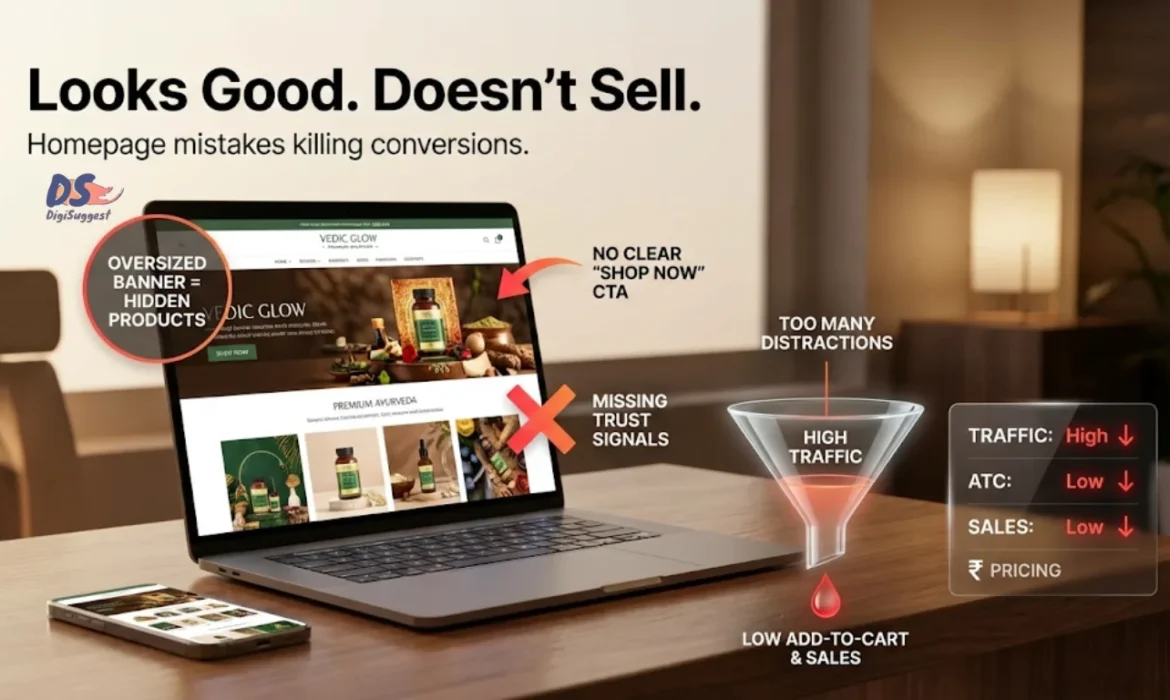
Homepage Mistakes That Reduce Ecommerce Conversions
“Website Sundar Hai… Phir Bhi Log Buy Kyun Nahi Kar Rahe?”
Many ecommerce founders proudly say:
- “Website premium lagti hai”
- “Design bahut acha hai”
- “Homepage modern hai”
Yet the data tells a different story:
- High bounce rate
- Low product page visits
- Poor conversion rate
This leads to confusion: “Homepage toh sahi hai… problem ads mein hogi.”
Here’s the uncomfortable truth:
👉 Most ecommerce homepages don’t fail because they look bad. They fail because they don’t guide decisions.
In ecommerce, your homepage is not:
- A brand brochure
- A mood board
- A design showcase
👉 Your homepage is a decision-making page.
This blog breaks down the most common homepage mistakes that reduce ecommerce conversions, why they happen, and how Indian ecommerce brands can fix them in 2026.
Is your Homepage leaking revenue?
Get a professional audit to find out why users aren't buying.
- The 5-Second Rule: Why Homepages Matter So Much
- Mistake 1️⃣ Your Hero Section Is Vague or Brand-Focused
- Mistake 2️⃣ No Clear Primary Call-to-Action (CTA)
- Mistake 3️⃣ Too Much Information Too Early
- Mistake 4️⃣ No Trust Signals Above the Fold
- Mistake 5️⃣ Homepage Talks About Brand, Not User Problems
- Mistake 6️⃣ Weak Navigation Structure
- Mistake 7️⃣ No Clear “Who Is This For?”
- Mistake 8️⃣ Over-Reliance on Discounts
- Mistake 9️⃣ Homepage Is Not Mobile-Optimized
- Mistake 🔟 No Clear Flow to Product Pages
- A Simple High-Converting Homepage Framework
- Why Homepage CRO Impacts Ads & SEO Performance
- How Digi Suggest Fixes Homepage Conversion Issues
- Final Thought
The 5-Second Rule: Why Homepages Matter So Much
When a user lands on your homepage, you have:
👉 5 seconds or less to answer three questions:
- What do you sell?
- Who is it for?
- Why should I trust you?
If your homepage doesn’t answer these immediately:
- Users scroll aimlessly
- Or bounce
- Or click randomly
None of these lead to conversions. This is often referred to as the 5-second test in marketing psychology.
Mistake 1️⃣ Your Hero Section Is Vague or Brand-Focused
This is the biggest homepage mistake. Most ecommerce hero sections show:
- Brand slogans
- Emotional taglines
- Lifestyle images
- Generic claims
Example: “Redefining wellness for modern India.”
Sounds nice. Converts nothing.
Why This Kills Conversions
New visitors:
- Don’t know your brand
- Don’t care about your mission yet
- Want clarity, not poetry
CRO Fix
Your hero section should clearly state:
- What you sell
- For whom
- The main benefit
Example: “Skincare products designed for Indian skin dermatologically tested, safe for daily use.”
👉 Clarity beats creativity on the homepage, especially for D2C brands.
Mistake 2️⃣ No Clear Primary Call-to-Action (CTA)
Many homepages have:
- Multiple CTAs
- Competing buttons
- Or no clear next step
Examples:
- “Explore”
- “Learn more”
- “Our story”
- “Shop collections”
- “Read blog”
This creates decision paralysis.
Why This Reduces Conversions
Users don’t want to decide what to do. They want guidance.
CRO Fix
- One primary CTA above the fold
- Clear, action-oriented text
- Secondary CTAs only after intent builds
Example:
“Shop Bestsellers”
“Find Your Perfect Product”
👉 One page = one main action.
Mistake 3️⃣ Too Much Information Too Early
Many ecommerce homepages try to show:
- All categories
- All products
- All features
- All certifications
- All blog content
This overwhelms users.
Why This Fails
Users landing on your homepage are:
- Cold
- Curious
- Not ready to process everything
Information overload causes:
- Skimming
- Confusion
- Exit
CRO Fix
- Progressive disclosure
- Show essentials first
- Deeper details later
👉 Homepage should invite exploration, not demand attention.
Mistake 4️⃣ No Trust Signals Above the Fold (Critical in India)
Indian ecommerce users are cautious.
If your homepage doesn’t show trust immediately, users assume: “Ye naya brand lag raha hai… risk hai.”
Common Missing Trust Signals
- Customer reviews
- Media mentions
- COD availability
- Return policy highlights
- Social proof numbers
CRO Fix
Add trust signals above or just below the fold:
- “Trusted by 50,000+ customers”
- ⭐⭐⭐⭐⭐ reviews
- COD & easy returns badges
- Delivery timeline clarity
👉 In India, trust precedes interest.
Build Trust & Increase Sales
We help you optimize for the Indian consumer mindset.
Mistake 5️⃣ Homepage Talks About Brand, Not User Problems
Many homepages focus on:
- Brand story
- Vision & mission
- Founder philosophy
This content has value but not upfront.
Why This Hurts Conversions
New users think: “This brand is talking about itself, not me.”
CRO Fix
Flip the narrative:
- Start with user pain
- Then introduce the brand as the solution
Example:
❌ “We started this brand to change the industry”
✅ “Tired of products that don’t work for Indian conditions?”
👉 Make the user the hero, not the brand.
Mistake 6️⃣ Weak Navigation Structure
Navigation Structure is often ignored in CRO discussions.
Common issues:
- Too many menu items
- Confusing category names
- Hidden bestsellers
- No logical flow
Why This Reduces Conversions
If users can’t quickly find:
- What they’re looking for
- Or where to start
They leave.
CRO Fix
- Simple category structure
- Highlight bestsellers
- Logical grouping
- Clear labels
👉 Navigation should reduce thinking, not add it.
Mistake 7️⃣ No Clear “Who Is This For?”
Many ecommerce homepages fail to clarify:
- Target audience
- Use cases
- Scenarios
This causes users to wonder: “Is this meant for someone like me?”
CRO Fix
Use segmentation:
- “For dry skin”
- “For beginners”
- “For daily use”
- “For fitness beginners”
This helps users self-identify quickly.
👉 Relevance increases conversions.
Mistake 8️⃣ Over-Reliance on Discounts
Some homepages lead with:
- Flat discounts
- Big offers
- Sale banners
This attracts:
- Price-only buyers
- Low loyalty users
And hurts:
- Brand perception
- Long-term conversions, as discount-only marketing kills brand value.
CRO Fix
- Lead with value
- Support with offers
- Don’t make discounts your identity
👉 Trust + value convert better than price alone.
Mistake 9️⃣ Homepage Is Not Mobile-Optimized
In India, most ecommerce traffic is mobile.
Common mobile homepage issues:
- Long loading time
- Huge banners
- Tiny text
- Difficult navigation
- Too much scrolling
CRO Fix
- Design mobile-first
- Short sections
- Clear CTAs
- Fast load speed (Focus on Core Web Vitals)
👉 If your homepage fails on mobile, it fails overall.
Mistake 🔟 No Clear Flow to Product Pages
Many homepages fail to push users toward product pages. They:
- Distract with content
- Promote too many sections
- Forget the core goal
CRO Fix
Your homepage flow should be:
Hero → Trust → Categories → Bestsellers → Proof → CTA
👉 Every section should move users closer to products.
A Simple High-Converting Homepage Framework
Here’s a structure that works for most ecommerce brands:
- Clear hero section (what + who + benefit)
- Primary CTA (shop / explore)
- Trust signals
- Bestsellers or categories
- Benefits & differentiators
- Social proof
- Reassurance (delivery, returns)
Simple. Focused. Effective.
Why Homepage CRO Impacts Ads & SEO Performance
If your homepage:
- Confuses users
- Lacks clarity
- Doesn’t build trust
Then:
- Ad traffic wastes money
- SEO traffic bounces
- Overall CPA increases
👉 Homepage CRO multiplies the ROI of every channel.
How Digi Suggest Fixes Homepage Conversion Issues
At Digi Suggest, we don’t redesign homepages blindly. We diagnose:
- User behavior
- Funnel flow
- Trust gaps
- Clarity issues
Our Homepage CRO Approach
- Heatmap & behavior analysis
- Above-the-fold clarity fixes
- Trust & reassurance optimization
- Mobile-first improvements
- Funnel-aligned layout changes
🎯 The goal is not “better design”.
🎯 The goal is more conversions from the same traffic.
This is why most websites don't rank or sell as they miss the basics of user experience.
Homepage Getting Traffic but Not Sales?
Book a free homepage CRO audit and uncover what’s stopping conversions.
Final Thought
A good-looking homepage doesn’t guarantee sales. A clear, trust-building homepage does.
If your homepage:
- Confuses users
- Hides value
- Lacks trust
No amount of ads will save it. Before scaling traffic fix your homepage.
FAQs
In 2026, the homepage sets trust and clarity within the first 5 seconds. If users don’t immediately understand the product and value, they exit.
Homepages should focus on clarity and guidance first. Branding supports conversions but should not replace clear product messaging.
The biggest mistake is vague hero messaging that talks about the brand instead of clearly explaining what the user can buy and why it matters.
Yes. Reviews, COD availability, delivery timelines, and return policies significantly improve homepage conversions in India.
Homepages should be reviewed quarterly or whenever traffic sources, product focus, or user behavior changes.


