“SEO Karna Hai… Par Kahan Focus Karein?”
Almost every Indian ecommerce founder asks this at some point:
- “Category pages optimize karein ya product pages?”
- “Blogs likhne se better product SEO hai?”
- “Limited budget hai, priority kya honi chahiye?”
And this confusion is valid. Because most SEO advice online is:
- Generic
- Blog-focused
- Not written for ecommerce businesses
The result?
Brands invest time and money in SEO but organic sales remain low. The truth is simple but uncomfortable:
👉 Both category page SEO and product page SEO matter.
But they do NOT contribute equally to sales. This blog breaks down:
- The real difference between category and product page SEO
- How Google treats both in 2026
- What actually drives revenue for Indian D2C brands
- Where you should invest first (and why)
No theory. No fluff. Just ground reality ecommerce SEO.
Confused about where to start your Ecommerce SEO?
Get a clear roadmap tailored for your brand.
- First, Understand How Ecommerce Buyers Search on Google
- What Is Category Page SEO? (And Why Google Loves It)
- What Ranking Category Pages Look Like in 2026
- What Is Product Page SEO? (And Where It Truly Works)
- Category SEO vs Product SEO: Revenue Reality Check
- The Biggest SEO Mistake Indian Ecommerce Brands Make
- The Right SEO Priority for Indian D2C Brands
- When Product Page SEO Should Be Prioritized First
- How Internal Linking Connects Category & Product SEO
- India-Specific SEO Considerations
- So… What Actually Drives More Sales?
- How Digi Suggest Builds Revenue-Focused Ecommerce SEO
First, Understand How Ecommerce Buyers Search on Google
Before choosing what to optimize, you must understand search intent. Indian ecommerce buyers usually fall into 3 stages:
1️⃣ Exploration Stage
Searches like:
- “best skincare products”
- “protein powder for beginners”
- “shoes for office wear”
They’re not looking for one product. They want options.
👉 These searches favor category pages.
2️⃣ Comparison Stage
Searches like:
- “whey protein isolate vs concentrate”
- “minimalist vs plum serum”
- “best shoes for flat feet India”
They’re narrowing choices.
👉 These searches favor blogs + category/product hybrids.
3️⃣ Decision Stage
Searches like:
- “Minimalist salicylic acid serum price”
- “buy whey protein isolate 1kg”
- “Nike Air Zoom Pegasus size 9”
They know what they want.
👉 These searches favor product pages.
Now here’s the key insight:
Most ecommerce revenue comes from users in Stage 1 and 2 not Stage 3.
And that’s where most brands make the wrong SEO choice.
What Is Category Page SEO? (And Why Google Loves It)
Category pages are collection pages like:
- Men’s T-Shirts
- Face Serums
- Protein Powders
- Office Chairs
Traditionally, brands treated them as: “Just product listing pages”.
In 2026, Google treats optimized category pages as: High-intent landing pages.
Why Category Pages Drive More Organic Revenue
Let’s break this down realistically.
1️⃣ Category Pages Target High-Volume, Buyer-Intent Keywords
Examples:
- “men t-shirts online india”
- “best face serum for oily skin india”
- “protein powder for beginners india”
These keywords:
- Have high search volume
- Are commercial in nature
- Bring users ready to explore & buy
A single well-ranked category page can:
- Bring thousands of visitors/month
- Distribute traffic to multiple products
- Scale revenue automatically
👉 One category page can outperform 20–30 product pages combined.
2️⃣ Category Pages Capture Non-Brand Demand
Most Indian D2C brands don’t have:
- Strong brand searches initially
- High recall like Amazon or Nykaa
Category pages allow you to:
- Capture generic demand
- Introduce your brand
- Compete without brand bias
Example: A user searching: “best face serum for oily skin” Is open to discovering brands.
If your category page:
- Educates
- Builds trust
- Shows options clearly
You win the sale.
3️⃣ Category Pages Reduce Dependency on Single Products
Product-focused SEO has a risk:
- One product goes out of stock
- Product demand drops
- SEO traffic collapses
Category pages are resilient:
- New products can be added
- Old products removed
- SEO value remains intact
👉 Category SEO is scalable SEO.
What Ranking Category Pages Look Like in 2026
High-performing category pages in 2026 include:
- 500–1000 words of useful content
- Clear H1 + subheadings
- Buying guidance (how to choose)
- Filters handled via canonical tags
- FAQs answering buyer doubts
- Internal links to blogs & subcategories
- Mobile-first layout
They are written for humans first, SEO second.
Is your site structure hurting your sales?
We build technical SEO foundations that support scale.
What Is Product Page SEO? (And Where It Truly Works)
Product pages target searches like:
- “buy minimalist salicylic acid serum”
- “whey protein isolate 1kg price”
- “nike pegasus 40 india”
These users are:
- Highly intent-driven
- Close to purchase
- Often brand-aware
Product page SEO works best when:
- The brand already has demand
- The product is unique or popular
- Trust is already established
Why Product Page SEO Converts Well (But Scales Poorly)
1️⃣ Product Pages Capture Bottom-Funnel Searches
These users:
- Know what they want
- Are comparing prices, delivery, reviews
- Convert at higher rates
Conversion rate is high. Traffic volume is low.
👉 Product SEO = high intent, low scale.
2️⃣ Product SEO Depends Heavily on Brand Trust
In India, buyers ask:
- “Is this brand legit?”
- “COD milega?”
- “Returns honge?”
If your brand is unknown: Even ranking product pages won’t guarantee sales. Product SEO works best after category pages and brand signals are built.
3️⃣ Product Pages Are Harder to Rank at Scale
Challenges with product SEO:
- Duplicate content across variants
- Similar descriptions across SKUs
- Products frequently change
- Stock issues affect rankings
Optimizing 100 product pages individually is:
- Time-consuming
- Expensive
- Less scalable
Category SEO vs Product SEO: Revenue Reality Check
Let’s compare honestly.
| Factor | Category Page SEO | Product Page SEO |
|---|---|---|
| Search volume | High | Low |
| Buyer stage | Exploration & comparison | Decision |
| Traffic scale | High | Limited |
| Conversion rate | Medium | High |
| Brand dependency | Low | High |
| SEO maintenance | Moderate | High |
| Revenue scalability | Very high | Limited |
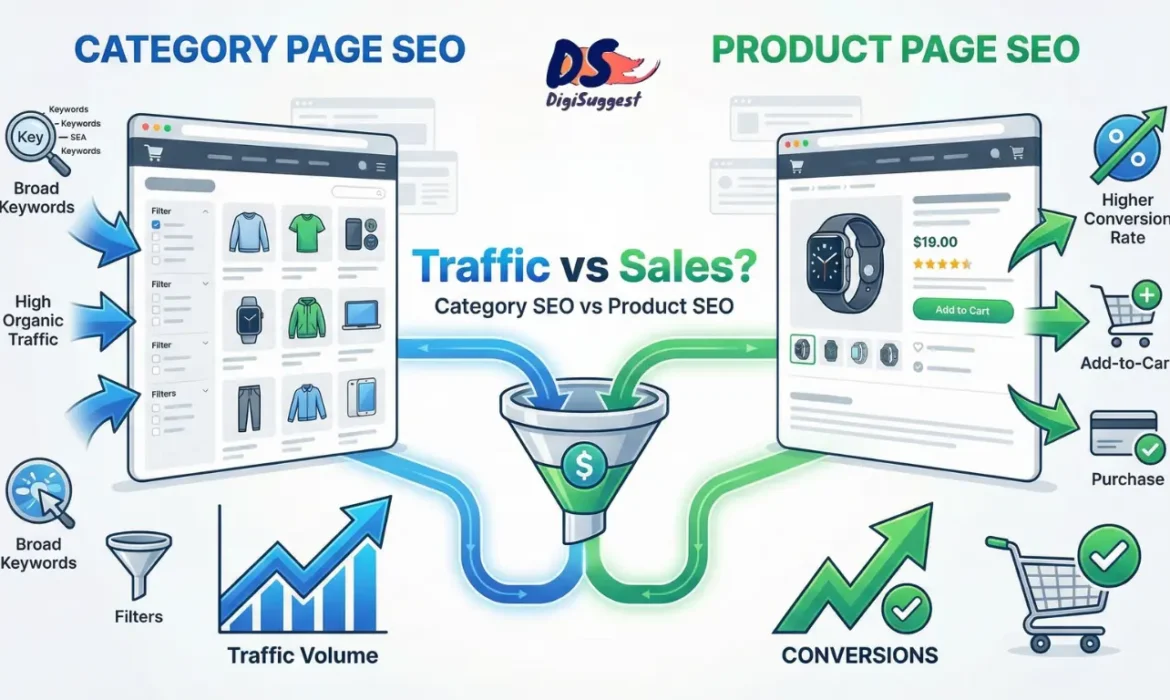
👉 Category pages drive more total revenue. Product pages close the sale.
The Biggest SEO Mistake Indian Ecommerce Brands Make
They start with product SEO first. Why?
- Feels logical
- Looks closer to sales
- Easier to explain
But in reality:
- There’s no demand yet
- Brand trust is low
- Traffic is insufficient
Result: “Product pages optimize kar liye… par traffic nahi aa raha.”
Because Google doesn’t rank products in isolation easily. This is one of the most common ecommerce SEO mistakes we see.
The Right SEO Priority for Indian D2C Brands
Here’s the correct order for most ecommerce brands in India:
Phase 1: Category Page SEO (Foundation)
- Capture non-brand demand
- Build traffic
- Introduce brand
- Build internal authority
Phase 2: Buyer-Intent Content
- “Best ___ for ___”
- “___ vs ___”
- Comparison & guides (On-page SEO is crucial here)
- Link to categories & products
Phase 3: Product Page SEO
- Optimize top-selling products
- Strengthen bottom-funnel conversion
- Capture branded searches
This is how SEO compounds.
When Product Page SEO Should Be Prioritized First
There are exceptions. Focus on product SEO first if:
- You sell a patented or unique product
- You already have strong brand demand
- You’re launching limited SKUs
- You have influencer-led demand
Otherwise, category SEO should lead.
How Internal Linking Connects Category & Product SEO
Internal linking is what makes both work together. Correct structure:
- Blogs → Category pages
- Category pages → Top products
- Product pages → Supporting blogs
- FAQs → Related collections
This tells Google:
- What pages matter
- How topics connect
- Where authority should flow
Without internal linking, both category and product SEO underperform.
India-Specific SEO Considerations (Very Important)
1️⃣ Language & Search Patterns
Indian users search in:
- English
- Hinglish
- Regional variations
Category pages can be optimized for:
- Broader language intent
- Location-specific modifiers
Product pages are more rigid.
2️⃣ COD & Trust Signals
Category pages can:
- Explain COD
- Show trust badges
- Reduce risk perception
Product pages only reinforce.
3️⃣ Marketplace Competition
Competing with Amazon on product keywords is hard. Category pages allow:
- Niche targeting
- Long-tail domination
- Lower competition
So… What Actually Drives More Sales?
Let’s be very clear:
👉 Category page SEO drives more total sales volume.
👉 Product page SEO improves conversion and closes deals.
If you have limited resources: Start with category pages.
If you want to scale: Build both in the right order. Learn more about scaling in our ecommerce sales growth case study.
How Digi Suggest Builds Revenue-Focused Ecommerce SEO
At Digi Suggest, we don’t choose between category or product SEO blindly. We build full ecommerce SEO systems.
Our Approach:
- Category-first SEO architecture
- Buyer-intent keyword mapping
- Product page optimization for top SKUs
- Strong internal linking framework
- Technical SEO that supports scale
🎯 The goal is not rankings.
🎯 The goal is organic revenue.
Need an Ecommerce SEO Agency?
Digi Suggest helps brands scale organically. Book a strategy call and build SEO that actually drives sales.
Final Thought
If SEO feels confusing, it’s not your fault. Most people ignores ecommerce realities.
Remember this:
- Category pages build demand
- Product pages close demand
- SEO works when both are aligned
Build the foundation first. Sales follow naturally.
FAQs
Category pages are more important for traffic and scale, while product pages are critical for conversions. Category pages usually drive more total revenue.
Category pages target high-volume, non-brand buyer searches and offer multiple options, which matches how users search during the buying process.
It is difficult. Product pages usually rank better when supported by strong category pages and internal linking.
No. Most new brands should prioritize category page SEO first to capture demand and build authority before focusing heavily on product SEO.
Category pages attract traffic, while product pages convert it. Internal linking connects both to create a complete ecommerce SEO funnel.