“Shopify SEO Friendly Hai… Phir SEO karwane ki kya jarurat hai?”
Almost every Indian Shopify store owner believes this:
“Shopify SEO-friendly platform hai, toh ranking apne aap aa jaani chahiye.”
But reality looks like this:
- Products don’t rank
- Category pages don’t show up
- Blogs bring traffic but no sales
- Google Search Console shows impressions but no clicks
So what’s wrong?
👉 Shopify is SEO-friendly, but it is NOT SEO-optimized by default.
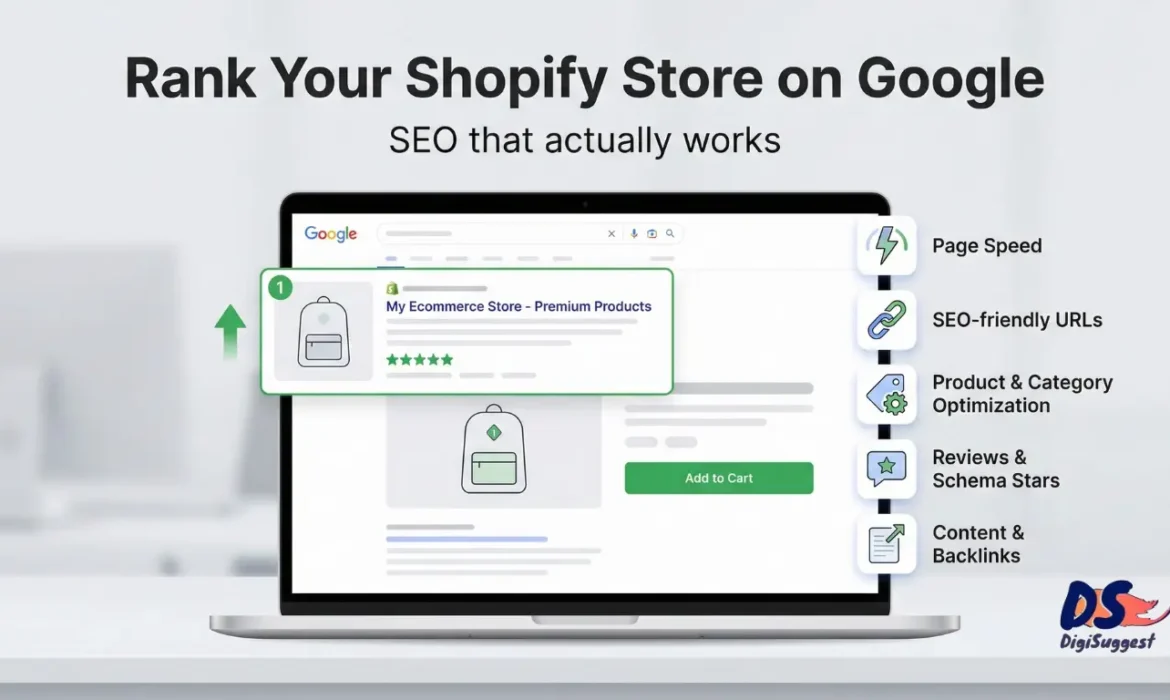
Ranking a Shopify store in 2026 requires:
- Proper structure
- Category-first SEO
- Buyer-intent content
- Technical control
- Internal linking discipline
This guide walks you through exactly how Indian D2C brands should do Shopify SEO step by step, without fluff or outdated tactics.
Struggling to Rank Your Shopify Store in India?
- Step 1️⃣: Fix Shopify SEO Foundations
- Step 2️⃣: Build SEO-Ready Shopify URL Structure
- Step 3️⃣: Category (Collection) Page SEO
- Step 4️⃣: Product Page SEO That Actually Ranks & Converts
- Step 5️⃣: Shopify Blog SEO That Supports Sales
- Step 6️⃣: Internal Linking – The Hidden Multiplier
- Step 7️⃣: Technical SEO Fixes Specific to Shopify
- Step 8️⃣: Build Brand Signals Alongside SEO
- Step 9️⃣: Realistic Shopify SEO Timeline (India)
- Common Shopify SEO Mistakes Indian Brands Make
- How Digi Suggest Helps Shopify Stores Rank & Scale
- Final Thought
Step 1️⃣: Fix Shopify SEO Foundations
First (Non-Negotiable)
Before writing content or chasing keywords, your Shopify foundation must be solid.
1.1 Set Up Google Tools Correctly
You must have:
- Google Search Console
- Google Analytics (GA4)
- Bing Webmaster Tools (optional but useful)
Ensure:
- Sitemap is submitted
- No critical coverage errors
- Important pages are indexed
👉 If Google can’t crawl or understand your store, nothing else matters.
1.2 Choose the Right Shopify Theme (Speed > Design)
Indian Shopify brands often pick:
- Heavy themes
- Fancy animations
- Multiple sliders
This kills:
- Mobile speed
- Core Web Vitals
- Rankings silently
What Works Best:
- Lightweight themes
- Mobile-first layouts
- Minimal scripts
Remember: 75%+ Indian ecommerce traffic is mobile. If your store is slow on mobile, Google pushes you down.
Read more about how page speed affects ecommerce sales.
1.3 Remove SEO-Killing Apps
Common Shopify mistakes:
- Too many popup apps
- Review apps loading heavy scripts
- Page builder apps everywhere
Audit apps and remove:
- Anything unused
- Anything slowing page load
- Anything duplicating content
SEO hates clutter.
Step 2️⃣: Build SEO-Ready Shopify URL Structure
Shopify creates URLs like:
- /collections/
- /products/
- /pages/
This is fine but how you use them matters.
Best Practices:
- Clean, readable slugs
- No keyword stuffing
- No date-based URLs
- Avoid unnecessary nesting
Example:
❌ /products/best-organic-natural-ayurvedic-hair-oil-2026
✅ /products/ayurvedic-hair-oil
Short, clear URLs perform better.
Step 3️⃣: Category (Collection) Page SEO – The Biggest Ranking Lever
This is where most Shopify stores fail. Most collection pages have:
- Only product grids
- No content
- No keywords
- No context
Google sees them as filter pages, not ranking pages.
3.1 Optimize Collection Page Structure
Each collection page must have:
- One clear H1
- SEO-friendly title & meta description
- Introductory content (above or below products)
- Internal links
- FAQs
Example Collection Page Content:
- What products are included
- Who this category is for
- How to choose the right product
- Why your brand is trustworthy
Target keywords like:
- “men t shirts online india”
- “face serum for oily skin india”
- “protein powder for beginners india”
3.2 How Much Content Is Enough?
In 2026:
- 500–1000 words per collection page works well
- Content should be helpful, not filler
- Don’t repeat product descriptions
👉 Collection pages are SEO landing pages now.
Step 4️⃣: Product Page SEO That Actually Ranks & Converts
Product SEO is not about keywords. It’s about decision support.
4.1 Write Product Descriptions for Humans First
Most Indian Shopify stores use:
- Manufacturer copy
- Generic bullet points
- Repetitive text
This doesn’t rank and doesn’t convert.
High-Ranking Product Pages Include:
- Clear product benefits
- Who it’s ideal for
- Indian usage context
- FAQs (delivery, COD, returns)
- Trust elements
Aim for:
- 400–800 words for top products
- Unique content per SKU
4.2 Optimize Product Page Elements
Every product page must have:
- Optimized title tag
- Unique meta description
- Structured H1
- Schema (Product, Review, FAQ)
- Optimized images (alt text)
Don’t forget: Reviews & UGC boost both SEO and conversion. See our tips on checkout page optimization.
Need a comprehensive audit for your Product and Collection pages?
Step 5️⃣: Shopify Blog SEO That Supports Sales (Not Vanity Traffic)
Blogs are support tools, not traffic goals.
Blog Types That Work for Shopify SEO:
- “Best ___ for ___”
- “___ vs ___”
- “How to choose ___”
- “Is ___ worth buying?”
Each blog should:
- Link to relevant collections
- Push users toward products
- Solve a buying problem
❌ Writing informational blogs only wastes time.
Step 6️⃣: Internal Linking – The Hidden Shopify SEO Multiplier
Internal linking tells Google:
- What pages matter
- How topics connect
- Where authority flows
Ideal Shopify Internal Linking:
- Blog → Collection
- Collection → Products
- Product → Blog
- FAQs → Related collections
Most Shopify stores:
- Don’t do this at all
- Leave pages orphaned
👉 Internal linking is one of the fastest SEO wins.
Step 7️⃣: Technical SEO Fixes Specific to Shopify
Shopify has some known SEO issues you must control.
7.1 Control Duplicate URLs
- Use canonical tags properly
- Prevent filter URLs from indexing
- Avoid duplicate collections
7.2 Improve Core Web Vitals
- Compress images
- Reduce third-party scripts
- Lazy-load images
- Minimize JS where possible
7.3 Implement Schema Properly
Important schemas:
- Product
- Review
- FAQ
- Breadcrumb
This improves:
- Rich results
- Click-through rate
- Trust signals
Step 8️⃣: Build Brand Signals Alongside SEO
In 2026, brand trust affects rankings.
Brand signals include:
- Branded searches
- Mentions
- Reviews
- Engagement
Ways to boost brand SEO signals:
- Consistent brand messaging
- PR mentions
- Influencer collaborations
- Strong social proof
SEO and branding now overlap.
Step 9️⃣: Realistic Shopify SEO Timeline (India)
Set expectations correctly.
- Month 0–2: Foundation & fixes
- Month 3–4: Collection pages start ranking
- Month 5–6: Traffic growth visible
- Month 6–12: Organic sales compound
Shopify SEO is not instant. But when it works, it scales beautifully.
Common Shopify SEO Mistakes Indian Brands Make
- Relying only on blogs
- Ignoring collection pages
- Copying product descriptions
- Using too many apps
- Expecting fast results
- No internal linking
Avoid these, and you’re already ahead of 80% stores.
How Digi Suggest Helps Shopify Stores Rank & Scale
At Digi Suggest, we specialize in Shopify-first ecommerce SEO, not generic SEO.
What We Do:
- Shopify SEO audits
- Collection & product optimization
- Buyer-intent keyword mapping
- Technical SEO fixes
- Internal linking architecture
- Revenue-focused content strategy
🎯 Our goal is not just rankings.
🎯 Our goal is organic sales growth.
Check out our ecommerce sales growth case study.
🚀 Need an Ecommerce SEO Agency?
Digi Suggest helps brands scale organically. Book a strategy call and build Shopify SEO that compounds over time.
Final Thought
Shopify SEO is not hard. But it requires clarity, structure, and patience.
If you build:
- Strong collections
- Helpful product pages
- Buyer-intent content
- Clean technical foundation
And once organic traffic starts compounding, Shopify SEO becomes one of your most profitable growth channels.
FAQs
Yes, Shopify is SEO-friendly, but it requires proper optimization. By default, Shopify stores are not fully optimized for rankings.
Most Shopify stores fail due to weak collection pages, thin product descriptions, poor internal linking, slow mobile speed, and overuse of apps.
Collection pages are the most important SEO assets on Shopify because they target buyer-intent keywords and scale organic traffic.
Typically, 500–1000 words of helpful, buyer-focused content works best when combined with proper structure and internal links.
Shopify SEO usually shows early results in 3–4 months, with compounding organic sales growth after 6–12 months.