“PMax Chalaya… Shuru Mein Sale Aayi, Phir ROAS Gir Gaya”
Performance Max (PMax) is probably the most confusing Google Ads product for ecommerce brands right now.
Almost every Indian D2C founder says one of these:
- “Google ne bola PMax best hai”
- “Agency ne Shopping band karke PMax chala diya”
- “Shuru mein ROAS acha tha, ab bilkul gir gaya”
- “Samajh hi nahi aa raha PMax ka paisa kahan ja raha hai”
Some founders love PMax.
Some hate it.
So, what’s the truth?
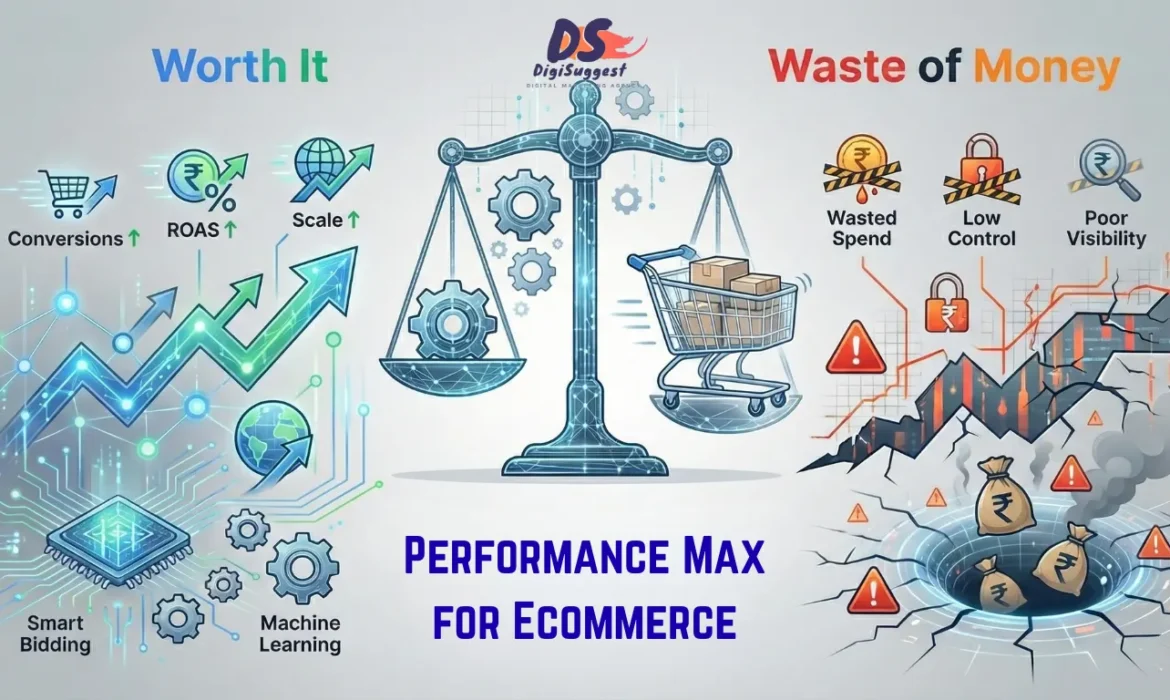
👉 Performance Max is neither magic nor useless.
👉 It’s powerful when used correctly and extremely expensive when used blindly.
This blog will give you an honest, non-Google-sales answer to:
- Is Performance Max worth it for ecommerce?
- When does it actually work?
- When does it burn money?
- How Indian ecommerce brands should really use it
- What Performance Max Actually Is
- Why Google Pushes Performance Max So Hard
- Why Performance Max Sometimes Looks Amazing (Initially)
- When Performance Max ACTUALLY Works
- When Performance Max Becomes a Waste of Money
- Performance Max vs Shopping Ads (Reality Check)
- How Indian Ecommerce Brands Should Use PMax
- India-Specific Performance Max Problems
- So… Is Performance Max Worth It?
- How Digi Suggest Uses Performance Max Profitably
First, What Performance Max Actually Is (Without Marketing Talk)
Google positions Performance Max as:
“One campaign to run across Search, Shopping, Display, YouTube, Discover, Gmail.”
But here’s what that really means:
Performance Max:
- Uses your Shopping feed
- Uses your creatives
- Uses your conversion data
- Uses automation heavily
- Decides placements on its own
👉 You don’t choose keywords.
👉 You don’t choose placements.
👉 You don’t control channel-level spend.
You are giving Google maximum control. That can be good or dangerous.
Why Google Pushes Performance Max So Hard
Let’s be honest. Google pushes PMax because:
- It increases automation adoption
- It uses more inventory (YouTube, Display, Discover)
- It simplifies account management
- It often increases spend
This does NOT automatically mean:
- Better ROAS
- Better profitability
- Better control for advertisers
Google optimizes for:
👉 Conversions, not your margins. That difference matters a lot in ecommerce.
Why Performance Max Sometimes Looks Amazing (Initially)
Many Indian ecommerce brands report: “PMax launch ke baad ROAS 3x aa gaya.” This usually happens because:
1️⃣ Brand Traffic Is Being Counted as “Success”
PMax often:
- Shows ads on brand searches
- Shows ads to people already searching for you
- Retargets existing users
So conversions that would have happened anyway: 👉 Get credited to PMax.
ROAS looks great. Incremental growth is questionable.
2️⃣ Low-Hanging Fruit Phase
In the beginning:
- Google targets easiest converters
- Uses warm audiences
- Plays safe
Once that’s exhausted:
- PMax expands aggressively
- CPA rises
- ROAS drops
👉 Early success ≠ long-term profitability.
Is your PMax ROAS dropping after a strong start?
Don't let automation burn your budget.
When Performance Max ACTUALLY Works for Ecommerce
Let’s be very clear. Performance Max does work but only under specific conditions.
✅ 1️⃣ You Already Have Stable Search & Shopping Campaigns
PMax works best when:
- Search Ads are structured
- Shopping Ads are optimized
- Feed quality is strong
- Conversion tracking is clean
In this case:
- PMax adds incremental volume
- Doesn’t replace core campaigns
- Scales reach safely
👉 PMax should be an expansion layer, not the foundation.
✅ 2️⃣ Your Product Feed Is High Quality
Performance Max is feed-driven for ecommerce. PMax works well if:
- Product titles are optimized
- Categories are accurate
- Images are high quality
- Pricing is competitive
- Availability is correct
Bad feed = bad PMax. No amount of ecommerce SEO or automation can fix poor feed data.
✅ 3️⃣ You Have Enough Conversion Data
PMax needs data to learn. It works best when:
- 30–50+ conversions/month
- Clean conversion tracking
- No duplicate or missing events
Without data: PMax guesses. Guessing is expensive.
✅ 4️⃣ You Don’t Need Micro-Level Control
If your goal is:
- Scale volume
- Expand reach
- Find new pockets of demand
PMax can help.
If your goal is:
- Strict CPA control
- Keyword-level optimization
- Tight intent targeting
PMax will frustrate you.
When Performance Max Becomes a Waste of Money
Now the important part.
❌ 1️⃣ Replacing Search & Shopping With PMax
This is the biggest Indian ecommerce mistake. Many agencies do this:
- Pause Shopping
- Pause Search
- Launch only PMax
Why? Because it’s easier to manage.
Result:
- Loss of control
- Brand traffic cannibalization
- ROAS confusion
- CPA instability
👉 PMax should never replace Search & Shopping completely.
❌ 2️⃣ New Ecommerce Brands Using PMax Too Early
If your brand is:
- New
- Low data
- No brand searches
- No stable conversions
PMax will:
- Spend on low-quality placements
- Chase cheap but bad traffic
- Burn budget
New ecommerce brands need:
PMax removes all three.
❌ 3️⃣ No Asset Optimization (Very Common)
Most Indian brands:
- Upload few images
- Add generic headlines
- Ignore videos
- Never refresh assets
Google then:
- Reuses poor creatives
- Shows low-engagement ads
- Pushes spend to low-quality inventory
Automation without quality inputs = waste.
❌ 4️⃣ No Visibility = No Accountability
With PMax:
- You don’t know where money goes
- You don’t know which keyword converts
- You don’t know which placement works
For many founders, this creates:
- Trust issues
- Panic decisions
- Blind spending
If you don’t track incrementality:
👉 PMax can silently waste money.
Performance Max vs Shopping Ads (Reality Check)
Many people think: “PMax = upgraded Shopping Ads”. That’s incorrect.
| Factor | Shopping Ads | Performance Max |
|---|---|---|
| Control | Medium | Very Low |
| Keyword visibility | Limited | None |
| Placement clarity | High | Low |
| Brand protection | Possible | Weak |
| CPA stability | Higher | Volatile |
| Best use | Core revenue | Expansion |
👉 Shopping Ads are foundational.
👉 PMax is experimental & scalable.
How Indian Ecommerce Brands Should Use Performance Max (Best Practice)
Here’s the safest, most profitable way to use PMax in India.
Step 1️⃣ Stabilize Search & Shopping First
Before PMax:
- Brand Search active
- Non-brand Search structured
- Shopping Ads optimized
- Feed cleaned
Step 2️⃣ Launch PMax as a Separate Layer
- Dedicated budget
- Not stealing core spend
- Clear performance expectations
Step 3️⃣ Exclude Brand Where Possible
- Use brand exclusions (where available)
- Monitor brand search trends
- Compare incremental lift
Step 4️⃣ Optimize Assets Aggressively
- Add multiple creatives
- Use real product visuals
- Refresh assets every 30–45 days
- Add videos (even simple ones)
Step 5️⃣ Judge PMax by Incremental Value, Not ROAS Alone
Ask:
- Did total revenue increase?
- Did blended CPA improve?
- Did brand searches grow?
Not just: “PMax ka ROAS kya hai?” See how to maximize ROI with PPC.
Want a Strategy that Scales Profitably?
We build foundations before enabling automation.
India-Specific Performance Max Problems (Very Important)
1️⃣ Cheap Display Traffic Problem
PMax often pushes spend to:
- Display
- YouTube
- Low-quality inventory
This brings:
- Low-intent clicks
- Poor conversion rate
- Fake engagement
2️⃣ COD & RTO Distortion
PMax optimizes for:
- Conversion event
Not for: - Delivered orders
So:
- Low-quality COD orders
- High RTO
- Artificial ROAS
Similar issues are seen with low ROAS on Meta Ads.
3️⃣ Marketplace Cannibalization
PMax can:
- Show ads on brand searches
- Compete with your own Shopping/Search
- Steal credit from better campaigns
So… Is Performance Max Worth It?
Here’s the honest answer:
👉 Performance Max is worth it IF:
- You already have a strong Google Ads foundation
- You want incremental scale
- You can afford some volatility
- You monitor performance carefully
👉 Performance Max is a waste of money IF:
- You replace Search & Shopping with it
- You’re a new brand
- You want strict control
- You don’t optimize feeds & assets
PMax is not bad. Blind PMax is.
According to Search Engine Land, automation requires strategic inputs to function correctly.
How Digi Suggest Uses Performance Max Profitably
At Digi Suggest, we don’t treat PMax as a shortcut. We treat it as a controlled expansion tool.
Our PMax Approach:
- Foundation-first (Search + Shopping)
- Feed & asset optimization
- Brand cannibalization checks
- Incrementality-based evaluation
- CPA & ROAS stability focus
🎯 Our goal is not to “use PMax”.
🎯 Our goal is profitable Google Ads growth.
🚀 Confused About Performance Max?
If PMax is spending your money but you’re unsure whether it’s actually helping your business, you need clarity not guesses. Get profitable Google Ads managed by Digi Suggest.
Final Thought
Performance Max is not the future of ecommerce advertising.
Controlled automation is.
Brands that:
- Use PMax blindly
- Lose money.
Brands that:
- Use PMax strategically
- Scale profitably
The difference is not the tool.
The difference is the strategy behind it.
FAQs
Yes, but only as an expansion tool. In 2026, Performance Max works best when layered on top of strong Search and Shopping campaigns.
Performance Max often captures brand and retargeting traffic early, which inflates ROAS before expanding to colder audiences.
No. Performance Max should not fully replace Shopping Ads in 2026, as it offers less control and higher volatility.
Yes, especially for brands with COD-heavy orders, weak feeds, or low data volume. Without control, PMax can burn money.
Brands should measure incremental revenue, blended CPA, and long-term impact not just reported ROAS.