Ecommerce SEO Is Not What It Used to Be
If you’re running an ecommerce brand in India and thinking:
- “SEO se pehle jaisa traffic nahi aa raha”
- “Blogs likhne ke baad bhi rankings nahi badh rahi”
- “Google updates ke baad sab disturb ho gaya”
You’re not wrong.
Ecommerce SEO in 2026 is very different from what worked even 2–3 years ago.
Old tactics like:
- Publishing generic blogs
- Keyword stuffing
- Random backlink building
- Ranking only informational content
…are no longer enough.
Google has changed. User behavior has changed. Competition has exploded.
Yet, SEO is still one of the most profitable growth channels for ecommerce, if done the right way.
This guide breaks down what actually works for ecommerce SEO in 2026, specifically for Indian D2C brands, and what you should completely stop wasting time on.
Is your Ecommerce SEO strategy outdated?
Get a strategy built for 2026.
- First, Understand This: Google Has One Goal in 2026
- What Stopped Working in Ecommerce SEO (Stop Doing This)
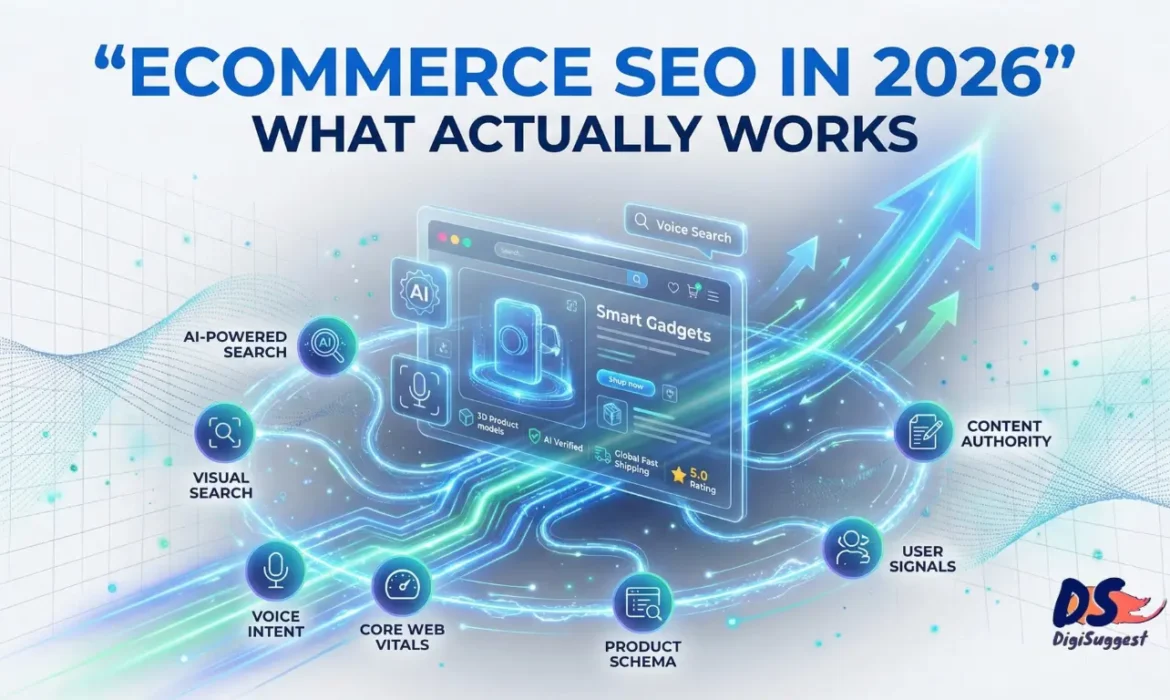
- What Actually Works for Ecommerce SEO in 2026
- What a Winning Ecommerce SEO Strategy Looks Like in 2026
- How Long Does Ecommerce SEO Take in 2026?
- Why Most Ecommerce Brands Still Fail at SEO
- How Digi Suggest Helps Ecommerce Brands Scale Organically
- Final Thought
First, Understand This: Google Has One Goal in 2026
Google’s goal is no longer just “best content”.
Google’s real goal is: 👉 Show the page that best helps users make a decision.
For ecommerce, that means:
- Helping users compare
- Helping users choose
- Helping users trust
- Helping users buy confidently
SEO today is not about ranking pages. It’s about earning trust at scale.
What Stopped Working in Ecommerce SEO (Stop Doing This)
Before we talk about what works, let’s be very clear about what does NOT work anymore.
❌ 1. Generic Blogging Without Purchase Intent
Blogs like:
- “What is skincare?”
- “Benefits of organic food”
- “Types of shoes”
These might get traffic, but:
- Traffic doesn’t convert
- Google doesn’t prioritize them
- AI summaries eat these queries
In 2026, informational-only blogs are the weakest SEO asset for ecommerce.
❌ 2. Backlinks Without Context
Buying backlinks from:
- Random blogs
- Low-quality directories
- Irrelevant guest posts
No longer moves the needle. Google evaluates:
- Relevance
- Topical authority
- Link context
- Brand signals
10 relevant links > 100 random links.
❌ 3. Treating SEO as a Side Task
SEO fails when:
- Done by interns
- Outsourced cheaply
- Treated as “extra work”
- Expected to deliver in 2 months
Ecommerce SEO in 2026 is a system, not a task.
What Actually Works for Ecommerce SEO in 2026
Now let’s talk about what does work - the real drivers of rankings, traffic and sales.
1️⃣ Category Pages Are the Backbone of Ecommerce SEO
If there is one thing ecommerce brands must get right in 2026, it’s category page SEO.
Yet most Indian D2C brands:
- Leave category pages empty
- Use only product grids
- Don’t write any contextual content
Why Category Pages Matter More Than Blogs
Category pages:
- Target buyer-intent keywords
- Capture ready-to-purchase traffic
- Scale faster than product pages
- Convert better than blogs
Example buyer-intent searches:
- “men t shirts online india”
- “best protein powder for beginners india”
- “skincare products for oily skin india”
These searches don’t want blogs. They want collections with clarity.
What Ranking Category Pages Look Like in 2026
High-performing category pages include:
- 500–1000 words of useful content
- Clear H1 + subheadings
- Buying guidance
- Internal links to subcategories
- FAQs addressing buyer doubts
- Optimized filters (non-indexed)
👉 Category pages are no longer just navigation pages. They are SEO landing pages.
2️⃣ Product Page SEO Is About Decision Support, Not Keywords
In 2026, product pages rank when they reduce hesitation. Most product pages fail because:
- Content is thin
- Descriptions are copied
- No FAQs
- No trust signals
- No real differentiation
What Google Rewards Now
Product pages that rank and convert:
- Explain who the product is for
- Explain why it’s better
- Address objections clearly
- Include UGC & reviews
- Use structured data properly
For Indian buyers, this means addressing:
- COD availability
- Return & exchange clarity
- Delivery timelines
- Authenticity concerns
SEO content that helps people decide beats content that just exists.
Need High-Converting Product Pages?
We optimize for decision-making, not just keywords.
3️⃣ Buyer-Intent Content > Informational Content
This is a massive shift. In 2026, ecommerce SEO content must align with commercial intent.
Content That Works:
- “Best ___ for ___”
- “___ vs ___”
- “Is ___ worth buying?”
- “___ price in India”
- “___ for Indian conditions”
Content That Underperforms:
- Definitions
- General education
- Academic-style articles
Why? Because:
- AI summaries cover generic info
- Google prioritizes decision-making content
- Brands must show expertise, not just knowledge
👉 SEO content should move users closer to purchase, not just educate them.
4️⃣ Internal Linking Is Now a Ranking Multiplier
In ecommerce SEO 2026, internal linking is no longer optional. Google uses internal links to understand:
- Page importance
- Topic relationships
- Conversion pathways
Yet most ecommerce websites:
- Publish content
- Forget to link it properly
- Create orphan pages
Proper Internal Linking Structure
A strong ecommerce SEO structure looks like:
- Blogs → Category pages
- Category pages → Top products
- Product pages → Supporting blogs
- FAQs → Related collections
This creates topical authority and improves crawl efficiency.
👉 Pages that receive more internal links from relevant content rank faster.
5️⃣ Technical SEO Is the Foundation (Especially Mobile)
No matter how good your content is, SEO will fail if the technical foundation is weak. In India:
- 75%+ ecommerce traffic is mobile
- Slow websites lose rankings quietly
What Actually Matters in 2026
- Mobile-first performance
- Core Web Vitals
- Clean URL structure
- Proper indexing control
- Canonical handling for filters
- Schema implementation
Platforms like Shopify and WooCommerce are SEO-friendly but not SEO-optimized by default.
Technical SEO is no longer about “best practices”. It’s about user experience at scale.
6️⃣ Brand Signals Matter More Than Ever
In 2026, Google heavily relies on brand signals to evaluate trust. Signals include:
- Brand searches
- Branded traffic
- Mentions across the web
- Reviews
- Engagement metrics
This is why:
- Strong brands rank faster
- New brands struggle initially
- SEO and branding overlap more than ever
👉 SEO is no longer isolated from brand building.
7️⃣ AI Didn’t Kill SEO - It Just Changed SEO
AI tools didn’t kill ecommerce SEO. They killed:
- Low-effort content
- Generic explanations
- Mass-produced blogs
AI-assisted SEO works when:
- Human strategy leads
- AI supports execution
- Content is refined for intent
- Pages are built for buyers
In 2026, AI is a tool, not a strategy.
8️⃣ India-Specific Ecommerce SEO Realities
Indian ecommerce SEO has unique challenges:
Language & Cultural Context
- English-only SEO limits reach
- Regional intent is growing
- Hinglish queries are increasing
COD & Trust
- Buyers need reassurance
- SEO content must address risk
Competition Explosion
- Thousands of D2C brands
- SEO is no longer “easy wins”
Brands that adapt to Indian buyer psychology win.
What a Winning Ecommerce SEO Strategy Looks Like in 2026
A future-ready SEO strategy includes:
- Category-first SEO
- Product pages built for decisions
- Buyer-intent content clusters
- Strong internal linking
- Solid technical foundation
- Brand-building integration
- Long-term consistency
SEO is no longer about tricks. It’s about systems.
How Long Does Ecommerce SEO Take in 2026?
Let’s set realistic expectations:
- 0–3 months: Foundation & fixes
- 3–6 months: Early traction
- 6–12 months: Scalable growth
- 12+ months: Predictable organic sales
SEO compounds. Those who stay consistent win disproportionately.
Why Most Ecommerce Brands Still Fail at SEO
Because they:
- Focus on shortcuts
- Ignore intent
- Avoid technical work
- Expect fast results
- Treat SEO as content writing
SEO doesn’t fail. Execution does.
How Digi Suggest Helps Ecommerce Brands Scale Organically
At Digi Suggest, we don’t do generic SEO. We build ecommerce-first SEO systems designed for:
- Indian D2C brands
- Long-term growth
- Sales-focused outcomes
- Category & product SEO optimization
- Buyer-intent keyword research
- Technical SEO audits
- Internal linking architecture
- Content that drives revenue, not vanity traffic
🎯 We help brands scale organically with clarity and consistency.
Need an Ecommerce SEO Agency?
Digi Suggest helps brands scale organically.
Final Thought
Ecommerce SEO in 2026 rewards:
- Depth over volume
- Intent over traffic
- Systems over hacks
- Trust over tricks
If your SEO strategy is still based on old playbooks, you’ll struggle.
If you adapt now, SEO can become your strongest growth channel.
FAQs
Yes. Ecommerce SEO is more valuable in 2026 than before because it reduces dependency on ads, builds long-term traffic, and improves profitability as ad costs continue to rise.
Google now prioritizes buyer intent, category pages, product decision support, internal linking, UX signals, and brand trust instead of generic blogs and backlinks.
Blogs work only when they support buying decisions. Informational blogs alone don’t drive ecommerce sales anymore; buyer-intent and comparison content performs better.
Typically, 3–6 months for early traction and 6–12 months for consistent organic sales, depending on competition and execution quality.
Category page optimization combined with buyer-intent content and strong internal linking is the biggest driver of ecommerce SEO success.