
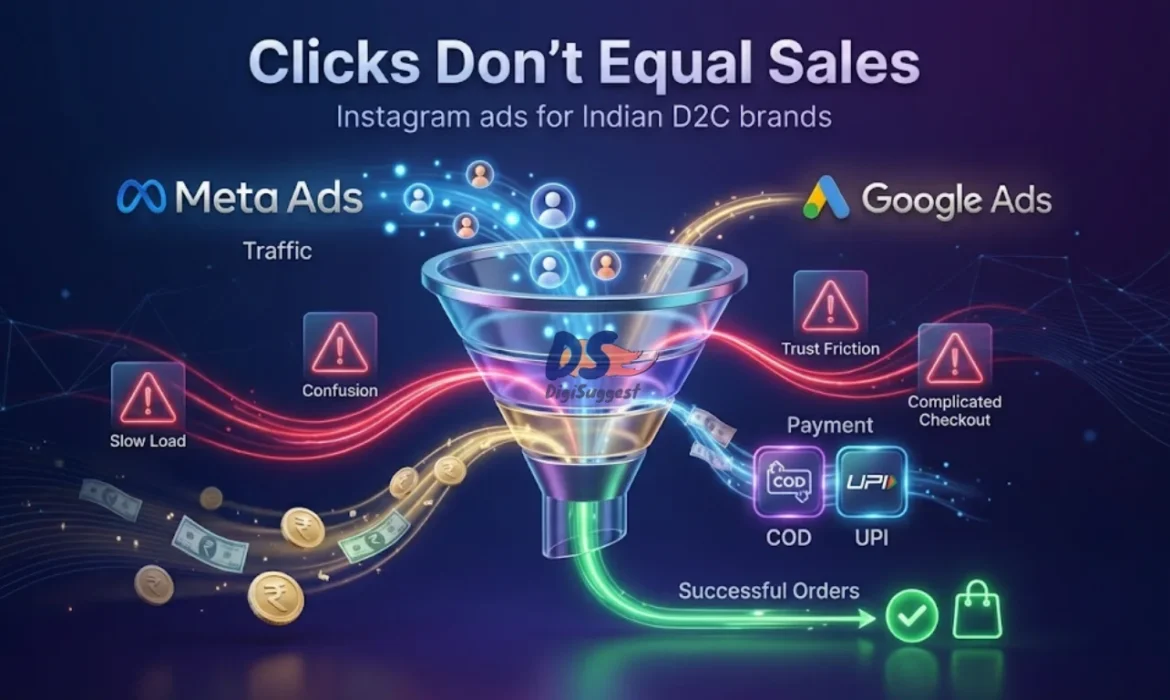
“User Click Karta Hai… Phir Kya Hota Hai?”
Most ecommerce brands believe their funnel looks like this:
Ad → Product Page → Checkout → Sale
That’s not a funnel.
That’s hope.
In reality, ecommerce sales are not linear.
They are emotional, hesitant, distracted and fragmented - especially in India.
This is why brands say:
- “Traffic aa raha hai, sales nahi”
- “Ads ka ROAS unstable hai”
- “Users checkout tak jaate hain, par buy nahi karte”
- “Repeat sales nahi aa rahi”
The problem is rarely:
- Traffic quality
- Ad platform
- Budget
👉 The real problem is a broken ecommerce funnel.
This blog explains:
- What an ecommerce funnel actually is
- How users move from click to conversion
- Where most Indian ecommerce brands leak revenue
- How to fix funnel gaps in 2026
- What Is an Ecommerce Funnel (Really)?
- Why Most Ecommerce Funnels Fail (Especially in India)
- Stage 1: The Click (Where Funnels Are Born)
- Stage 2: Landing Page (Interest or Exit)
- Stage 3: Exploration (Silent Decision-Making)
- Stage 4: Add to Cart (Intent, Not Commitment)
- Stage 5: Checkout (Where Money Is Won or Lost)
- Stage 6: Purchase Confirmation (Big Mistake)
- Stage 7: Retention & Repeat Purchases
- The Biggest Ecommerce Funnel Mistakes Indian Brands Make
- How Traffic, CRO & Funnels Work Together
- Funnel Optimization vs More Traffic: The ROI Truth
- What a Healthy Ecommerce Funnel Looks Like in 2026
- How Digi Suggest Optimizes Ecommerce Funnels
- Final Thought
What Is an Ecommerce Funnel (Really)?
An ecommerce funnel is not pages.
It is user psychology over time.
A funnel represents how users move through these mental stages:
- Awareness
- Interest
- Consideration
- Trust
- Purchase
- Retention
Pages support these stages but they don’t replace them.
👉 Funnels are psychological journeys, not URLs. You can read more about sales funnel stages here.
Why Most Ecommerce Funnels Fail (Especially in India)
Most funnels fail because brands assume:
- Users are ready to buy
- One visit is enough
- One ad can close a sale
- Discounts replace trust
Indian ecommerce users:
- Compare heavily
- Research slowly
- Distrust new brands
- Get distracted easily
- Often return multiple times
If your funnel doesn’t support this behavior:
👉 Users drop out silently.
Is your Ecommerce Funnel Leaking Revenue?
Stop guessing. Start converting.
Stage 1: The Click (Where Funnels Are Born)
The funnel starts before the website.
The click comes from:
- Meta Ads
- Google Ads
- SEO
- Influencers
- WhatsApp / Email
The Biggest Funnel Mistake at This Stage
Sending traffic with misaligned intent.
Example:
- Ad promises “problem solution”
- Landing page shows product features
- User feels confused
Funnel Principle
👉 Every click carries an expectation.
Your landing page must match it.
This is called message match and it’s critical.
Stage 2: Landing Page (Interest or Exit)
This is where most funnels collapse.
Users ask subconsciously:
- “Am I in the right place?”
- “Is this relevant to me?”
- “Can I trust this brand?”
Common Funnel Leaks Here
- Vague messaging
- Slow page speed
- No clarity above the fold
- No trust signals
What a Funnel-Ready Landing Page Does
- Clearly explains the product
- Shows who it’s for
- Builds trust immediately
- Guides the next action
👉 Landing pages don’t sell. They guide.
Stage 3: Exploration (Silent Decision-Making)
If users don’t bounce, they explore:
- Scroll
- Click images
- Read reviews
- Check FAQs
- Open policies
This stage is invisible in dashboards but crucial.
What Users Are Really Doing
They’re asking:
- “Is this legit?”
- “Will this work for me?”
- “What if I regret it?”
Funnel Leak Here
- Weak product pages
- Feature-heavy content
- No proof
- Poor mobile UX
Funnel Fix
- Benefits over features
- Social proof everywhere
- Clear use cases
- Real images & videos
👉 Users don’t need more info.
They need more confidence.
Stage 4: Add to Cart (Intent, Not Commitment)
Add to cart feels like success but it’s not.
In India:
- Add to cart is often “bookmarking”
- Users add and leave (known as cart abandonment)
- Intention exists, commitment doesn’t
Funnel Leak
Brands celebrate add-to-cart but ignore:
- Cart clarity
- Cart friction
- Cart reassurance
Funnel Fix
- Clear pricing
- Shipping & COD clarity
- Easy cart edits
- Visible trust signals
👉 Add to cart = interest. Checkout = trust.
Don't let high intent users drop off.
We optimize your cart and checkout flow.
Stage 5: Checkout (Where Money Is Won or Lost)
Checkout is the most fragile stage.
Users are ready but anxious.
They think:
- “Is payment safe?”
- “What if delivery is late?”
- “What if product is bad?”
- “What if return is hard?”
Common Funnel Killers
- Forced login
- Long forms
- Hidden charges
- Payment failures
- Poor mobile checkout
Funnel Fix
- Guest checkout
- Minimal fields
- Transparent pricing
- COD clarity
- Reassurance near CTA
👉 Checkout optimization is emotional optimization.
Stage 6: Purchase Confirmation (Most Brands Stop Here - Big Mistake)
After purchase, brands relax.
But this stage decides:
- Trust
- Repeat purchases
- Word of mouth
- Refund anxiety
Funnel Leak
- Poor confirmation page
- No reassurance
- No next steps
Funnel Fix
- Clear order summary
- Delivery expectations
- Support info
- Thank-you messaging
- Cross-sell (soft)
👉 Post-purchase experience decides loyalty.
Stage 7: Retention & Repeat Purchases (The Hidden Funnel)
Most ecommerce profit comes from:
Yet many brands:
- Ignore post-purchase funnel
- Focus only on acquisition
- Burn money repeatedly
Funnel Fix
- Email & WhatsApp flows
- Product education
- Review requests
- Repeat purchase offers
- Loyalty incentives
👉 Acquisition without retention is expensive.
The Biggest Ecommerce Funnel Mistakes Indian Brands Make
- ❌ Assuming one visit = one sale
- ❌ Sending cold traffic directly to checkout
- ❌ Ignoring mobile behavior
- ❌ Overusing discounts instead of trust
- ❌ Fixing ads instead of funnel leaks
- ❌ Measuring only last-click ROAS
Funnels fail when brands think tactically, not holistically.
How Traffic, CRO & Funnels Work Together
Traffic brings users.
CRO removes friction.
Funnels guide decisions.
If any one is weak:
- Growth stalls
- Costs rise
- ROAS becomes unstable
👉 Funnels multiply the impact of traffic.
Funnel Optimization vs More Traffic: The ROI Truth
Option A:
- Increase ad spend by 20%
- Risk higher CPA
Option B:
- Fix funnel leaks
- Improve conversion by 20%
- Same traffic, more revenue
👉 Funnel optimization always wins long-term.
What a Healthy Ecommerce Funnel Looks Like in 2026
A strong funnel:
- Matches intent at every step
- Builds trust progressively
- Reduces friction continuously
- Supports Indian buyer behavior
- Works on mobile first
- Encourages repeat purchases. See India's growing ecommerce stats here.
It doesn’t force sales.
It removes reasons not to buy.
How Digi Suggest Optimizes Ecommerce Funnels
At Digi Suggest, we don’t optimize pages in isolation.
We optimize the entire ecommerce funnel.
Our Funnel Optimization Approach
- Traffic & intent audit
- Funnel-stage diagnostics
- Friction & trust mapping
- CRO + speed optimization
- Checkout & retention fixes
🎯 We don’t chase clicks.
🎯 We fix the journey.
🚀 Getting Clicks but Not Conversions?
If your ecommerce store is getting traffic but not consistent sales, the problem is almost always the funnel not the ads.
Final Thought
Ecommerce success is not about:
- One ad
- One page
- One trick
It’s about:
- Guiding users
- Building trust
- Removing friction
- Respecting buyer psychology
Traffic brings users.
Funnels turn them into customers.
If you want sustainable ecommerce growth fix the funnel.
FAQs
An ecommerce funnel represents the journey users take from first click to purchase, including awareness, trust-building, checkout, and retention.
Funnels fail because brands focus on traffic instead of intent, trust, and friction removal across different user stages.
No. Funnels are psychological journeys. Pages support funnels, but user intent and decision-making drive conversions.
Brands should analyze bounce rates, scroll depth, add-to-cart drop-offs, checkout exits and repeat purchase data.
Better funnel optimization is usually more profitable, as it increases revenue from existing traffic without increasing acquisition costs.


[…] funnel was leaking money. […]
[…] Google Shopping Ads and Google Search Ads are NOT competitors. They serve different roles in the ecommerce buying journey. […]
[…] ROAS = Ad + Creative + Landing Page + Offer + Funnel + […]
[…] ad spend doesn’t break ecommerce brands. Weak funnels […]
[…] ❌ Funnel mismatch […]