
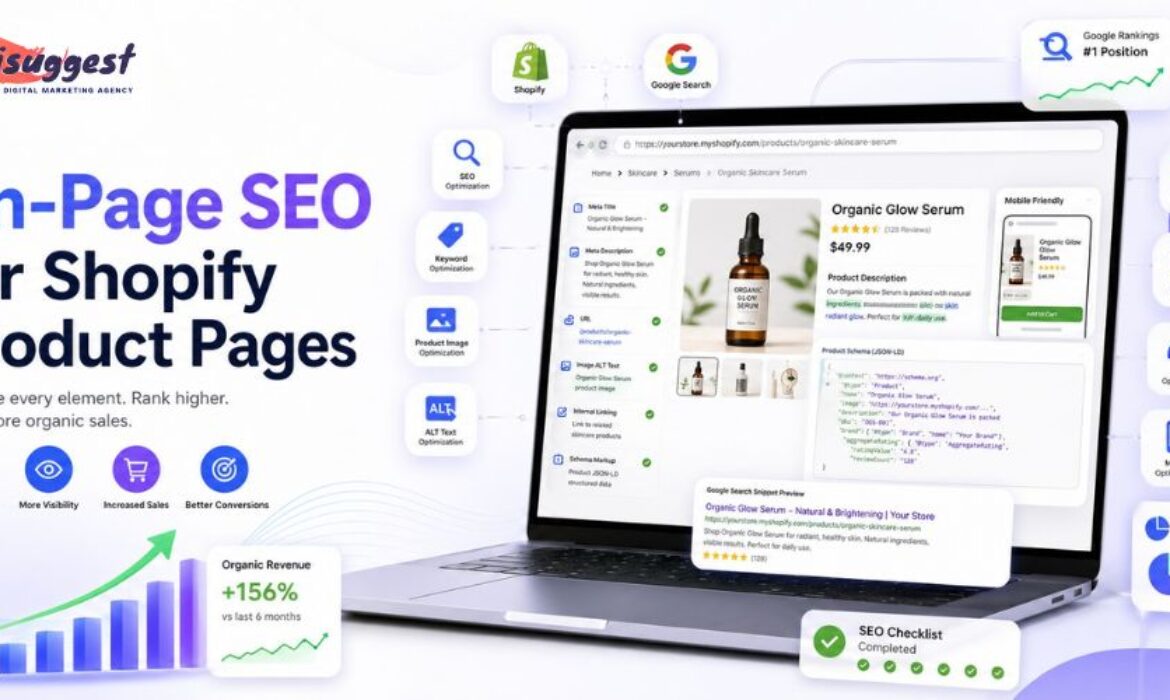
In the rapidly evolving eCommerce landscape of 2026, a Shopify product page can no longer function as just a digital product catalog. With Google's shift toward Generative Engine Optimization (GEO) and the rapid adoption of AI-powered search experiences, every product page must serve two audiences simultaneously—search engines that analyze structured data and customers who expect trust, transparency, and an exceptional shopping experience.
For brands competing in India's highly competitive online marketplace, this has become more important than ever. Modern shoppers don't simply compare prices—they compare trust signals, page speed, customer reviews, product information, and overall user experience before making a purchase decision.
Whether you're optimizing a fashion store, electronics website, beauty brand, or a growing D2C business, every element of your Shopify product page—from Core Web Vitals and schema markup to product descriptions and internal linking—directly impacts your visibility in both traditional search results and AI-generated recommendations.
As a leading Shopify Website Development Agency in Delhi India, Digi Suggest has created this comprehensive guide to help businesses optimize their Shopify product pages for higher rankings, increased conversions, and long-term organic growth in 2026.
- The Architecture of a High-Ranking Product Page
- Writing for Factual Density (The 2026 AI Requirement)
- The Technical Trio: Meta Tags, URLs & Image SEO
- Schema Markup: Speaking Google's Language
- Mobile Optimization & Core Web Vitals
- User-Generated Content (UGC) as SEO Fuel
- Internal Linking Strategy
- Why Choose Digi Suggest?
- Related Shopify Blogs
- Conclusion
- FAQs
The Architecture of a High-Ranking Product Page
Every successful Shopify product page serves two important purposes. First, it provides structured information that helps Google and AI search engines understand your products. Second, it builds trust by giving shoppers all the information they need to make confident purchasing decisions.
In today's AI-first search environment, product pages must be informative, technically optimized, and conversion-focused. Search engines no longer rely only on keywords—they evaluate content quality, page structure, loading speed, structured data, and user engagement before determining rankings.
The "Above the Fold" Strategy
The first screen your visitors see after landing on a product page has the greatest influence on both search performance and conversions. Essential product information should be immediately visible without forcing users to scroll.
- Use a descriptive H1 product title. Instead of generic names like "Blue Kurta," use detailed titles such as Royal Blue Cotton Lucknowi Chikankari Kurta for Men.
- Display pricing clearly in Indian Rupees (₹). Local currency helps customers make quicker purchasing decisions while giving Google stronger geographic relevance.
- Highlight product availability. Clearly indicate whether the item is in stock, low in stock, or available for pre-order.
- Show important trust signals. Ratings, verified reviews, secure payment icons, delivery estimates, and return policies should be visible immediately.
- Use high-quality product images. Display multiple product angles with zoom functionality for a better shopping experience.
Google increasingly rewards product pages that provide complete information immediately because they improve the overall user experience and reduce bounce rates.
Build a Logical Breadcrumb Structure
Breadcrumb navigation helps both visitors and search engines understand where a product belongs within your website. It improves navigation, distributes internal link equity, and creates a cleaner site architecture.
A recommended Shopify breadcrumb structure looks like:
Home → Men's Wear → Kurtas → Royal Blue Chikankari Kurta
Well-structured breadcrumbs make it easier for Google to crawl your website while helping shoppers quickly navigate back to collections or related categories.
Need Better Shopify Product Pages?
Our Shopify experts optimize every product page for higher rankings, faster loading speeds, and improved conversion rates.
A strong product page doesn't stop with great design—it also requires proper technical optimization behind the scenes. We recommend reviewing our Shopify Store Speed Optimization Guide 2026 to improve Core Web Vitals and reading How to Rank Your Shopify Store on Google for additional SEO strategies.
Writing for Factual Density (The 2026 AI Requirement)
In 2026, Google's AI doesn't reward product pages filled with marketing buzzwords—it rewards pages that provide accurate, structured, and useful information. This concept is known as Factual Density, where every section of your product page contributes meaningful data that both search engines and customers can understand.
Instead of writing generic descriptions, focus on explaining exactly what the product is, who it is designed for, how it should be used, and why it performs better than competing alternatives. The more complete your product information, the easier it becomes for AI-powered search engines to recommend your products.
The "Chunking" Method
Rather than publishing one large paragraph, divide your product description into well-organized sections that are easy for users to scan and AI models to interpret.
- Product Specifications: Clearly mention material, dimensions, weight, size options, manufacturing process, country of origin, warranty, and compatibility.
- Usage Scenarios: Explain where and when customers should use the product. For example, "Ideal for Delhi's humid summers" or "Perfect for festive occasions and wedding ceremonies."
- Key Benefits: Highlight practical advantages such as wrinkle resistance, breathable fabric, waterproof construction, or organic ingredients.
- Unique Selling Points: Showcase features that differentiate your product from competitors.
- Care Instructions: Provide washing, maintenance, or storage guidelines wherever applicable.
Breaking information into logical sections improves readability, keeps visitors engaged for longer, and increases the chances of appearing in AI-generated search summaries.
Need AI-Optimized Product Content?
Create detailed, SEO-friendly Shopify product pages that rank higher on Google and convert more visitors into customers.
The Technical Trio: Meta Tags, URLs & Image SEO
Some of the most important SEO elements on a Shopify product page are invisible to shoppers but extremely valuable to search engines. Optimizing your meta tags, URL structure, and image attributes helps Google understand your content while improving click-through rates from search results.
Meta Titles & Meta Descriptions
Never rely on Shopify's automatically generated meta titles and descriptions. Instead, write unique metadata for every important product page.
- Keep meta titles under 60 characters.
- Write compelling meta descriptions within 150–160 characters.
- Include your primary keyword naturally.
- Add a strong call-to-action such as "Shop Now," "Free Delivery," "Cash on Delivery Available," or "Limited Stock."
Example Meta Title:
Buy Blue Cotton Chikankari Kurta | Free Delivery Across India
Example Meta Description:
Premium handwoven blue cotton Chikankari kurta with fast delivery, easy returns, and secure payments. Shop online today.
Create Clean, SEO-Friendly URLs
Short, descriptive URLs help both users and search engines understand page content more easily.
Recommended URL:
yourstore.com/products/blue-cotton-chikankari-kurta
Avoid URLs like:
yourstore.com/products/product123-blue-sale-item-final
Keep URLs simple, readable, and focused on your primary keyword.
Optimize Every Product Image
Google Images continues to drive valuable organic traffic, making image optimization an essential part of Shopify SEO.
- Rename image files before uploading.
- Use descriptive ALT text for every image.
- Upload WebP or AVIF images for faster loading.
- Compress images without compromising quality.
- Include your primary keyword naturally in one or two ALT attributes.
Example Image Name:
blue-cotton-chikankari-kurta-men.webp
Example ALT Text:
Front view of a man wearing a royal blue cotton Lucknowi Chikankari kurta against a white background.
Well-optimized images improve accessibility, increase image search visibility, and provide additional relevance signals to Google's algorithms.
Schema Markup: Speaking Google's Language
Schema Markup (JSON-LD) allows your Shopify product pages to communicate directly with search engines. Instead of forcing Google to guess what your content represents, structured data provides clear information about products, pricing, reviews, availability, and business details.
Proper Schema implementation significantly increases your chances of earning rich search results that attract more clicks and improve organic visibility.
Essential Schema Types for Shopify Product Pages
- Product Schema – Displays product name, price, currency, SKU, availability, and brand information.
- Review Schema – Enables star ratings to appear in Google Search.
- FAQ Schema – Helps your questions appear in Google's "People Also Ask" section.
- Breadcrumb Schema – Improves navigation understanding for search engines.
- Video Schema – Increases visibility when product demonstration videos are available.
Rich snippets containing product ratings, pricing, and availability often receive significantly higher click-through rates compared to standard search listings.
To further improve your Shopify SEO strategy, read our How to Rank Your Shopify Store on Google, explore our Shopify SEO Services, and learn how faster websites improve rankings in our Shopify Store Speed Optimization Guide 2026.
Mobile Optimization & Core Web Vitals
With more than 85% of online shopping in India happening on smartphones, your Shopify product page must be designed for mobile-first users. Google now evaluates mobile performance before desktop performance, making Core Web Vitals one of the strongest ranking signals for eCommerce websites.
A fast-loading, responsive, and easy-to-use product page not only improves search rankings but also increases customer confidence and reduces cart abandonment.
Optimize Largest Contentful Paint (LCP)
Your primary product image is usually the Largest Contentful Paint (LCP) element. It should load within 2.5 seconds to deliver an excellent user experience.
- Convert product images to WebP or AVIF.
- Compress images before uploading.
- Preload your hero product image.
- Avoid oversized image dimensions.
- Use Shopify's responsive image loading.
Reduce Layout Shifts (CLS)
Unexpected page movement frustrates users and negatively affects Google's Core Web Vitals score.
- Always define image dimensions.
- Reserve space for banners and promotional widgets.
- Avoid dynamically inserting content above the Add to Cart button.
- Load third-party widgets after the primary content.
Create a Sticky Call-to-Action
Customers shouldn't have to scroll back to purchase a product after reading reviews or specifications.
- Keep the Add to Cart button visible.
- Include Buy Now for faster checkout.
- Display pricing beside the CTA.
- Ensure buttons remain thumb-friendly on mobile devices.
Want Faster Shopify Product Pages?
Improve Core Web Vitals, boost search rankings, and increase conversions with professionally optimized Shopify product pages.
User-Generated Content (UGC) as SEO Fuel
Google continues to prioritize authentic customer experiences, making User-Generated Content one of the most valuable SEO assets for Shopify stores. Reviews, ratings, customer photos, and videos continuously add fresh content to your product pages while increasing buyer confidence.
Unlike AI-generated content, genuine customer feedback demonstrates real-world experience and provides additional context that search engines can use when evaluating product relevance.
Encourage Rich Customer Reviews
- Allow customers to upload product photos.
- Collect video testimonials whenever possible.
- Ask buyers to describe their experience in detail.
- Reply to customer reviews to build trust.
- Display verified purchase badges.
For example, a review such as "Perfect fit for XL size and extremely comfortable during Delhi summers" naturally introduces valuable long-tail keywords that improve your page's relevance without additional content writing.
Photo reviews also increase trust and help Google's AI understand that your products are being used by genuine customers.
Internal Linking: Connecting Your Shopify Store
Your Shopify product pages should never exist in isolation. Strategic internal linking improves crawlability, distributes page authority throughout your website, and helps customers discover additional products and useful resources.
Best Internal Linking Practices
- Link related products.
- Display "Customers Also Bought" recommendations.
- Connect product pages with buying guides.
- Link to relevant category pages.
- Use descriptive anchor text instead of generic phrases like "Click Here."
For example, if you're selling Chikankari Kurtas, you can naturally link to styling guides, seasonal fashion blogs, fabric care instructions, and related product collections. This improves user engagement while strengthening your topical authority.
We also recommend exploring our Shopify SEO Services, reading How to Rank Your Shopify Store on Google, and improving performance using our Shopify Store Speed Optimization Guide 2026.
Why Choose Digi Suggest?
Optimizing hundreds of Shopify product pages manually can become overwhelming. At Digi Suggest, we combine technical SEO, AI-ready content, Core Web Vitals optimization, Schema Markup, and conversion-focused UX to create product pages that rank higher and sell more.
Our Shopify product page optimization services include:
- Technical SEO Audits
- Product Page Optimization
- Schema Markup Implementation
- Core Web Vitals Optimization
- Image SEO
- Internal Linking Strategy
- Content Optimization for GEO
- Conversion Rate Optimization
- AI Search Optimization
- Monthly Performance Monitoring
Related Shopify Blogs
- Shopify Store Speed Optimization Guide 2026
- How to Rank Your Shopify Store on Google
- Custom vs Theme-Based Shopify Development in India
- Complete Shopify Store Setup Guide
- Shopify Pricing Plans India 2026
- Cost of Shopify Website Development in India
- eCommerce Conversion Rate Optimization Guide
- Why Mobile-First Design is Crucial for Indian Businesses
Conclusion: Every Product Page is a Landing Page
Your Shopify product page is often the first interaction a customer has with your brand. A well-optimized page doesn't just rank higher—it educates visitors, builds trust, answers buying questions, and guides users toward making confident purchasing decisions.
By combining technical SEO, structured data, compelling product content, optimized images, customer reviews, internal linking, and excellent mobile performance, your Shopify product pages become powerful assets capable of generating consistent organic traffic and higher conversion rates.
At Digi Suggest, we help businesses transform ordinary product pages into high-performing sales pages that are optimized for both Google's search algorithms and the future of AI-powered search.
FAQs
Yes, but place it at the end unless your brand is world-famous. For most Delhi-based startups, leading with the Product Category + Key Feature is better for SEO because that’s what people are actually searching for.
Aim for 4-7 images. While more images provide a better user experience, ensure they are all compressed. Use different angles, a close-up of the fabric, and at least one “lifestyle” shot showing the product in a real-life setting.
Basic Shopify themes include some Schema, but they often miss “FAQ Schema” or “Review Schema.” Using an app like Avada SEO or custom code from Digi Suggest can fill these gaps and give you a competitive edge.
Never delete the page! Deleting it creates a 404 error and kills your SEO ranking. Keep the page live, show “Related Products,” and provide an “Email me when back in stock” button to capture the lead.
Aim for 300-500 words. This provides enough “textual meat” for search engines to crawl while remaining readable for mobile users. Break it up with clear headings, bold text, and bullet points to keep it “skimmable.”


