Client Background
- Client: Bharat Reshma
- Industry: Ethnic wear & traditional textiles
- Business Model: D2C ecommerce
- Market: India (pan-India shipping)
Bharat Reshma is a bollywood inspired Indian brand selling premium traditional and ethnic men's wear online. The brand had a strong offline reputation and high-quality products, but ecommerce performance did not reflect that belief.
The founders believed in the product, but ecommerce performance did not reflect that belief.
- The Situation Before Digi Suggest
- The Real Problem (What Most Agencies Miss)
- Why Their Earlier Efforts Failed
- Digi Suggest’s Growth Philosophy for This Project
- Step 1: Funnel & Website Audit (Foundation)
- Step 2: CRO & Website Optimization
- Step 3: Paid Ads Strategy (After Funnel Fix)
- Step 4: Continuous Optimization (Scaling Phase)
- Results: 300% Increase in Ecommerce Sales
- Key Learnings for Other Ecommerce Brands
- How Digi Suggest Helps Ecommerce Brands Scale
The Situation Before Digi Suggest
When Bharat Reshma approached us in October 2021, their ecommerce store had:
- Website traffic from ads and no organic traffic at all
- Regular Instagram activity
- Active Google & Meta Ads campaigns
Yet, results were disappointing.
Key Problems Observed
- Online sales were inconsistent and stagnant
- Paid ads were running, but ROAS was unstable
- Cost per purchase kept increasing
- Traffic was coming in, but conversion rate was low
- Scaling ads resulted in higher spend, not higher profit
In simple words:
Traffic existed. Sales did not scale.
This is a very common situation for Indian ecommerce brands.
Struggling with high traffic but low sales?
The Real Problem (What Most Agencies Miss)
At first glance, many agencies would say:
- “Increase ad budget”
- “Run more creatives”
- “Try influencers”
But after auditing the account and website, the real problem became clear:
👉 Bharat Reshma did not have a scalable ecommerce funnel.
More specifically:
- Ads were sending traffic without intent alignment
- Homepage messaging was unclear for new users
- Product pages lacked strong trust signals
- Checkout experience had friction for first-time buyers
- CRO was completely missing from the growth strategy
This meant:
Even good traffic could not convert consistently.
Why Their Earlier Efforts Failed
Before working with us, the brand had already tried:
- Increasing Meta Ads budgets
- Running discount-based campaigns
- Promoting products on Instagram
But these approaches failed because:
- Discounts attracted price-only buyers
- Ads were not aligned with landing pages
- Website experience did not support decision-making
- Checkout drop-offs were high
👉 The brand was trying to scale traffic before fixing conversions.
Digi Suggest’s Growth Philosophy for This Project
At Digi Suggest, we follow one rule:
Never scale traffic before fixing the funnel.
So instead of jumping straight into aggressive advertising, we rebuilt the entire ecommerce growth system.
Our strategy had four clear pillars:
- Funnel clarity
- CRO & trust building
- Performance-focused ads
- Scalable optimization framework
Step 1: Funnel & Website Audit (Foundation)
We started with a full funnel audit, not just ads.
What We Analyzed
- User behavior (entry pages, exits, drop-offs)
- Homepage clarity & trust signals
- Product page content & structure
- Checkout friction points
- Mobile experience (critical for India)
Key Insights
- Homepage did not clearly communicate why the brand was different
- New users did not immediately trust the brand
- Product pages focused more on product description than benefits
- Checkout lacked reassurance for first-time buyers
This explained the low conversion rate.
Step 2: CRO & Website Optimization
Instead of redesigning everything, we applied high-impact CRO fixes.
Homepage Optimization
- Clear value proposition above the fold
- Trust signals (heritage, quality, authenticity)
- Strong primary CTA guiding users to products
Product Page Optimization
- Benefit-focused product descriptions
- Real product imagery and use-case clarity
- Clear delivery, return, and COD information
- Social proof placement near CTAs
Checkout Optimization
- Reduced friction in form fields
- Clear COD and delivery messaging
- Reassurance near payment buttons
👉 These changes alone improved user confidence and flow.
Need a high-impact CRO Audit for your store?
Step 3: Paid Ads Strategy (After Funnel Fix)
Only after fixing the website funnel did we scale ads.
Meta Ads Strategy
- Shifted from discount-only creatives to story + product value creatives
- Focused on problem-awareness for cold audiences
- Used retargeting to close warm users
- Controlled budget scaling to avoid CPA spikes
Google Ads Strategy
- Focused on high-intent search & shopping traffic
- Optimized product feed for relevance and clarity
- Avoided wasteful keywords and placements
👉 Ads were now sending ready-to-convert traffic to a conversion-ready website.
Step 4: Continuous Optimization (Scaling Phase)
Scaling was done gradually and systematically. We:
- Monitored conversion rates closely
- Identified winning creatives and messages
- Removed underperforming traffic sources
- Improved ROAS by improving conversion efficiency, not just bids
This allowed the brand to scale without losing profitability.
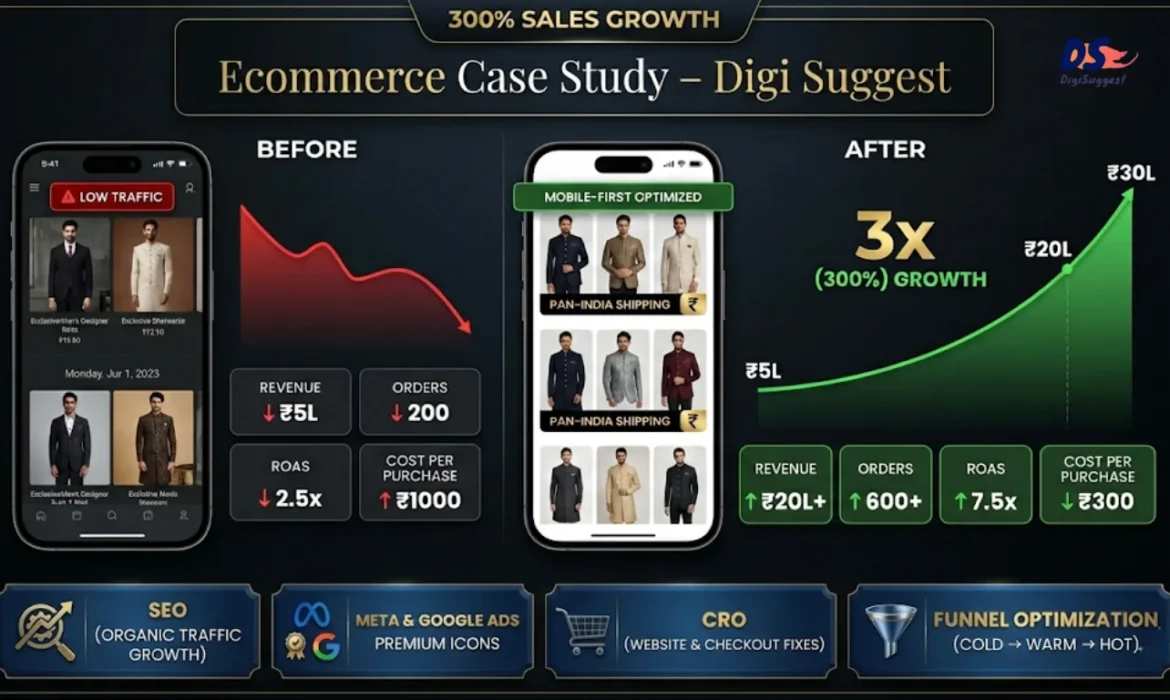
Results: 300% Increase in Ecommerce Sales
Within a few months of implementing this strategy, Bharat Reshma achieved:
📈 Key Outcomes
- 300% growth in online sales
- Significant improvement in conversion rate
- Lower cost per purchase despite higher volume
- More predictable and stable revenue
- Improved confidence in scaling ads
Importantly: 👉 Growth was sustainable, not a short-term spike.
Why This Strategy Worked
This growth did not happen because of:
- ❌ One viral ad
- ❌ Massive discounts
- ❌ Aggressive budget increases
It worked because:
- The funnel was fixed first
- Trust was built before selling
- CRO supported paid traffic
- Scaling was controlled and data-driven
In short: We fixed the journey, not just the traffic.
Key Learnings for Other Ecommerce Brands
If you’re an ecommerce founder, this case study highlights some important lessons:
1️⃣ Traffic Does Not Equal Sales - If your website doesn’t convert, traffic only increases losses.
2️⃣ CRO Is Not Optional - Conversion optimization is the foundation of scaling.
3️⃣ Ads Work Best After Funnel Fixes - Paid ads amplify what already exists - good or bad.
4️⃣ Indian Buyers Need Trust First - Clear messaging, reassurance, and transparency matter more than hype.
Who This Case Study Is Relevant For
This approach works best for ecommerce brands that:
- Have good products but low online sales
- Are spending on ads but not seeing returns
- Want sustainable growth, not short-term spikes
- Are serious about building a brand, not just running offers
If this sounds like your business this strategy is replicable.
How DigiSuggest Helps Ecommerce Brands Scale
At Digi Suggest, we don’t promise hacks or shortcuts. We focus on:
- Ecommerce Funnel optimization
- CRO-driven growth
- Ads aligned with user intent
- Long-term profitability
This case study is not an exception. It’s the result of a repeatable growth system.
🚀 Struggling to Scale Ecommerce Sales?
If your store gets traffic but not sales, you need a better funnel.
Final Thought
Ecommerce growth doesn’t come from spending more. It comes from fixing what stops users from buying.
This case study proves one thing clearly: When traffic, CRO, and ads work together growth becomes predictable.
FAQs
Yes, but only when growth is driven by funnel optimization, CRO, and intent-aligned ads. Results depend on product quality, margins, and execution.
The growth happened progressively over a few months, not overnight. Sustainable ecommerce growth requires fixing the funnel before scaling traffic.
No. Ads alone did not drive results. CRO, trust optimization, and checkout improvements played a major role in increasing conversions.
Yes. The strategy is designed specifically for Indian buyer behavior, including trust concerns, COD preference, and mobile usage.
No ethical agency should guarantee numbers. Digi Suggest focuses on building systems that maximize growth potential, not promising fixed outcomes.