“Meta Ads Pe Kitna Spend Karein?”
This is one of the most stressful questions for ecommerce founders. You’ll hear it in different forms:
- “Minimum budget kitna hona chahiye?”
- “₹1,000/day kaam karega?”
- “Kitna spend karein taaki ROAS positive aaye?”
- “Budget badhane se sales kyun nahi badh rahi?”
And most answers online are useless:
“Start with a small budget.”
“Test and scale.”
“Depends on your product.”
These answers don’t help when real money is at stake.
👉 The truth: There is no “perfect” Meta Ads budget. But there is a wrong budget for every stage.
This blog will help you decide how much your ecommerce brand should spend on Meta Ads in 2026, based on:
- Brand stage
- Margins
- Funnel maturity
- Indian market realities.
Confused about your Ad Budget? Get a Free Audit.
- First, Kill This Myth: “Low Budget = Safe Budget”
- What Actually Decides Your Meta Ads Budget
- Factor 1: Your Brand Stage (Most Important)
- Factor 2: Your Gross Margins
- Factor 3: Your Funnel Maturity
- Factor 4: Creative Volume
- Factor 5: Time Horizon
- Common Budget Mistakes Indian Brands Make
- How to Increase Budget Without Killing Performance
- How to Know If You’re Spending Too Much or Too Little
- How Digi Suggest Helps Brands Set the Right Budget
First, Kill This Myth: “Low Budget = Safe Budget”
Many Indian founders believe:
“Kam budget lagayenge toh risk kam hoga.”
In Meta Ads, the opposite is often true.
Why Very Low Budgets Fail
If your budget is too low:
- Meta doesn’t get enough data
- Learning phase never stabilizes
- Creatives don’t get tested
- Performance looks random
A ₹300–₹500/day budget often produces no clarity, wastes time and creates wrong conclusions.
👉 Low budget is not testing. It’s guessing.
What Actually Decides Your Meta Ads Budget
Your Meta Ads budget should NOT be decided by:
- What competitors spend
- What an agency suggests blindly
- Arbitrary daily limits
It should be decided by five business factors.
Factor 1️⃣ Your Brand Stage (Most Important)
Let’s break this down clearly.
Stage 1: New / Early-Stage Brand
Profile:
- Low brand awareness
- No proven creatives
- Limited data
- Founder-driven marketing
Recommended Budget:
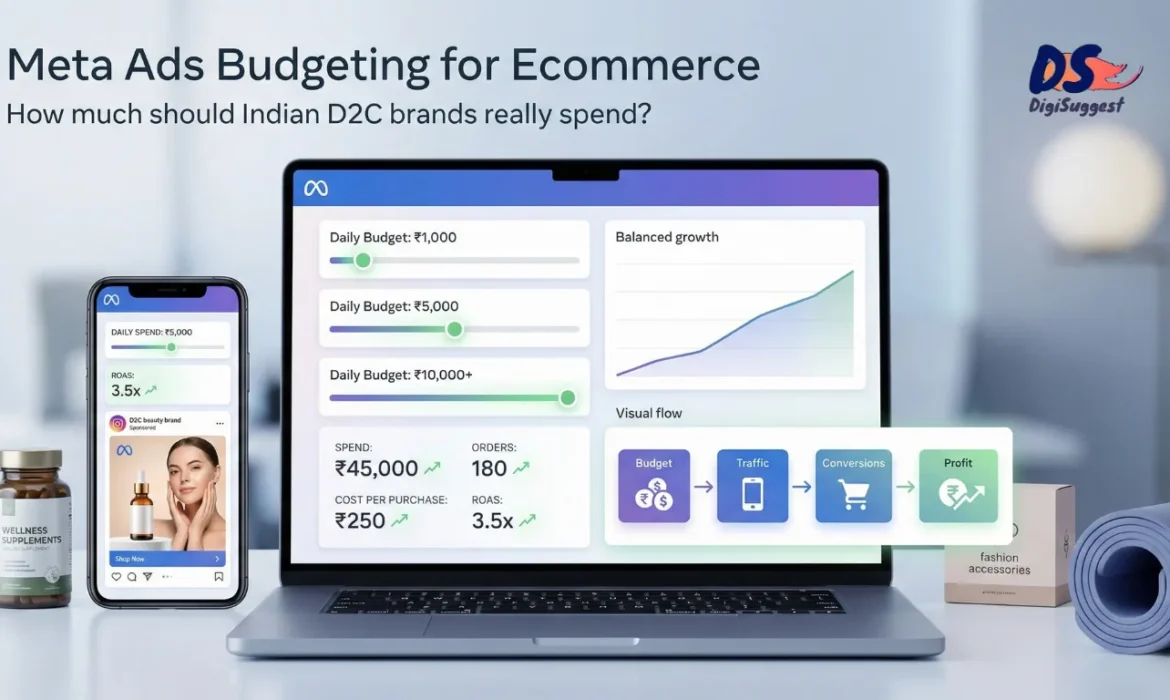
- ₹1,000 – ₹3,000/day
- ₹30,000 – ₹90,000/month
Why This Range Works:
- Enough data for learning
- Allows creative testing
- Doesn’t overexpose brand.
Focus at This Stage:
- Finding winning creatives
- Understanding ICP
- Building retargeting pool.
❌ Don’t expect scale.
❌ Don’t chase ROAS aggressively.
👉 Goal: Clarity, not profit.
Stage 2: Growing Brand (Validation Achieved)
Profile:
- Ads already generating sales
- Some repeat buyers
- Creative patterns emerging
- Clear product-market fit.
Recommended Budget:
- ₹3,000 – ₹10,000/day
- ₹1L – ₹3L/month.
Focus at This Stage:
- Scaling winning creatives
- Funnel optimization
- Retargeting efficiency
- CPA stabilization.
👉 This is where Meta Ads become a growth engine.
Stage 3: Scaling Brand
Profile:
- Consistent ROAS
- Multiple winning creatives
- Strong funnel, Stable supply chain
Recommended Budget:
- ₹10,000 – ₹50,000+/day
- ₹3L – ₹15L+/month)
Focus at This Stage:
- Creative velocity
- Fatigue management
- Incremental scaling
- Profit optimization.
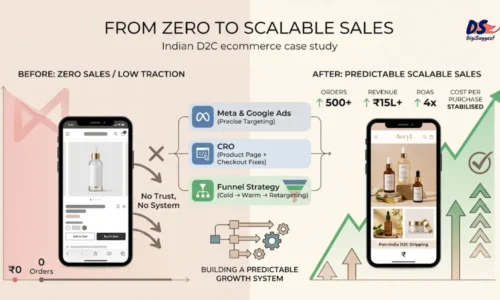
👉 Budget now follows performance. (See our Zero to Scalable Case Study).
Factor 2️⃣ Your Gross Margins (India Reality Check)
Margins decide how much you can spend, not how much you want to spend.
Example:
- If Product price: ₹1,500
- Gross margin: 50% (₹750)
- Your maximum sustainable CPA (roughly): ₹400–₹500 (before overheads)
If your Meta Ads CPA is ₹700–₹800, no budget will save you.
👉 Budget cannot fix poor unit economics.
Stop Wasting Money on Wrong Budgets
Get a Unit Economics Analysis Today.
Factor 3️⃣ Your Funnel Maturity
Two brands with the same budget can get very different results.
Why?
👉 Funnel maturity
Weak Funnel = Low Budget Ceiling
If:
- Cold ads are sales-focused
- Retargeting is missing
- Creatives are generic
- Landing page is weak
Even ₹10L/month will struggle.
Strong Funnel = Higher Budget Efficiency
If:
- Cold ads build interest
- Retargeting closes sales
- Creatives match intent
- Landing pages convert well
Even ₹1L/month can perform well.
👉 Budget works only when the funnel works.
Factor 4️⃣ Creative Volume (Most Ignored Factor)
Meta Ads scaling in 2026 is creative-driven.
Budget Without Creative Volume Is Dangerous
If you spend:
- ₹5,000/day and test
- 1–2 creatives only
Your ads will:
- Fatigue fast
- Become expensive
- Stop scaling
Creative Rule of Thumb (2026)
For every:
- ₹1L/month spend
You need: - 8–12 new creatives/month
More spend = more creative testing.
👉 Creative volume sets your spending ceiling.
Factor 5️⃣ Time Horizon (Short-Term vs Long-Term)
Many founders ask:
“Kitne din mein result aayega?”
Your budget decision changes based on expectations.
Short-Term Expectation (1–2 months)
- Budget should be controlled
- Focus on testing
- Avoid aggressive scaling
Long-Term Expectation (6–12 months)
- Higher budget justified
- Funnel optimization pays off
- Creative systems compound
👉 Meta Ads reward patience + consistency.
Common Budget Mistakes Indian Brands Make
- ❌ Spending Too Little for Too Long: No data, no learning, no results.
- ❌ Increasing Budget to Fix Bad Performance: Budget amplifies problems (Read why ads fail despite high spend).
- ❌ Copying Competitor Budgets: Different margins, different funnels.
- ❌ Ignoring Creative Costs: Ad spend without creative investment fails.
- ❌ Expecting ROAS on Day 1: Meta Ads need time to stabilize.
How to Increase Budget Without Killing Performance
Scaling budgets incorrectly is the fastest way to destroy ROAS.
Safe Scaling Rules:
- Increase budgets by 15–25% at a time
- Scale winning campaigns only
- Don’t touch everything at once
- Monitor frequency & CPA closely
👉 Scaling is gradual, not aggressive.
How to Know If You’re Spending Too Much or Too Little
Signs You’re Spending Too Little:
- Learning phase never ends
- Results fluctuate daily
- No clear winners
- Retargeting pool stays small
Signs You’re Spending Too Much:
- CPA rising continuously
- Creatives fatiguing fast
- Frequency > 3–4
- Diminishing returns (See why ROAS drops)
Budget must sit in the productive middle.
2026 Reality: ROAS Is Not the Only KPI
In 2026, judging Meta Ads only on ROAS is dangerous. You should also track:
- Blended CPA
- Total revenue growth
- Retargeting efficiency
- Brand search lift (often driven by comparing platforms)
- Repeat purchase rate
Sometimes: Slightly lower ROAS = much higher scale & profit.
Scale Your Brand Profitably & Sustainably.
How Digi Suggest Helps Brands Set the Right Meta Ads Budget
At Digi Suggest, we don’t push random budgets. We align budgets with Brand stage, Margins, Funnel maturity, Creative capacity, and Growth goals.
Our Budget-First Approach:
- Unit economics analysis (via our consulting services)
- Funnel readiness audit
- Creative capacity planning
- Safe scaling roadmap
- Continuous optimization
🎯 Our goal is not “more spend”.
🎯 Our goal is profitable, sustainable growth.
🚀 Unsure How Much to Spend on Meta Ads?
If you’re confused about Meta Ads budget, chances are you’re either overspending or underspending.
👉 Struggling with Instagram Ads or Meta Ads? Let Digi Suggest handle it.
👉 Book a free Meta Ads budget & funnel audit and get clarity before wasting money.
Final Thought
Meta Ads don’t fail because budgets are low or high. They fail because:
- Budgets don’t match brand stage
- Funnels aren’t ready
- Creatives aren’t scaled
- Expectations are unrealistic
Spend the right amount, at the right time, for the right reason. That’s how Meta Ads grow ecommerce brands in 2026.
FAQs
In 2026, most ecommerce brands need at least ₹1,000–₹3,000 per day to allow Meta’s algorithm to learn and optimize properly.
No. Very low budgets often fail to generate enough data, leading to unstable results and wrong conclusions.
Margins determine the maximum sustainable CPA. Without healthy margins, increasing Meta Ads budget will not improve profitability.
Budgets should be increased only after stable performance, winning creatives, and a functional funnel are established.
Not always. In 2026, brands should also track blended CPA, revenue growth, retargeting efficiency, and repeat purchase behavior.