Shopping Ads Chalayen Ya Search Ads?
If you’re running Google Ads for ecommerce, you’ve definitely asked this:
- “Shopping ads better hoti hain ya search ads?”
- “Search ads mein CPC zyada lagta hai”
- “Shopping ads mein control kam hota hai”
- “Sirf ek chalani chahiye ya dono?”
And most answers online are vague:
- “Test both.”
- “Depends on industry.”
- “Shopping ads are best for ecommerce.”
None of this helps when:
- Your ad budget is limited
- CPA is rising
- ROAS is unstable
- You need predictable sales
👉 The truth:
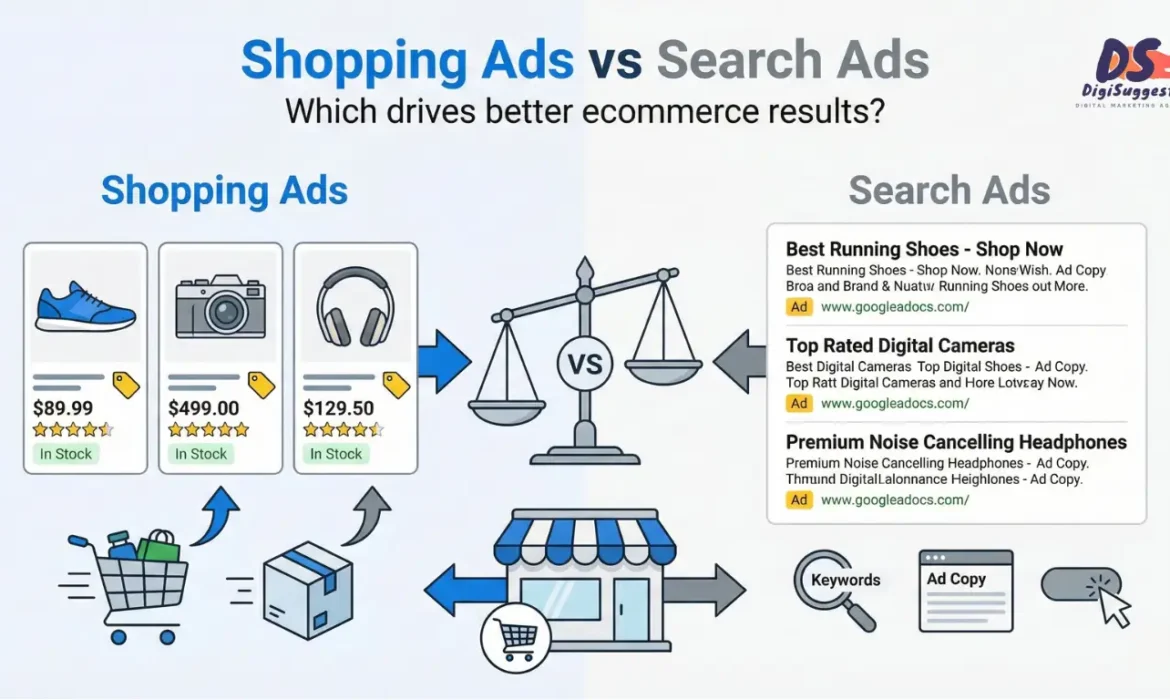
Google Shopping Ads and Google Search Ads are NOT competitors. They serve different roles in the ecommerce buying journey.
This blog will explain clearly and practically what works better, when, and why, specifically for Indian D2C brands.
- First, Understand the Core Difference
- How Indian Ecommerce Buyers Actually Behave
- What Are Google Shopping Ads Best At?
- Where Google Shopping Ads Fail
- What Are Google Search Ads Best At?
- Where Google Search Ads Struggle
- Shopping Ads vs Search Ads: Honest Comparison
- The Biggest Mistake Indian Ecommerce Brands Make
- The Ideal Google Ads Mix for Ecommerce (India)
- How Landing Pages Impact Both Ad Types
- Where Performance Max Fits
- How Digi Suggest Runs Google Ads for Ecommerce
First, Understand the Core Difference (Very Important)
Before comparing performance, you must understand how users interact with these ad types.
Google Search Ads
- Triggered by keywords
- Text-based
- Intent-driven
- User knows what they’re searching for
Example searches:
- “buy whey protein isolate”
- “best face serum for oily skin”
- “running shoes under 5000”
Google Shopping Ads
- Triggered by product feed
- Visual (image, price, brand)
- Discovery + intent
- User is browsing & comparing
Example behavior:
- User searches “protein powder”
- Sees multiple products
- Compares price, brand, reviews
- Clicks the most attractive option
Know how Shopping ads work directly from Google.
👉 Search Ads capture intent.
👉 Shopping Ads shape intent.
Confused about your Ads Strategy?
Get a custom Profit-Focused Plan for your Ecommerce Brand.
How Indian Ecommerce Buyers Actually Behave on Google
Indian ecommerce behavior is unique. Most buyers:
- Don’t always know exact brand names
- Compare prices heavily
- Look for visual validation
- Are cautious (trust, COD, reviews)
This means:
- Shopping Ads work well for discovery
- Search Ads work well for high-intent decisions
Understanding this is the key to profitability.
What Are Google Shopping Ads Best At?
Let’s start with Shopping Ads.
1️⃣ Shopping Ads Capture Non-Brand Demand at Scale
Shopping Ads dominate searches like:
- “protein powder”
- “face serum”
- “office chair”
- “running shoes”
These searches:
- Are high volume
- Are non-brand
- Represent early-to-mid buying intent
Shopping Ads allow your product to
- Appear visually
- Show price upfront
- Compete without brand recall
👉 This is extremely powerful for new & growing Indian D2C brands.
2️⃣ Shopping Ads Drive Higher CTR for Ecommerce
Because Shopping Ads show:
- Product image
- Price
- Brand name
- Reviews (if enabled)
Users click more confidently.
In many Indian accounts:
- Shopping Ads CTR > Search Ads CTR
- Especially for generic product searches
3️⃣ Shopping Ads Scale Faster Than Search Ads
Shopping Ads:
- Don’t depend on keyword expansion
- Automatically match multiple queries
- Scale easily with budget
This makes them ideal for:
- Large catalogs
- Seasonal pushes
- Festival sales
- Inventory clearance
4️⃣ Shopping Ads Work Best When Price Is Competitive
Indian buyers are price-conscious. Shopping Ads show price upfront, which means:
- Competitive pricing = higher clicks
- Overpriced products = low traction
If your pricing is reasonable, Shopping Ads can be very cost-effective. However, a discount-only marketing strategy can hurt your brand long-term.
Where Google Shopping Ads Fail (Reality Check)
Despite the hype, Shopping Ads are NOT perfect.
❌ Low Control Over Search Queries
You cannot:
- Target exact keywords
- Control query intent tightly
- Exclude irrelevant searches easily
Result:
- Some wasted spend
- Traffic that doesn’t convert
- CPA fluctuations
❌ Feed Quality Can Make or Break Performance
Most Indian ecommerce brands:
- Upload feeds and forget them
- Use weak product titles
- Ignore attributes
- Don’t optimize descriptions
Bad feed = bad Shopping Ads.
Shopping Ads success depends heavily on:
- Product titles
- Category mapping
- Images
- Pricing accuracy
❌ Shopping Ads Struggle for High-Intent Brand Searches
For searches like:
- “Minimalist salicylic acid serum”
- “Nike Pegasus 40”
- “Boat headphones price”
Search Ads usually outperform Shopping Ads for these specific queries.
What Are Google Search Ads Best At?
Now let’s talk about PPC Search Ads.
1️⃣ Search Ads Capture Bottom-Funnel Buyers
Search Ads dominate searches like:
- “buy ___ online”
- “___ price in india”
- “___ official website”
These users:
- Know what they want
- Are ready to buy
- Convert at higher rates
👉 Search Ads usually have higher conversion rates than Shopping Ads.
2️⃣ Search Ads Give Maximum Control
With Search Ads, you control:
- Keywords
- Match types
- Ad copy
- Landing pages
This makes Search Ads ideal for:
- Brand terms
- High-intent keywords
- Competitor targeting
- Offer-based campaigns
3️⃣ Search Ads Are Essential for Brand Protection
If you don’t run Search Ads on your brand name:
- Competitors can bid on it
- Marketplaces can hijack traffic
- You lose cheap conversions
This is why you need a strong brand strategy.
Brand Search Ads:
- Have very low CPC
- Very high ROAS
- Very high intent
Every ecommerce brand should run them.
Brand Search Ads: Have very low CPC, Very high ROAS, Very high intent. Every ecommerce brand should run them.
Where Google Search Ads Struggle
❌ Search Ads Are Limited by Keyword Volume
You can only scale as much as:
- Search demand allows
- Keywords exist
Once keywords are exhausted:
- Growth slows
- CPC rises
- Scaling becomes difficult
❌ CPCs Can Get Expensive in India
For competitive niches:
- Fashion & Lifestyle
- Supplements
- Electronics
- Fashion
Search CPCs can rise fast due to:
- Marketplaces
- Aggregators
- Heavy competition
Without optimization, Search Ads can quickly become expensive, leading to common PPC errors that kill ROI.
Don't let high CPCs eat your profit.
We optimize your ad spend for maximum ROI.
Shopping Ads vs Search Ads: Honest Comparison
| Factor | Shopping Ads | Search Ads |
|---|---|---|
| Buyer stage | Discovery + comparison | Decision |
| Visual appeal | High | Low |
| Keyword control | Low | High |
| Scaling ability | High | Medium |
| Conversion rate | Medium | High |
| CPC stability | Medium | Can be high |
| Best for | Generic searches | High-intent searches |
| Feed dependency | Very high | None |
👉 Shopping Ads bring volume.
👉 Search Ads bring quality.
The Biggest Mistake Indian Ecommerce Brands Make
They choose one and ignore the other.
Mistake 1: “Sirf Shopping Ads Chalao”
- Volume comes
- CPA fluctuates
- Control is weak
Mistake 2: “Sirf Search Ads Chalao”
- Good ROAS
- Limited scale
- Growth plateaus
👉 The winning strategy is combination + sequencing.
The Ideal Google Ads Mix for Ecommerce (India)
Stage 1: New / Testing Phase
- 60–70% Shopping Ads
- 30–40% Search Ads (brand + high intent)
Goal: Discover demand, Identify winners, Generate early sales.
Stage 2: Scaling Phase
- 50% Shopping Ads
- 40% Search Ads
- 10% Remarketing Ads
Goal: Stabilize CPA, Increase ROAS, Capture full funnel.
Stage 3: Mature Brand
- Shopping + Search + Performance Max
- Search protects brand & intent
- Shopping drives volume
Goal: Predictable revenue, Lower blended CPA.
How Landing Pages Impact Both Ad Types
Many brands ignore this. Shopping Ads and Search Ads:
- Bring different mindset users
- But land on same pages
If landing pages: Load slow, Lack trust, Don’t match intent. You must focus on checkout page optimization to ensure traffic actually converts.
Both ad types fail if the page fails.
👉 Ads don’t fix bad pages.
👉 Pages fix ads.
Where Performance Max Fits (Quick Note)
Performance Max uses Shopping + Search + Display + YouTube. It can amplify results, but can also burn money.
PMax works best:
- After Shopping & Search are stable
- With strong feed & high-converting creatives
- With clear conversion tracking
You can read more about Performance Max campaigns on Google's official guide.
So… What’s Better for Ecommerce?
Here’s the honest answer:
👉 Shopping Ads are better for scale.
👉 Search Ads are better for efficiency.
The brands that win don’t ask: “Which is better?”
They ask: “How do we use both profitably?”
How Digi Suggest Runs Google Ads for Ecommerce
At Digi Suggest, we don’t push one ad type blindly. We build profit-focused Google Ads systems.
Our Approach:
- Shopping Ads for demand capture
- Search Ads for intent & efficiency
- Feed optimization for performance
- Keyword-level control where needed
- Continuous CPA & ROAS improvement
🎯 Our goal is not clicks.
🎯 Our goal is profitable ecommerce growth.
🚀 Confused Between Shopping Ads & Search Ads?
If your Google Ads spend isn’t translating into consistent profits, you don’t need guesses - you need strategy.
👉 Get profitable Google Ads managed by Digi Suggest.
👉 Book a free Google Ads audit and see what’s actually holding your account back.
Final Thought
Google Shopping Ads and Search Ads are tools. Neither is “better” on its own.
Profit comes from:
- Using the right tool
- At the right time
- For the right intent
- With the right structure
Do that and Google Ads becomes a growth engine, not an expense.
FAQs
In 2026, Google Shopping Ads are better for scale and discovery, while Search Ads perform better for high-intent and brand-driven purchases. Most ecommerce brands need both.
Shopping Ads will remain dominant for ecommerce discovery, but Search Ads will continue to be essential for bottom-funnel and brand protection in 2026.
Yes. Due to increased competition and marketplace bidding, Search Ads CPCs are rising in 2026, making Shopping Ads more important for volume efficiency.
No. Relying only on Shopping Ads reduces control and increases CPA volatility. A balanced Search + Shopping strategy is safer in 2026.
In 2026, profitable ecommerce brands use Shopping Ads for demand capture and Search Ads for intent protection and efficiency.