
Introduction
Marketing budgets are rarely unlimited. A business might be publishing Instagram Reels, running Facebook campaigns, collaborating with influencers, and posting regularly—yet still struggle to turn engagement into qualified enquiries or sales. At the same time, SEO can feel slow: website improvements and new articles may take time to gain visibility in search results.
So, where should a growing business invest first? The answer depends on your audience, sales cycle, budget, and immediate goals. If customers already search online for the products or services you provide, SEO is often a strong long-term starting point. Social media can then support that work by distributing content, encouraging conversations, and keeping your brand visible.
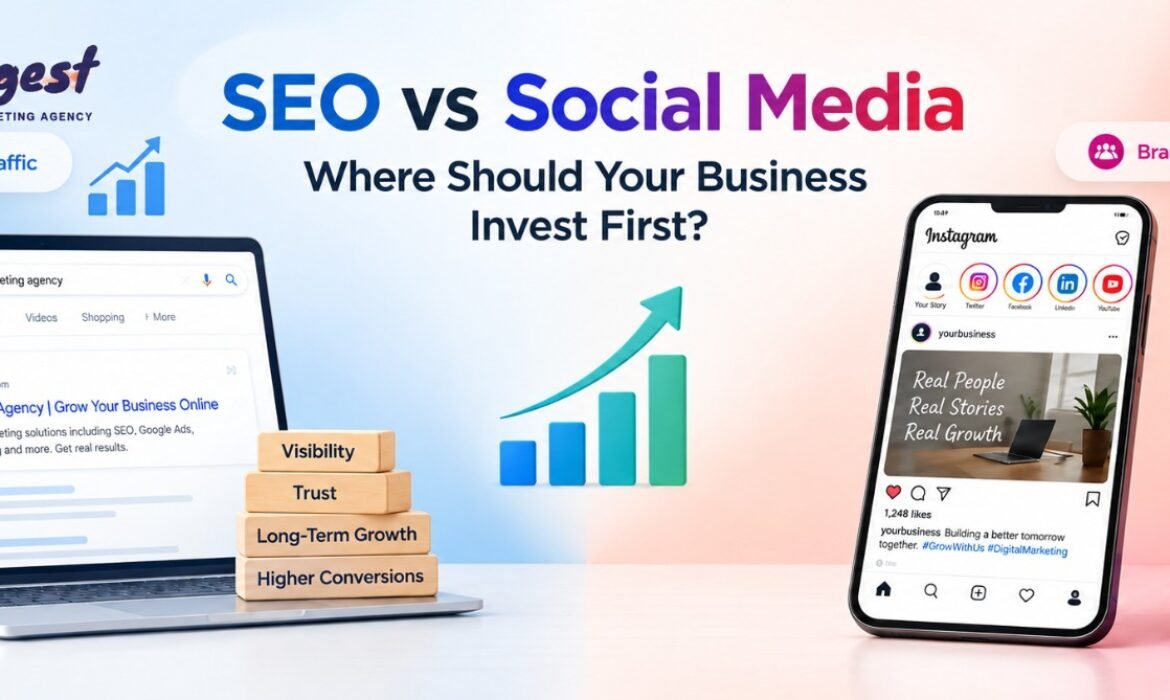
SEO helps people discover your business when they are actively searching. Social media helps you build awareness, trust, and relationships with people who may become customers later.
SEO and Social Media Serve Different Purposes
One common marketing mistake is treating SEO and social media as competing channels. They are better understood as complementary parts of the customer journey.
SEO helps your website appear when people search for a product, service, or answer. For example, a user searching for “digital marketing agency in Delhi,” “SEO company for small business,” or “how to generate leads from Google” is already looking for information or a solution.
Social media reaches people while they browse platforms such as Instagram, Facebook, YouTube, or LinkedIn. They might not be ready to buy, but useful posts, short videos, customer stories, and demonstrations can introduce your brand and build familiarity.
For a broader understanding of how these channels fit into a digital strategy, explore our SEO services and social media marketing.
Why SEO Is Important for Growing Businesses
SEO helps your website become more visible when people search for relevant products, services, and information. A well-optimized service page, useful blog post, or local business listing can continue attracting potential customers after the initial work is complete.
SEO Builds a Long-Term Traffic Asset
A useful article may attract search traffic for months or longer, and a properly optimized service page can keep bringing relevant visitors. Local businesses can also improve discovery by strengthening their local search presence. SEO is not completely free or maintenance-free: it requires quality content, technical improvements, authority building, and performance tracking. However, organic search does not charge you for every click.
SEO performance also depends on the technical health of your site. Slow loading, poor mobile usability, weak internal links, duplicate content, indexing problems, and unclear conversion paths can limit results. Our guides on on-page SEO and off-page SEO explain two important parts of a well-rounded strategy.
Which Is Faster: SEO or Social Media?
If speed is your main priority, social media can often create awareness faster. A new campaign, product announcement, or paid promotion can start reaching people shortly after launch. It can be useful when a business needs immediate exposure or wants to test a message before investing more heavily.
SEO usually takes longer. Search engines need to discover, crawl, interpret, and rank website pages, and the timeline depends on factors such as competition, website authority, content quality, and keyword difficulty. There is no guaranteed ranking timeline.
However, faster does not always mean more sustainable. Paid social traffic generally declines when spending stops, and organic reach can fluctuate as platforms and audience behaviour change. Strong search visibility may continue to bring organic visits over time, although it still requires monitoring and updates.
Challenges of SEO and Social Media
SEO Has Its Own Challenges
SEO is not an instant solution. Publishing a few blogs does not guarantee immediate traffic, particularly in competitive markets. Technical issues, poor keyword targeting, thin content, weak internal linking, and pages that do not convert can all reduce the value of SEO work.
Businesses should focus on search intent and create content that answers real customer questions. For e-commerce brands, this may include improving product pages and category content. Read more about SEO tips for e-commerce websites if online store growth is one of your priorities.
Social Media Requires Consistency
Social media also takes time and effort. Publishing regularly, responding to comments, creating useful content, and maintaining a consistent brand voice require resources. Paid campaigns need budgets and measurement, and high reach does not necessarily mean high-quality leads or sales.
Neither channel should be judged by traffic or engagement alone. Each needs a clear objective and a path from discovery to conversion.
Which Should Your Business Invest in First?
Choose SEO First If:
- Your potential customers actively search for your services or products.
- You want to build long-term organic traffic.
- Your website is an important source of enquiries or sales.
- You need to build authority and trust in search results.
- You want to reduce dependence on paid traffic over time.
- You can invest consistently and allow time for results to develop.
SEO may be a strong priority for local service providers, coaching centres, law firms, SaaS businesses, e-commerce stores, and digital agencies whose customers use search engines to compare options.
Choose Social Media First If:
- Your product is highly visual or discovery-led.
- Your audience is active on Instagram, Facebook, YouTube, or LinkedIn.
- You are launching a new product or offer.
- Your immediate goal is brand awareness or community building.
- Influencer partnerships and social proof matter in your industry.
- You need to test creative ideas and messages quickly.
Fashion, beauty, food, lifestyle, and many direct-to-consumer brands can benefit from social platforms because visuals, demonstrations, creators, and community conversations can influence purchase decisions.
How to Use SEO and Social Media Together
The strongest strategy is often not SEO versus social media. Instead, use SEO as a foundation for discoverability and social media as a channel for distribution and engagement.
Step 1: Build Your Search Foundation
Review your website, service pages, product pages, mobile experience, technical SEO, and internal linking. Make sure visitors can understand your offer and take the next step.
Step 2: Create Content Around Customer Problems
Do not choose topics only because a keyword has search volume. Create useful pages and articles that answer questions your target customers actually ask and guide them towards a relevant solution.
Step 3: Repurpose Content for Social Media
Turn a detailed blog into an Instagram carousel, LinkedIn post, short Reel, YouTube video, Facebook post, or email newsletter. One strong piece of content can serve several channels without requiring you to start from scratch every time.
Step 4: Use Paid Advertising When It Makes Sense
Paid social or search advertising can help with launches, retargeting, lead generation, and scaling campaigns that are already working. Compare the cost and quality of leads rather than focusing only on clicks. You can also review our guide to Google Ads vs. Facebook Ads for e-commerce businesses when evaluating paid channels.
Step 5: Measure the Full Customer Journey
Track how people move from seeing your brand to visiting your website, submitting an enquiry, becoming a qualified lead, and making a purchase. This helps reveal which channels contribute to meaningful business growth.
How to Measure SEO and Social Media Results
Do not evaluate both channels using exactly the same metrics. Their roles differ, so their performance indicators should reflect their goals.
| SEO metrics | Social media metrics |
|---|---|
| Organic traffic | Reach and engagement |
| Keyword rankings and search visibility | Video views and profile visits |
| Organic enquiries and leads | Leads and cost per lead |
| Click-through and conversion rates | Conversion rate and customer acquisition cost |
| Revenue from organic traffic | Revenue and return on ad spend |
A post with 100,000 views is not automatically more valuable than one with 5,000 views. If the smaller post brings qualified prospects who become customers, it may deliver stronger business value. Connect every metric to your actual objectives and review the entire funnel, from impression to revenue.
The Bottom Line
Where should a growing business invest first? If people are already searching for your products or services and you want sustainable visibility, SEO is often the sensible foundation. It helps build discoverability and can continue attracting relevant visitors over time.
That does not mean ignoring social media. Use it to create awareness, share useful content, start conversations, and build relationships with potential customers. Add paid advertising when you have a clear goal, a relevant audience, and a way to measure outcomes.
Think of SEO as your digital real estate: it helps customers find you. Think of social media as the conversation around your brand: it gives people reasons to remember and engage with you. The right mix is the one that helps your business turn awareness into qualified leads, customers, and lasting value.
Ready to build a stronger digital marketing strategy?
Explore practical ways to improve your search visibility and connect with the right audience online.


The Advantages of Social Media
Social media offers a different advantage: it helps a business show its personality, interact with its audience, and distribute content quickly. Brands can share behind-the-scenes moments, customer stories, educational videos, product demonstrations, founder stories, testimonials, offers, and user-generated content.
This content makes a business feel more human. People want to understand not only what you sell, but also who you are and whether they can trust you. Social media is especially useful for visual products, product launches, community building, and campaigns where awareness is the immediate priority.
Organic social media and paid social advertising are different. Organic content builds familiarity over time, while paid campaigns can reach selected audiences more quickly. Businesses can use Meta Ads to promote offers, generate leads, retarget website visitors, and test campaigns. Paid activity should be tracked carefully so that clicks and engagement are connected to business results.