
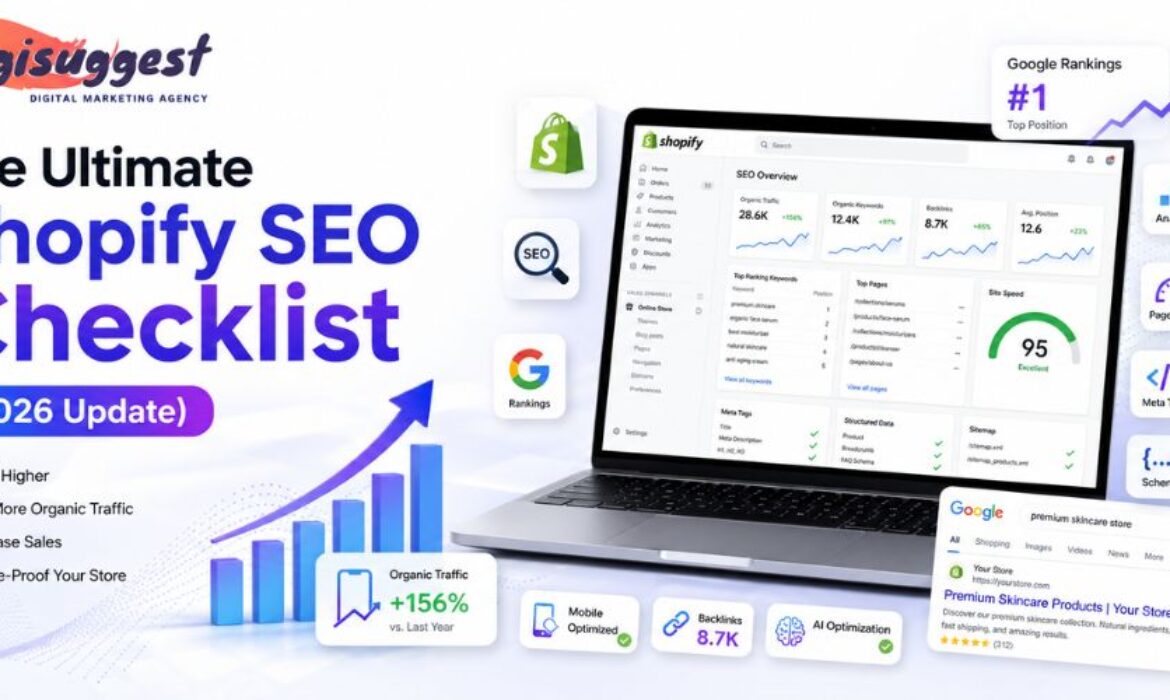
In 2026, the rules of eCommerce visibility have fundamentally changed. SEO is no longer just about ranking on Google's traditional blue links. Today, your Shopify store must also be optimized for AI-powered search experiences where customers ask questions and receive recommendations from platforms like Google Gemini, ChatGPT, and Perplexity.
While Shopify handles many technical SEO basics out of the box, that alone is no longer enough to outperform competitors in an increasingly competitive online marketplace. Modern Shopify SEO requires a strategy that combines technical excellence, exceptional user experience, structured data, and AI-friendly content.
Whether you are a fast-growing D2C brand or an established online retailer, this comprehensive checklist will help you identify technical issues, optimize your store architecture, improve product visibility, and build long-term organic growth.
As a leading Shopify Website Development Agency in Delhi India, Digi Suggest has created this updated Shopify SEO Checklist for 2026 to help businesses dominate both traditional search engines and AI-powered search platforms.
Phase 1: Technical SEO (The Foundation)
Before publishing blogs, writing product descriptions, or building backlinks, your Shopify store must have a strong technical foundation. If search engine bots or AI crawlers cannot efficiently access and understand your website, your chances of ranking become extremely limited.
Think of Technical SEO as the engine of your Shopify store. Everything else depends on how efficiently this engine performs.
1. Optimize Core Web Vitals & INP
Google now measures Interaction to Next Paint (INP) instead of First Input Delay (FID). INP evaluates how quickly your website responds after a visitor interacts with a page, making it one of the most important ranking factors for Shopify stores in 2026.
- Target LCP: Keep Largest Contentful Paint below 2.5 seconds.
- Improve INP: Remove unnecessary Shopify apps that slow down user interaction.
- Reduce CLS: Prevent layout shifts by assigning proper image dimensions and avoiding late-loading elements.
- Compress Images: Use WebP or AVIF formats instead of heavy JPEG or PNG files.
- Minify Assets: Reduce unnecessary CSS and JavaScript wherever possible.
For advanced optimization techniques, read our complete guide on Shopify Store Speed Optimization Guide 2026.
Want a Faster Shopify Store?
Improve Core Web Vitals, boost search rankings and deliver a lightning-fast shopping experience for every customer.
2. Allow AI Crawlers to Access Your Store
SEO is no longer limited to Google Search. AI-powered platforms now crawl websites to generate shopping recommendations and answer customer queries.
Many Shopify merchants unknowingly block AI crawlers through incorrect robots.txt configurations, causing their products to disappear from AI-generated search results.
- Review robots.txt.liquid before making custom edits.
- Allow Google-Extended so Google's AI systems can understand your content.
- Do not block OAI-SearchBot if you want visibility across AI-powered search experiences.
- Regularly audit crawl directives after theme or app updates.
3. Build a Logical Shopify Site Architecture
A well-organized website helps both visitors and search engines navigate your store more efficiently. Google prefers websites with a clear hierarchy and strong internal linking.
Follow the Three-Click Rule whenever possible. Users should be able to reach any important product within three clicks from the homepage.
- Homepage
- Collection Page
- Sub Collection (if applicable)
- Product Page
A clean architecture also improves crawl efficiency, distributes authority across important pages, and creates a better shopping experience for users.
If you're planning a new Shopify store, our complete Shopify Store Setup Guide for India explains the ideal store structure from day one.
You can also explore our Shopify SEO Services to build an SEO-friendly Shopify store designed for long-term organic growth.
Phase 2: On-Page SEO & GEO Optimization
Once your technical foundation is strong, the next step is optimizing every page so both search engines and AI models clearly understand what you offer. In 2026, stuffing keywords into product descriptions no longer works. Instead, Google rewards websites that provide factual, structured, and genuinely helpful information.
Generative Engine Optimization (GEO) focuses on creating content that AI search engines can easily interpret, summarize, and recommend to users. Every product page, collection page, and blog should answer customer questions before they even ask them.
4. Create Generative-Ready Product Descriptions
Modern AI search engines don't simply scan keywords—they understand context. Your product descriptions should clearly explain features, specifications, benefits, target audience, and real-world use cases.
- Write factual descriptions instead of promotional copy.
- Include ingredients, materials, specifications or technical details wherever applicable.
- Mention ideal customer types and use cases naturally.
- Break important information into bullet points for easier scanning.
- Answer common buying questions within the description.
Instead of writing:
"Best skincare product for glowing skin."
Write:
"Formulated with 5% Niacinamide and Hyaluronic Acid, this lightweight moisturizer delivers up to 24 hours of hydration and is suitable for oily and combination skin types living in humid climates."
Google, Gemini and ChatGPT prefer structured factual information because it increases confidence when generating AI-powered recommendations.
Need SEO-Optimized Shopify Content?
We create AI-friendly product pages and content that improve rankings, increase visibility, and drive more qualified traffic.
5. Implement Complete Schema Markup (JSON-LD)
Schema Markup acts as the language search engines use to understand your website. Without structured data, Google has to guess what your content represents. With proper schema implementation, your products become eligible for rich results, AI summaries, and enhanced search visibility.
- Product Schema for pricing, availability and product details.
- Review Schema for ratings and customer feedback.
- FAQ Schema for frequently asked questions.
- Organization Schema for business information.
- Breadcrumb Schema for improved navigation.
Proper Schema implementation increases your chances of appearing in Google Rich Results, AI Overviews, and "People Also Ask" sections.
6. Optimize Images for Search & AI Discovery
Images contribute significantly to Shopify SEO, yet many merchants upload files named "IMG1234.jpg" without any optimization.
- Rename image files before uploading.
- Use descriptive ALT text.
- Upload WebP or AVIF formats wherever possible.
- Compress images without sacrificing quality.
- Use product-specific keywords naturally.
Instead of:
IMG_2048.jpg
Use:
blue-silk-saree-gold-border.webp
Instead of ALT text:
Blue Saree
Use:
Handwoven blue silk saree with gold zari border for traditional wedding wear.
Optimized images improve accessibility, image search rankings, and AI-generated product recommendations.
For a complete optimization strategy, also read our guide on How to Rank Your Shopify Store on Google and explore our Shopify SEO Services to improve long-term organic visibility.
Phase 3: Content & Authority (The EEAT Factor)
Google continues to prioritize websites that demonstrate Experience, Expertise, Authoritativeness, and Trustworthiness (EEAT). Publishing random blog articles is no longer enough. Every piece of content should strengthen your authority within your niche and answer real customer questions.
7. Build Topical Authority Through Content Clusters
Instead of publishing unrelated blogs, organize your content into topic clusters. Multiple articles covering different aspects of the same subject help search engines recognize your expertise.
For example, if your business offers Shopify development services, your content cluster can include:
- Shopify Pricing Guide
- Shopify SEO Checklist
- Best Shopify Apps
- Store Speed Optimization
- Custom Shopify Development
- Shopify Conversion Optimization
Each article should internally link to related resources and your primary Shopify service pages.
We recommend reading these related guides:
- Shopify Pricing Plans India 2026
- Custom vs Theme-Based Shopify Development
- Cost of Shopify Website Development in India
- What is Shopify & How It Works in India
8. Create an llms.txt File
One of the newest developments in 2026 is the adoption of llms.txt. This lightweight text file helps AI systems quickly understand your business, products, services, and website structure.
Think of it as a simplified introduction to your brand that AI assistants can reference while generating recommendations.
- Summarize your business clearly.
- List important service pages.
- Include your primary expertise.
- Update the file whenever your business changes.
9. Strengthen Internal Linking
Internal linking remains one of the simplest yet most powerful SEO strategies. Instead of using generic anchor text like "Click Here," use descriptive anchor text that clearly explains the destination page.
- Link related blogs together.
- Connect blogs with collection and service pages.
- Use keyword-rich anchor text naturally.
- Avoid orphan pages.
Strong internal linking improves crawlability, distributes page authority, and helps visitors discover more relevant content throughout your Shopify website.
Want Better Shopify Rankings?
Our Shopify SEO specialists build complete technical, on-page, and content strategies that help stores rank higher on Google and AI-powered search engines.
Phase 4: Off-Page & Local SEO
Even the best-optimized Shopify store needs authority beyond its own website. Google continues to use backlinks, brand mentions, customer reviews, and local trust signals to determine which businesses deserve top rankings. In 2026, quality matters far more than quantity.
10. Strengthen Local SEO for Delhi-NCR
If your Shopify business serves customers in Delhi or anywhere across NCR, Local SEO should be a major part of your strategy. Appearing in Google's Local Pack can drive highly qualified traffic with strong purchase intent.
- Claim and optimize your Google Business Profile.
- Ensure your Name, Address and Phone Number (NAP) remain consistent across every platform.
- Add high-quality business images regularly.
- Publish Google Business updates every month.
- Reply to every customer review to build trust and engagement.
Businesses with an active Google Business Profile generally achieve higher local visibility while improving customer confidence before they even visit the website.
11. Earn High-Quality Backlinks
Backlinks remain one of Google's strongest ranking signals. However, thousands of low-quality directory links cannot compete with a few mentions from trusted industry publications.
- Focus on Digital PR campaigns.
- Publish original research and case studies.
- Contribute guest articles to authoritative websites.
- Earn mentions from reputable business publications.
- Avoid buying spammy backlinks.
One quality backlink from an established technology publication or eCommerce website often provides more SEO value than hundreds of low-quality links.
For long-term authority building, combine technical SEO with content marketing and Digital PR initiatives that naturally attract citations from trusted sources.
The 2026 Shopify SEO Checklist Summary
| Task | Priority | Recommended Tool |
|---|---|---|
| Improve Core Web Vitals & INP | Critical | Google PageSpeed Insights |
| Implement JSON-LD Schema | High | Schema.org Validator |
| Optimize Product Content | High | Human Editor + AI Review |
| Backlink Audit | Medium | Ahrefs / SEMrush |
| Google Business Profile Optimization | High | Google Business Profile |
| Internal Linking Audit | High | Screaming Frog SEO Spider |
Why Choose Digi Suggest?
Shopify SEO in 2026 requires much more than publishing blogs and adding keywords. Success depends on combining technical optimization, AI-ready content, structured data, user experience, and long-term authority building.
At Digi Suggest, we provide complete Shopify SEO solutions that focus on sustainable organic growth rather than short-term ranking tricks.
Our Shopify SEO services include:
- Complete Technical SEO Audit
- Core Web Vitals & Speed Optimization
- Shopify Store Architecture Planning
- AI-Ready Content & GEO Optimization
- Schema Markup Implementation
- Collection & Product Page SEO
- Blog Strategy & Topic Clusters
- Internal Linking Optimization
- Digital PR & Authority Building
- Monthly SEO Reporting & Continuous Improvements
Related Shopify Blogs
- Shopify Store Speed Optimization Guide 2026
- How to Rank Your Shopify Store on Google
- Custom vs Theme-Based Shopify Development in India
- Shopify Pricing Plans India 2026
- Cost of Shopify Website Development in India
- Shopify Store Setup Guide for India
- Is Shopify Good for Small Businesses?
- What is Shopify & How It Works in India?
- Why Mobile-First Design is Crucial for Indian Businesses
- eCommerce Conversion Rate Optimization Guide
Conclusion: SEO is a Marathon, Not a Sprint
Shopify SEO in 2026 is no longer about simply ranking higher on Google. It's about becoming the most trustworthy, relevant, and authoritative answer across both traditional search engines and AI-powered search experiences.
Every optimization—from Core Web Vitals and structured data to content quality and Digital PR—contributes to building long-term organic visibility. Businesses that consistently improve user experience while publishing factual, helpful content will continue to outperform competitors.
If you're serious about increasing organic traffic, improving search visibility, and growing sales without depending entirely on paid advertising, investing in a comprehensive Shopify SEO strategy is one of the smartest long-term decisions you can make.
Need a professional Shopify SEO audit? Our experts at Digi Suggest can identify technical issues, optimize your store for AI search, and build a scalable SEO strategy that delivers sustainable growth.
Coming Up Next: Shopify for Fashion Brands: How to Build a Digital Runway.
FAQs
While technical fixes (like speed) show results in weeks, content-based SEO usually takes 3 to 6 months to mature. However, with “GEO” (AI search), if your content is high-quality, you can start appearing in AI Overviews much faster.
Bilkul nahi! This is a myth from 2015. Today, Shopify is one of the most SEO-friendly platforms in the world. It handles Sitemaps, SSL, and basic Schema automatically. Any “limitations” can be easily fixed with custom Liquid code by an agency like Digi Suggest.
Generative Engine Optimization (GEO) is the practice of optimizing for AI search (like ChatGPT). Since more users are asking AI for product recommendations, you need to ensure your brand is cited as a source in their answers.
You can optimize product and collection pages, but a blog is your “SEO Powerhouse.” It allows you to target “Educational Keywords” (e.g., “How to style a Blue Saree”) which brings in customers who are not yet ready to buy but are researching.
We recommend Avada SEO or Plug in SEO. However, remember that an app is just a tool. The real “Magic” comes from your strategy, keyword research, and high-quality content.


