“Pehle Sale Aa Rahi Thi… Ab Achaanak Sab Down Hai”
If you’re running Google Ads for ecommerce, this situation will feel painfully familiar:
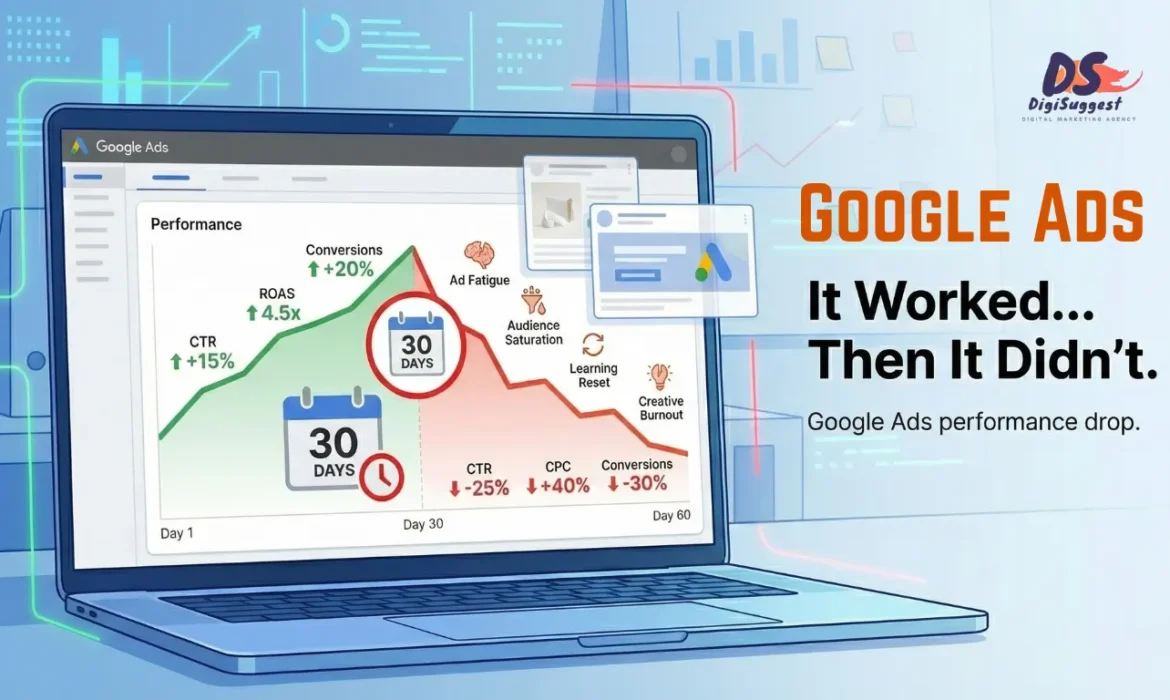
First 2–4 weeks:
- ✅ Orders coming
- ✅ ROAS looks healthy
- ✅ Team feels confident
After 30–45 days:
- ❌ CPA shoots up
- ❌ ROAS crashes
- ❌ Same budget, fewer orders
- ❌ Ads feel “dead”
Most founders react by saying:
“Google Ads kaam nahi karti.”
“Market hi kharab ho gaya.”
“Algorithm change ho gaya.”
Here’s the truth:
👉 Your ads didn’t die.
Your system stopped supporting them.
Google Ads performance doesn’t collapse randomly. It collapses due to predictable, fixable reasons, especially in Indian ecommerce.
Let’s break down why Google Ads work initially and then fail, and exactly how to prevent or recover performance.
Ads stopped performing after the first month?
- Introduction
- First, Understand Why Ads Perform Well Initially
- Reason 1️⃣ Learning Phase Ends & Reality Begins
- Reason 2️⃣ Creative & Feed Fatigue
- Reason 3️⃣ Over-Reliance on Broad Traffic
- Reason 4️⃣ Budget or Bid Shock
- Reason 5️⃣ Shopping Feed Not Optimized
- Reason 6️⃣ Search Terms Pollution
- Reason 7️⃣ Performance Max Used Too Early
- Reason 8️⃣ Conversion Tracking Decay
- Reason 9️⃣ Landing Pages Stop Converting
- Reason 🔟 No Stabilization Strategy
- How to Stop Google Ads From “Dying”
- What a Healthy Google Ads Account Looks Like
- How Digi Suggest Recovers & Stabilizes Google Ads
First, Understand Why Ads Perform Well Initially
This part is important.
When you launch new Google Ads campaigns, Google gives you a temporary performance boost.
Why This Happens
- Fresh creatives & feeds
- Unsaturated audiences
- Broad learning signals
- Exploration phase advantage
Google is trying to:
- Understand your account
- Test different queries
- Find potential converters
This phase feels great but it’s not sustainable by default.
👉 Early performance is testing success, not scaling success.
Reason 1️⃣ Learning Phase Ends & Reality Begins
In the first few weeks:
- Google explores broadly
- Shows ads to many segments
- Tries different placements
After ~30 days:
- Google starts optimizing strictly
- Bad data hurts harder
- Structural weaknesses surface
What Goes Wrong
If your account has:
- Weak conversion tracking
- Poor keyword hygiene
- Low-quality traffic
Google “learns” the wrong patterns.
Result:
- CPA increases
- Traffic quality drops
- Performance collapses
👉 Bad learning = bad long-term performance.
Reason 2️⃣ Creative & Feed Fatigue (Most Common Cause)
Indian ecommerce brands rarely refresh:
- Shopping feeds
- Ad creatives
- Images
- Headlines
What Happens
- Same product images
- Same titles
- Same offers
Users see the same ads repeatedly.
Signals Google reads:
- CTR drops
- Engagement declines
- Relevance score weakens
Google responds by:
- Increasing CPC
- Reducing impressions
- Lowering priority
👉 Ads don’t die. Creatives get ignored.
Reason 3️⃣ Over-Reliance on Broad Traffic
Many accounts start with:
- Broad keywords
- Generic Shopping queries
- Wide Performance Max coverage
Initially:
- Volume is high
- Some conversions happen
Over time:
- Low-intent users dominate
- CPC rises
- Conversion rate drops
Why This Happens in India
- High comparison behavior
- Price-sensitive clicks
- Marketplace-driven searches
If you don’t tighten targeting:
👉 CPA explodes.
Is your CPA exploding while sales drop?
Reason 4️⃣ Budget or Bid Shock
A very common founder move:
“Ads chal rahi hain, budget double kar dete hain.”
What Google Hates
- Sudden budget jumps
- Aggressive bid changes
- Target CPA set too low
This:
- Resets learning
- Forces Google to re-test
- Pushes ads into unstable traffic
Result:
- 30 days good
- Next 30 days chaos
👉 Scaling without stability kills performance.
Reason 5️⃣ Shopping Feed Not Optimized After Launch
Most Indian ecommerce brands:
- Upload feed
- Start Shopping Ads
- Never touch feed again
Problem
Google Shopping is feed-driven, not keyword-driven.
If:
- Titles are generic
- Categories are wrong
- Images are weak
- Pricing changes aren’t reflected
Google loses confidence in your products.
👉 Shopping Ads quietly stop prioritizing you.
Reason 6️⃣ Search Terms Pollution
This is silent but deadly.
Many brands don’t:
- Check search term reports
- Add negative keywords
- Control match types
Over time:
- Ads trigger for irrelevant queries
- Clicks increase
- Conversions don’t
Example:
Selling premium shoes
Ad triggers for “cheap shoes under 500”
Early phase hides this.
Later phase exposes it.
👉 Wasted clicks slowly poison performance.
Reason 7️⃣ Performance Max Used Too Early (Or Blindly)
Performance Max is powerful but dangerous if misused.
Common Indian mistakes:
- Launch PMax without stable Search/Shopping
- No asset optimization
- No feed segmentation
- No conversion clarity
Initially:
- PMax finds easy conversions
Later:
- Expands aggressively
- Burns budget
- Steals brand traffic
- Kills ROAS
👉 PMax amplifies problems faster than it fixes them.
Reason 8️⃣ Conversion Tracking Decay
Over time:
- Website changes
- Checkout updates
- Apps are added
- Pages slow down
But tracking is never re-checked.
Result:
- Missed conversions
- Double counting
- Delayed signals
Google starts optimizing on bad data.
👉 When tracking breaks, performance follows.
Reason 9️⃣ Landing Pages Stop Converting at Scale
Early traffic:
- Smaller volume
- More intent-heavy
Later traffic:
- Broader
- More skeptical
- More price-conscious
If landing pages:
- Load slow on mobile
- Lack trust signals
- Don’t match intent
Conversion rate drops as traffic scales.
👉 Ads bring traffic. Pages convert traffic.
Reason 🔟 No Stabilization Strategy (Only Launch & Scale)
Most accounts have:
- Launch plan
- Scaling plan
But no stabilization plan.
Stabilization means:
- Refreshing creatives
- Cleaning queries
- Adjusting bids gradually
- Protecting ROAS
Without this, performance always collapses after early success.
How to Stop Google Ads From “Dying”
Here’s what actually works.
1️⃣ Control the Learning Phase
- Don’t rush smart bidding
- Keep data clean
- Start structured, not broad
2️⃣ Refresh Creatives & Feeds Regularly
- New images every 2–4 weeks
- Title & feed optimization monthly
- Seasonal angle updates
3️⃣ Tighten Traffic Over Time
- Add negatives weekly
- Shift from broad → phrase/exact
- Separate high-intent campaigns
4️⃣ Scale Slowly & Intentionally
- Increase budgets 15–25%
- Duplicate winners
- Avoid bid shocks
5️⃣ Use Performance Max Strategically
- Only after stable Search & Shopping
- Control assets
- Monitor brand cannibalization
6️⃣ Monitor Delivered ROAS (India-Specific)
- Factor COD & RTO
- Optimize for quality orders
- Exclude bad pincodes
What a Healthy Google Ads Account Looks Like After 90 Days
- Stable CPA
- Predictable daily spend
- Clear campaign roles
- Regular optimizations
- No sudden crashes
Ads don’t “die” here.
They mature.
How Digi Suggest Recovers & Stabilizes Google Ads
At Digi Suggest, we specialize in Google Ads recovery & stabilization for ecommerce brands.
What We Fix:
- Learning phase damage
- Feed & creative fatigue
- Search term pollution
- Bad PMax usage
- Tracking issues
- CPA & ROAS instability
🎯 We don’t chase short spikes.
🎯 We build stable, scalable Google Ads systems.
Recover Your Google Ads Performance
Google Ads Worked… Then Crashed? Book a free audit.
Final Thought
Google Ads don’t suddenly stop working.
They stop working when:
- Structure isn’t maintained
- Data gets messy
- Scaling is rushed
- Optimization is ignored
Fix the system and performance returns.
FAQs
In 2026, early performance often comes from Google’s learning phase. Ads fail later due to fatigue, bad data, poor structure, or aggressive scaling.
Yes. With higher ad frequency and automation, creative and feed fatigue is one of the biggest reasons Google Ads stop working in 2026.
Automation improves performance only when supported by clean structure, data, and creatives. Blind automation causes volatility in 2026.
Most ecommerce brands should refresh creatives, feeds, and search terms every 30–45 days in 2026 to maintain stability.
Yes. By fixing structure, refreshing feeds, cleaning keywords, and stabilizing budgets, ecommerce Google Ads can be recovered even in 2026.