Client: Omission Collection
Industry: D2C Fashion & Apparel
Business Model: Direct-to-Consumer (Ecommerce)
Primary Market: India
Omission Collection is a modern D2C fashion brand catering to style-conscious Indian consumers. The brand had strong visual appeal, good product quality, and an active Instagram presence.
However, despite consistent effort, online sales were not scaling predictably.
Struggling to Scale Your D2C Fashion Brand?
- The Situation Before Digi Suggest
- The Core Problem (What Most Fashion Brands Miss)
- Why Their Earlier Strategy Was Not Sustainable
- Digi Suggest’s Core Insight
- Step 1: Demand & Search Opportunity Audit
- Step 2: SEO Foundation for Fashion Ecommerce
- Step 3: Paid Ads Repositioned (Not Replaced)
- Step 4: Funnel Alignment Between SEO & Ads
- Step 5: CRO & Conversion Support
- Results: Stable & Scalable Growth
- Key Takeaways for D2C Fashion Brands
- Final Thought
The Situation Before Digi Suggest
When Omission Collection approached us, the brand was already doing many things “right” on the surface:
- Regular Instagram posting
- Influencer collaborations
- Active Meta Ads campaigns
- Decent website traffic
Yet, growth felt stuck.
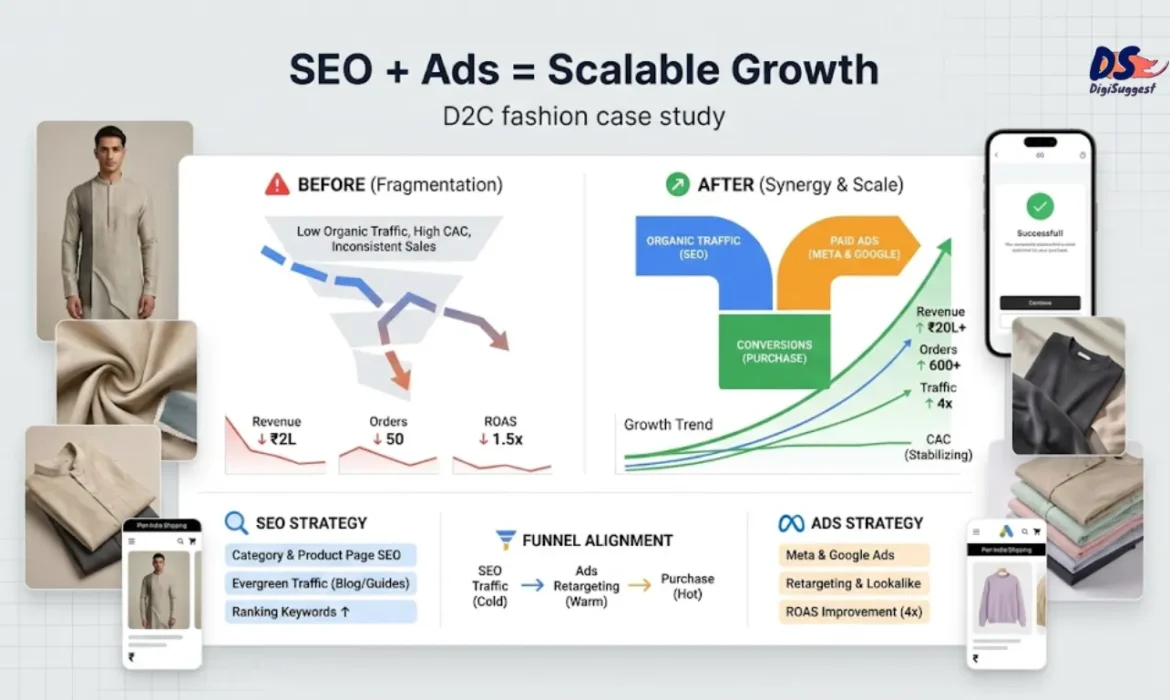
Core Challenges
- Heavy dependence on Instagram & Meta Ads
- Sales fluctuated month to month
- Rising cost per purchase
- No meaningful organic traffic
- No long-term traffic asset
In short: Sales existed, but stability and scalability did not.
The Core Problem (What Most Fashion Brands Miss)
Most D2C fashion brands believe: “Fashion sells on Instagram - SEO is not important.”
That assumption is costly.
Our audit revealed that:
- All growth depended on paid traffic
- Users had no organic discovery path
- Search demand existed, but the brand wasn’t capturing it
- Ads were doing both awareness and conversion work
👉 Paid ads were being forced to do everything.
This is why CPA kept increasing.
Why Their Earlier Strategy Was Not Sustainable
Before working with us, the brand relied on:
- Instagram creatives
- Influencer traffic
- Conversion-focused ads
This failed to scale because:
- Cold traffic was expensive
- There was no organic trust layer
- Users often researched but didn’t find the brand on Google
- Ads had to repeatedly introduce the brand from scratch
👉 Without SEO, every sale was rented - not owned.
Digi Suggest’s Core Insight
At Digi Suggest, we strongly believe:
SEO avoids dependency.
Ads create velocity.
Together, they create scale.
So, instead of choosing between SEO or ads, we built a hybrid growth system.
Step 1: Demand & Search Opportunity Audit
We started by identifying:
- How people search for fashion products
- Category-level search intent
- Non-brand vs brand keywords
- Comparison & style-based queries
Key Insight
Users were:
- Searching for outfit types
- Comparing styles
- Looking for alternatives
- Researching before buying
But Omission Collection was:
- Invisible in search results
- Dependent only on social discovery
This was a massive missed opportunity.
Step 2: SEO Foundation for Fashion Ecommerce
We built an SEO strategy focused on purchase intent, not vanity traffic.
What We Did
Category & Collection Page SEO
- Optimized category pages for style-based searches
- Improved on-page structure and internal linking
- Clear descriptions matching buyer intent
Product Page SEO
- Search-friendly titles & descriptions
- Structured content for discovery
- Better indexation & crawlability
Content That Supports Conversion
- Fashion-focused informational content
- Styling & category education
- Internal links to product collections
👉 SEO was designed to support sales, not just traffic.
Step 3: Paid Ads Repositioned (Not Replaced)
Once SEO foundation was laid, we restructured ads.
Meta Ads Changes
- Reduced pressure on cold ads
- Focused Meta Ads on discovery + retargeting
- Used creatives aligned with search intent
Google Ads Changes
- Focused on high-intent search terms
- Protected brand searches
- Avoided overlapping with organic rankings
👉 Ads now worked with SEO, not against it.
Step 4: Funnel Alignment Between SEO & Ads
A key reason this strategy worked was message alignment.
- SEO users landed on informative, trust-building pages
- Ads users landed on conversion-ready pages
- Retargeting worked across both channels
This created:
- Better user experience
- Higher trust
- Lower resistance to purchase
Step 5: CRO & Conversion Support
To support both SEO and Ads traffic, we made light but impactful CRO improvements:
- Clear value proposition on key pages
- Strong social proof placement
- Mobile-first usability improvements
- Clear delivery & return messaging
👉 SEO traffic converted better.
👉 Ads traffic converted cheaper.
Build a Sustainable Growth System for Your Brand.
Results: Stable & Scalable Growth
Within a few months of implementing this hybrid strategy, Omission Collection saw:
📈 Key Outcomes
- Significant increase in organic traffic
- Reduced dependency on Meta Ads alone
- More consistent month-on-month sales
- Improved ROAS across paid campaigns
- Better predictability in revenue planning
Most importantly: 👉 Growth became less volatile and more controllable.
Why This Strategy Worked for a Fashion Brand
This approach succeeded because:
- SEO captured existing demand
- Ads created new demand
- Trust was built through search visibility
- Paid ads didn’t carry the full burden
- Funnel was aligned across channels
Fashion ecommerce doesn’t fail because SEO doesn’t work. It fails when SEO is ignored.
Key Takeaways for D2C Fashion Brands
If you run a fashion ecommerce brand, learn this:
1️⃣ Instagram Alone Is Not a Growth Strategy - It’s a channel, not a foundation.
2️⃣ SEO Builds Trust Before Purchase - Users trust brands they can find on Google.
3️⃣ Ads Scale Faster When SEO Exists - Lower CPA, better ROAS, stronger retargeting.
4️⃣ Long-Term Brands Own Traffic - Short-term brands rent it.
Who This Case Study Is For
This strategy is ideal for D2C fashion brands that:
- Depend heavily on Meta Ads
- See rising CPAs
- Want predictable growth
- Are building a long-term brand
If that’s you then this model is proven.
How Digi Suggest Helps D2C Brands Scale Sustainably
At Digi Suggest, we don’t push one channel. We build:
- SEO foundations
- Performance ad systems
- Funnel alignment
- CRO-backed growth
This case study shows how balanced growth beats aggressive tactics.
🚀 Struggling With Unstable Ecommerce Sales?
Want SEO + Ads Working Together? Get a free growth audit.
Final Thought
D2C fashion growth doesn’t come from choosing SEO or Ads.
It comes from connecting them intelligently.
This case study proves one thing clearly:
When SEO builds trust and Ads create momentum, ecommerce growth becomes sustainable.
FAQs
Yes. Fashion brands benefit from SEO by capturing high-intent searches, comparison traffic, and category-level demand that ads alone cannot sustain.
Instagram creates demand, but SEO captures existing demand. Relying only on ads makes growth expensive and unstable long-term.
Initial SEO improvements can show impact in 3–6 months, while long-term compounding benefits grow over time.
Yes. SEO improves brand trust and awareness, which often leads to lower CPAs and better ROAS for paid ads.
Yes, but execution differs. New brands need stronger trust-building and controlled ad spend alongside SEO foundations.